Searching Case Laws & Precedent on Legal Query.....!
Analysing the retrieved Case Laws
Scanned Judgements…!



Searching Case Laws & Precedent on Legal Query.....!
Analysing the retrieved Case Laws
Scanned Judgements…!
Procedure for Filing Complaint under the Child Labour Prohibition and Regulation Act (CLPRA) - The Act emphasizes the importance of accurate age determination, stating that a child is defined as a person under 14 years (Section 2(ii)). Complaints can be lodged with police or relevant authorities, and age verification is crucial, often requiring medical or documentary evidence since oral evidence is insufficient (Sources: 2024 0 Supreme(Telangana) 1035). The complaint process involves registering FIRs, conducting investigations, and proceeding with legal action if prima facie evidence exists. The process must adhere to procedural safeguards to protect the child's rights and ensure proper investigation ["2024 0 Supreme(Telangana) 1035"].
Procedure under the POCSO Act - The Protection of Children from Sexual Offences (POCSO) Act provides a child-friendly and specialized procedure for reporting, investigating, and trial of offences against children. Complaints can be filed directly with the court or police, and the Act mandates specific procedures such as recording statements through special procedures (Section 19, 21, 33). It also prescribes penalties for false complaints (Section 22) and ensures that children making false allegations are protected from punishment (Sources: 2023 0 Supreme(All) 823, 2023 Supreme(Online)(Bom) 27869,
Mahesh Baburao Dhavale VS State of Maharashtra - Crimes (2023)
). The Act emphasizes that investigations and trials should be conducted in a manner that minimizes trauma to the child, with special courts having the powers of a Court of Session ["2023 0 Supreme(All) 823"].Filing Complaint under the Child Labour Act - Complaints related to child labour require proper age verification and adherence to child protection procedures. Authorities must ensure that the complaint is genuine and that the child's rights are safeguarded, including conducting medical examinations if necessary. The complaint process involves reporting to police or child welfare authorities, who then initiate investigations and legal proceedings, following the provisions of the Act and relevant rules ["2023 Supreme(Online)(Bom) 27869"].
Analysis and Conclusion:The procedures for filing complaints under laws protecting children—such as the Child Labour Prohibition and Regulation Act, POCSO Act, and Child Marriage Act—are designed to be child-sensitive and ensure proper investigation and justice. They emphasize accurate age determination, specialized procedures for child victims, and safeguarding against false allegations. Authorities must follow statutory procedures, conduct thorough investigations, and ensure that the child's welfare remains central throughout the process Sources: All provided.
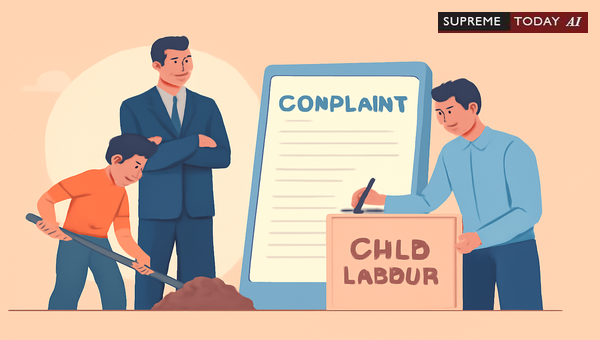
Child labour remains a pressing issue in India, robbing children of their childhood and future opportunities. If you've witnessed or suspect child labour violations, knowing the correct procedure for filing a complaint under the is crucial. This guide breaks down the process, roles of authorities, and judicial insights to help you navigate it effectively. Note: This is general information; consult a legal professional for specific advice.
The (now updated as the in some contexts), bans employment of children below 14 years in hazardous occupations and regulates conditions for adolescents. Violations attract penalties, but enforcement follows strict procedures. The key question many ask is: What is the procedure of filing complaint under the Child Labour Prohibition Act?
Courts have clarified that complaints must go through designated channels, emphasizing over administrative actions. 2005 0 Supreme(SC) 1288
Filing a complaint isn't a DIY process for individuals in all cases; it typically involves inspectors and courts. Here's the general procedure:
Report the Violation: Anyone can report suspected child labour to a local Labour Inspector or the district Labour Department. Provide details like location, child's details, and evidence (photos, videos).
Investigation by Inspector: Inspectors, appointed under the Act, investigate. They can:
Inspectors' role is limited to investigation and reporting; they cannot try cases. As held: the jurisdiction of the Inspector to file a complaint with regard to any offence under the Act does not extend to the trying of the complaint which, as specifically provides, only courts not inferior to the or a may try. 2005 0 Supreme(SC) 1288
Filing the Complaint in Court: Post-investigation, the inspector or authorized person files a formal complaint before a competent court ( or First-Class Magistrate). mandates this judicial route.
Trial and Adjudication: The court hears evidence, verifies facts (e.g., age via if needed), and decides. Failure in procedural compliance, like improper age proof, can lead to . 2017 0 Supreme(Raj) 1207
Post-Filing Actions: Courts may impose fines (up to ₹20,000 for first offence, imprisonment for repeats) or rehabilitation orders.
In one case, under was set aside because road construction isn't listed in Part-A of the Schedule, highlighting the need for precise violation matching. 2013 0 Supreme(Jhk) 741
A common misconception is that inspectors can directly penalize or adjudicate. Judicial precedents clarify:
Inspectors' Powers: Limited to surveys, inspections, evidence collection, and reporting. They cannot prosecute or try offences. The jurisdiction of the Inspector ... does not extend to the trying of the complaint. 2005 0 Supreme(SC) 1288
Courts' Exclusive Role: Only courts try complaints under (3). This ensures and fairness.
Age determination follows strict rules: Produce birth certificates or refer to medical authorities for disputes. Inspectors deciding unilaterally risks invalidation. 2017 0 Supreme(Raj) 1207
While focused on child labour, procedures align with broader child rights frameworks. For instance:
In missing children cases presumed as trafficking or abduction, mandate immediate registration, similar to child labour reports. 2025 Supreme(Online)(Kar) 21646
cases emphasize child-friendly procedures, overriding limitations, which may influence child labour trials involving exploitation. 2023 0 Supreme(Del) 1521
Courts stress procedural uniformity; lapses don't automatically quash proceedings but must be addressed at trial. 2025 0 Supreme(Kar) 531
Under the updated Child and Adolescent Labour Act, complaints may be reported to competent courts directly in some scenarios.
These reinforce that child-related complaints prioritize evidence, victim protection, and judicial scrutiny.
Avoid these to ensure your complaint succeeds:
Improper Age Verification: Always use statutory methods; courts quash non-compliant actions. 2017 0 Supreme(Raj) 1207
Bypassing Courts: Inspector notices without court filing may be invalid.
Non-Prohibited Work: Not all child work is banned; check Schedules (e.g., road construction may not qualify). 2013 0 Supreme(Jhk) 741
Exceptions:- Inspectors can't trial cases.- Complaints must be court-filed.- Age disputes go to medical experts.
Failure to follow these procedures may result in the quashing of penalties or notices, as the courts emphasize the importance of procedural compliance. 2017 0 Supreme(Raj) 1207
The procedure for filing a complaint under the Child Labour Prohibition Act prioritizes investigation by inspectors followed by court adjudication, safeguarding rights and ensuring justice. By understanding these steps, you contribute to eradicating child labour.
Key Takeaways:- Report to inspectors first; courts handle trials. 2005 0 Supreme(SC) 1288- Follow age verification protocols strictly. 2017 0 Supreme(Raj) 1207- Match violations to prohibited lists. 2013 0 Supreme(Jhk) 741- This is general guidance; laws evolve, so verify with experts.
References:1. 2017 0 Supreme(Raj) 1207: Procedural compliance in child labour determination.2. 2005 0 Supreme(SC) 1288: Inspector limits and court jurisdiction.3. 2013 0 Supreme(Jhk) 741: specifics.
Stay informed, report responsibly, and help build a child-labour-free India.
#ChildLabourLaw #FileChildLabourComplaint #IndiaLabourRights


He prays that minor victims of marital rape be allowed to file complaint till they attain the age of twenty years in consonance with Section 3(3) of Prohibition of Child Marriage Act, 2006 (`PCM Act'). The said Section is reproduced hereinbelow: "3. ... of Child Marriage Act, 2006. ... (3) The petition under this section may be filed at any time but before the #HL_STAR....

In Prathvi Raj Chauhan's case (supra), a prohibition of similar nature contained in section 18A (ii) of the SC/ST Act was considered, and the above observations were made. ... The crime was registered on the basis of the complaint submitted by the mother of the victim, who is the wife of the petitioner. Even though the child was subjected to examination by a clinical psychologist, no statement could be taken from the #HL_S....

To give the strengthen to his submissions for the procedure under Section 19 of the POCSO Act, learned counsel for the applicant drew the attention of the Court to the procedure of Section 21 (1) of the POCSO Act. ... He further submitted that in this regard in POCSO Act special procedure has also been mentioned under Section 19 of the POCSO Act. ... The proce....

During the pendency of trial, the petitioner is before this Court calling in question filing of charge sheet, order of taking cognizance and large-scale violation in the procedure adopted by the concerned Court qua the Act. ... Section 25 of the Act. He would further contend that the procedure adopted by the concerned Court is contrary to Section 26 (1) and (4) of the Act. ... Medical e....

Labour (Prohibition And Regulation) Act, 1986 (for short 'the Act'). ... Even in the entire complaint and charge sheet, there is no, prima facie, material evidence to show that the child is below 12 years, which is mandatory under the Act. Further, it is settled principle of law that age of the person cannot be determined on the basis of oral evidence. ... Child is defi....

complaint under the Act should be kept open. ... Procedure relating to offences. ... may be reported to the court of competent jurisdiction by way of filing a complaint. ... and Adolescent Labour (Prohibition and Regulation) Act, 1986 (for short, “the Act”) was the procedure.
The Ministry of Women and Child Development has also formulated an SOP, titled ‘Standard Operating Procedure For Cases of Missing Children’ which states that upon receiving a complaint of a missing child, an FIR shall be registered as trafficking or abduction. ... Complaint regarding missing child: o An alternate mode of registration of complaint are phone/email to the ....

Apart from the aforesaid provisions, Chapter V of the POCSO Act provides for procedure for reporting of cases in respect of commission of offence against the child. S.22 prescribes the punishment for false complaint or false information. The same reads thus: ... "S.22. ... Chapter VIII of the POCSO Act provides for procedure and powers of Special Courts and recording of evidence. S.33 is....

Apart from the aforesaid provisions, Chapter V of the POCSO Act provides for procedure for reporting of cases in respect of commission of offence against the child. Section 22 prescribes the punishment for false complaint or false information. ... (3) Whoever, not being a child, makes a false complaint or provides false information against a child, knowing it to be f....

His Lordship observed that the procedure under the said Act is also different obviously with a view to make it child friendly. I am not only in respectful agreement with the view of this Court in the case of Suresh Narvekar vs. ... Considering the aforementioned circumstances it is just and necessary kindly register complaint for criminal tresspass, criminal intimidation, outraging modesty and also under children court #HL....

It may also be noticed that a girl child faces several adverse challenges if she is married below 18 years of age. The child marriage is also prohibited under the Prohibition of Child Marriage Act, 2006. Clause six of Section 375 makes it clear that if the woman is under the age of 18 years then sexual intercourse with her, with or without consent is “rape”. Also, Section 375 defines “rape” and it provides that a man is said to commit “rape” if he has sexual intercourse with ....

The child marriage is also prohibited under the Prohibition of Child Marriage Act, 2006. Also, Section 375 defines “rape” and it provides that a man is said to commit “rape” if he has sexual intercourse with a woman under the circumstances falling under any of the seven descriptions mentioned in the Section. Clause six of Section 375 makes it clear that if the woman is under the age of 18 years then sexual intercourse with her, with or without consent is “rape”. It may also b....
(2) On receipt of information in respect of a cognizable offence against a child, the police shall register a First Information Report (FIR) forthwith. (3) On receipt of information of a non-cognizable offence against a child, the police shall make an entry in the Daily Diary which shall be transmitted to the Magistrate concerned forthwith who shall direct appropriate action under sub-section (2) of section 155 of the Code of Criminal Procedure, 1973. Rule 54 of JJ Rules, 2016 can be read in t....
Furthermore, such prosecution is maintainable only against the persons referred to in Sections 138 and 141 of the NI Act. The object behind such proceedings is to bring relief to the litigants in a summary manner if the complainant is able to establish his case. The NI Act provides for the procedure for filing a complaint under Section 138 of the NI Act.

4. Therefore, a complaint was lodged alleging therein that the petitioner being Managing Director of M/s. Reddy Veerana Construction Pvt. Ltd. has contravened the provision of Section 3 of the Child Laour (Prohibition and Regulation)Act punishable under Section 14(1) of the said Act. 5. On such complaint, cognizance of the offence punishable under Section 14(1) of the Child Laour (Prohibition and Regulation)


An indispensable Tool for Legal Professionals, Endorsed by Various High Court and Judicial Officers
Please visit our Training & Support
Center or Contact Us for assistance

Scan Me!
India’s Legal research and Law Firm App, Download now!


For Daily Legal Updates, Join us on :



 Back to top


