
 Back
Back





IN THE HIGH COURT OF KARNATAKA AT BENGALURU
M. NAGAPRASANNA, J.
Sri Avik Bid, S/o. Maloy Kumar Bid – Petitioner
Versus
The State By Jalahalli Police Station, Represented By Its Inspector Of Police and Anr. – Respondents
Criminal Petition No.2429 of 2022
Decided On : 10-06-2025
Based on the provided legal document, the key points are as follows:
The court addressed procedural compliance in child abuse cases, emphasizing that minor procedural lapses or violations of statutory provisions do not necessarily invalidate the proceedings or warrant dismissal before trial (!) (!) .
The recording of witness statements, even if appearing uniform or similar, does not automatically invalidate the trial; credibility assessments are reserved for the trial stage (!) .
Violations related to the manner of recording statements, such as not recording by audio-video means, are considered procedural irregularities that can be challenged during trial but do not warrant quashing proceedings at this stage (!) .
Non-conduct of medical examinations of child victims, while desirable, does not constitute a fatal defect affecting the legality of the proceedings, especially where other credible evidence exists (!) .
Alleged violations of statutory timelines for recording evidence or completing trial procedures are procedural in nature and are considered directory, not mandatory, thereby not grounds for quashing the proceedings (!) .
The order of taking cognizance, even if not explicitly reasoned, is valid as long as there is sufficient material in the police report or case diary indicating the commission of the offence, and the court has applied its mind to the material before proceeding (!) (!) .
The court clarified that orders taken on the basis of police reports under the relevant law do not require detailed reasoning or explicit application of mind at the cognizance stage; such procedural flexibility is permissible (!) (!) .
The court reaffirmed that the primary role at the cognizance stage is to determine whether there is sufficient prima facie material to proceed, with detailed examination of evidence deferred to trial (!) (!) .
The petitioner's challenge based on alleged procedural violations and irregularities in the investigation or cognizance order is deemed to be a matter for trial and appellate review, not for quashing proceedings in a pre-trial petition (!) (!) .
The court directed that the trial must be concluded within a specified short timeframe, emphasizing the importance of expeditious justice in cases involving child victims (!) .
Overall, procedural deviations that do not go to the root of the case or do not compromise the fundamental rights of the accused or the integrity of the trial process are not sufficient grounds for quashing proceedings at this stage (!) (!) .
The court rejected the petition, reaffirming that the trial should proceed without delay, and any procedural issues can be raised during trial or appellate proceedings (!) (!) .
These points collectively underscore that procedural irregularities or statutory violations, while relevant, do not automatically vitiate or invalidate criminal proceedings, especially when the court finds that sufficient grounds for the case's continuation exist. The emphasis is on allowing the trial to proceed fairly and efficiently, with procedural challenges to be addressed at appropriate stages.
| Table of Content |
|---|
| 1. overview of the incident leading to charges (Para 1 , 2) |
| 2. court's analysis of facts and procedural issues in the case. (Para 3 , 7 , 8) |
| 3. conflicting arguments from counsel (Para 4 , 6) |
| 4. violation of procedural requirements in child abuse cases (Para 9 , 10 , 12) |
| 5. discussion on alleged violations of the protection of children from sexual offences act. (Para 11) |
| 6. cognizance based on police report valid despite non-reasoned order (Para 14) |
| 7. rejection of petition; trial must conclude promptly (Para 15 , 16) |
ORDER :
(M. NAGAPRASANNA, J.)
The petitioner is before this Court calling in question proceedings in Special C.C.No.880 of 2018 registered for offences punishable under Sections 7 and 8 of the Protection of Children from Sexual Offences Act, 2012 (hereinafter referred to as ‘the Act’for short).
2. Sans details, facts in brief germane, are as follows: -
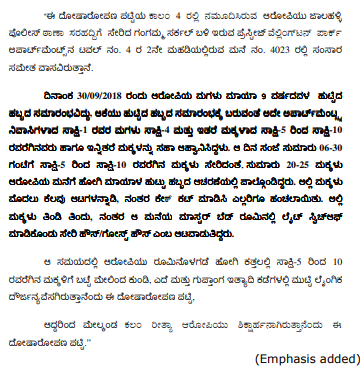
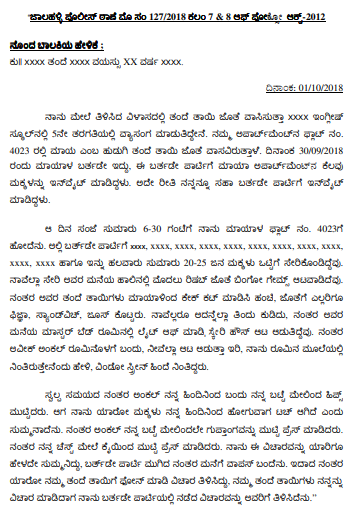
The petitioner is said to be an Assistant Professor in the Indian Institute of Science, Bangalore in the Department of Physics. The issue triggered on 30-09-2018 when his daughter aged 9 years wanted to celebrate her birthday and, in that connection, called all the neighbouring apartment residents at Prestige Wellington Park complex, Jalahalli. During the birthday party some children preferred to play in dark room and one child is said to have poked into the eye of another. The situation resulted in panic and, therefore, the averment in the petition is that the petitioner goes inside the room to bring the children out of dark room. After the party was over, the children are said to have dispersed and go to their respective houses. On the same day at about 9.30 p.m. the de-facto complainant, father of one of the children who had attended the birthday celebrations comes to the residence of the petitioner along with other men and women accusing the petitioner of having touched the girl children during the birthday party inappropriately. The petitioner is said to have refused to accept any of the allegations of the kind that is made against him. The complainant then, on the next day, registers a complaint before the jurisdictional Police, on the aforesaid allegation of the petitioner having touched the complainant’s daughter inappropriately. This becomes a crime in Crime No.127 of 2018. The petitioner is said to have been taken into custody and then released on bail later. These factors are not relevant to be noticed in the case at hand. The Police, after investigation, file a charge sheet against the petitioner for the offences afore-quoted. Trial commenced and 13 witnesses are examined. During the pendency of trial, the petitioner is before this Court calling in question filing of charge sheet, order of taking cognizance and large-scale violation in the procedure adopted by the concerned Court qua the Act.
3. Heard Sri C.V. Nagesh, learned senior counsel appearing for the petitioner and Sri B.N. Jagadeesha, learned Additional State Public Prosecutor appearing for the State/1st respondent.
4. The learned senior counsel Sri C.V. Nagesh would vehemently contend that no such incident has ever happened. It was the children who were playing a dark room game in which there was some commotion. Therefore, the petitioner had to intervene to assuage anguish. He would contend that the de-facto complainant has an axe to grind and, therefore, he has registered the complaint only to harass the petitioner. The learned senior counsel would submit that the statements recorded by the concerned Court of all the witnesses or victim children are verbatim similar and it runs contrary to Section 25 of the Act. He would further contend that the procedure adopted by the concerned Court is contrary to Section 26 (1) and (4) of the Act. He would contend that the order of taking cognizance is in blatant violation of Section 190 (1)(b) of the Cr.P.C ., as the concerned Court has not examined crucial documents. There is no order issuing summons to the petitioner upon taking of cognizance. Secti

AI
The court held that uniformity in witness statements does not invalidate a trial, and procedural lapses under relevant laws do not preclude prosecution.

The court clarified that taking cognizance of an offence requires applying judicial mind to the complaint, and mere examination of the complainant does not suffice.

(1) Issuance of Process – Section 204 requires sufficient ground for proceeding against the accused, which would mean the Court has to examine existence of sufficient grounds to proceed against the a....

The Magistrate must apply judicial mind when taking cognizance and issuing summons, ensuring sufficient grounds exist for proceeding with the case.

Judicial proceedings involving allegations of cheating and forgery must undergo comprehensive investigation; prima facie evidence suffices for proceeding, dismissing claims of civil nature.

The Magistrate is not required to record detailed reasons when issuing summons in response to a police report, provided there are sufficient grounds for proceeding.

At the stage of taking cognizance and issuing process, the Magistrate is only required to see the sufficiency of the material for proceeding further, not to meticulously examine the evidence. The cou....
Point of Law : Delay in lodging the FIR, final report being filed by an officer who was not in-charge of the Police Station; act of the learned Magistrate in taking cognizance of the offence which be....



An indispensable Tool for Legal Professionals, Endorsed by Various High Court and Judicial Officers
Please visit our Training & Support
Center or Contact Us for assistance

Scan Me!
India’s Legal research and Law Firm App, Download now!


For Daily Legal Updates, Join us on :



 Back to top


