Searching Case Laws & Precedent on Legal Query.....!
Analysing the retrieved Case Laws
Scanned Judgements…!



Searching Case Laws & Precedent on Legal Query.....!
Analysing the retrieved Case Laws
Scanned Judgements…!
Maintainability of Suit for Wild Animal Attack Compensation - Main Points and Insights
The primary issue is whether a suit filed by a victim or legal heirs for compensation due to wild animal attacks is maintainable in law. Several judgments and government resolutions affirm that victims of wild animal attacks are entitled to claim compensation from the State or relevant authorities. For instance, the responsibility of the State and the Forest Department to see that citizens are not attacked by any wild animal, and if attacked, it is the duty of the Government to provide adequate compensation ["2025 Supreme(Online)(Ker) 44941"].
The Wild Life (Protection) Act, 1972, defines wild animal as any animal found wild in nature including species listed in Schedules I-V ["2000 0 Supreme(HP) 70"]. Courts have consistently held that injuries or deaths caused by wild animals fall within the scope of compensable events, provided the attack is established and reported timely.
Several cases confirm that suits seeking compensation are maintainable, especially when statutory schemes or government resolutions specify compensation amounts (e.g., Rs. 10 lakhs for death due to wild animal attack ["2022 0 Supreme(Bom) 1024"], Rs. 5 lakhs ["AMRUTI PRADHAN vs STATE and ORS - Orissa"]). Courts have also rejected defenses based on limitations or mis-joinder when the injury or death is attributable to wild animal attacks ["AMRUTI PRADHAN vs STATE and ORS - Orissa"].
The legal framework and judicial pronouncements support the maintainability of such suits, emphasizing that victims or heirs have locus standi to claim compensation, and the State has a duty to compensate victims of wild animal attacks.
Analysis and Conclusion
Based on the cited judgments and statutory provisions, the original suit for wild animal attack compensation is generally maintainable. Courts recognize the obligation of the State to compensate victims under statutory schemes and government resolutions. The definition of wild animal under the Wild Life Act includes animals that cause injury or death, and the law provides for specific compensation amounts or schemes to address such incidents.
Therefore, a suit claiming compensation for injuries or death caused by wild animals is maintainable, provided the claim is supported by proper evidence, timely reporting, and adherence to prescribed procedures. The courts have consistently upheld the entitlement of victims or their heirs to seek redress through civil suits or statutory claims, affirming the suit's maintainability in such cases.
References:
["2000 0 Supreme(HP) 70"]: Discusses jurisdiction, statutory definitions, and the responsibility of the State to pay damages for wild animal attacks. It affirms that claiming damages is permissible under the Wild Life Act and related schemes.
["AMRUTI PRADHAN vs STATE and ORS - Orissa"]: Highlights a case where the husband's death due to wild animal attack led to compensation claims, indicating the legal recognition of such claims.
["2022 0 Supreme(Bom) 1024"]: Details a government resolution providing Rs. 10 lakhs compensation for death caused by wild animal attack, supporting the legal basis for maintainable claims.
["2025 Supreme(Online)(Ker) 55549"]: Notes schemes and orders that make the State liable for compensation, reinforcing the legal entitlement of victims.
["INDHC_PHHC010090862002"]: Confirms that claims for compensation are recognized when injuries or death are caused by wild animals, and that suits are maintainable when proper procedures are followed.
Summary:The legal framework, judicial decisions, and government schemes establish that suits for compensation due to wild animal attacks are maintainable. Victims or their heirs have the right to claim damages, and the courts uphold the enforceability of such claims under the Wild Life (Protection) Act, 1972, and related policies.
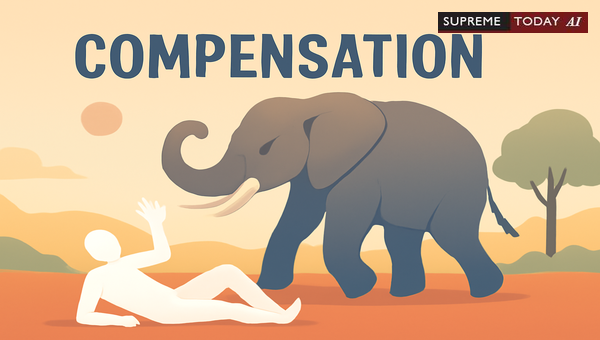
Imagine trekking through a forest or working on your farm when a wild elephant or leopard suddenly attacks, causing severe injury or loss of life. In the aftermath, families often seek justice and compensation. But is an original suit maintainable for wild animal attack compensation under Indian law? This question arises frequently in regions with high human-wildlife conflict, such as forested areas in Kerala, Maharashtra, and beyond.
This blog post delves into the legal framework, judicial precedents, and statutory provisions governing such claims. While this is general information based on established case law and not specific legal advice, it provides clarity for victims, families, and legal practitioners. Consult a qualified lawyer for personalized guidance.
have long recognized for damages caused by dangerous wild animals. Unlike ordinary negligence claims, holds the owner, keeper, or possessor responsible independent of negligence or intent2025 0 Supreme(Ker) 1683 2015 0 Supreme(Ker) 349.
This doctrine applies particularly to animals (wild by nature), such as elephants, tigers, and leopards. The landmark case of explicitly states: elephant belongs to that class of animals which is grouped as dangerous class of animals and liability is independent of any intent or negligence 2025 0 Supreme(Ker) 1683. Similarly, affirms: elephant is a dangerous animal () and the owner/keeper of an elephant is strictly liable, independently of negligence, for the damage caused by the elephant 2025 0 Supreme(Ker) 1683.
As a result, an for compensation is generally maintainable, allowing victims to claim damages without proving fault on the part of the keeper.
Courts have consistently supported the filing of original suits in wild animal attack cases:
In 2022 Supreme(Online)(BOM) 2548, the court directed compensation under a Government Resolution (GR) for death due to wild animal attack, noting it was unjust to refuse payment when the accident was undisputed. This reinforces that claims—whether via suit or writ—are viable.
Section 39 of the declares wild animals, including elephants, as property of the State or Central Government 2025 0 Supreme(Ker) 1683 2015 0 Supreme(Ker) 349. While this protects wildlife, it does not preclude civil liability. Instead, it underscores the inherent danger, bolstering claims.
The Act's framework supports compensation suits, as wild animals' state ownership implies governmental or keeper responsibility for harms caused.
Beyond original suits, many states have policies for , which courts often enforce:
Stray dog bites, analogous to wild attacks, led to directives for Rs. 6,50,000 compensation in one case, with calls for public awareness 2023 0 Supreme(Chh) 205. Property damage claims, like crop or tree loss by blue bulls or elephants, have succeeded under GRs, with courts striking down discriminatory classifications under 2015 0 Supreme(Bom) 697. For instance, orange trees damaged by blue bulls warranted Rs. 200 per tree.
These schemes complement civil suits, providing quicker relief while original suits offer comprehensive damages.
While suits are maintainable, certain factors may influence outcomes:- Provocation or third-party interference: May reduce liability but rarely bars the suit 2025 0 Supreme(Ker) 1683.- Statutory caps: GRs limit ex-gratia (e.g., Rs. 20,000 for minor deaths in some cases 2008 0 Supreme(P&H) 625), but civil suits can seek more.- Self-defense killings: Permitted under , but compensation focuses on attacks on persons 2017 0 Supreme(Ker) 762.
No blanket bar exists; suits remain valid even alongside criminal or statutory actions.
If affected by a wild animal attack:1. Document evidence: Photos, medical reports, witness statements proving the attack and animal's nature.2. Identify the keeper: State forest departments or private owners (e.g., temple elephants).3. File promptly: Approach civil courts for suits or via writs for policy-based claims.4. Invoke precedents: Cite cases and provisions.
Legal practitioners should blend tort law with statutory relief for robust claims.
In summary, an original suit for wild animal attack compensation is generally maintainable under Indian law, rooted in for dangerous animals like elephants 2025 0 Supreme(Ker) 1683 2015 0 Supreme(Ker) 349. Judicial precedents and the Wildlife (Protection) Act, 1972, affirm this, supplemented by state GRs for deaths, injuries, and property loss.
Key Takeaways:- applies—no negligence proof needed.- Suits viable against owners/keepers; state schemes as alternatives.- Defenses like provocation exist but don't typically dismiss claims.- Victims deserve remedy in human-wildlife conflicts.
Stay safe in wildlife zones and seek professional advice. For more legal insights, subscribe to our blog.
References:- 2025 0 Supreme(Ker) 1683: cases on elephants.- 2015 0 Supreme(Ker) 349: and liability recognition.- Other cases:
AMURTI PRADHAN vs STATE OF ORISSA
, 2022 Supreme(Online)(BOM) 2548, 2019 0 Supreme(Bom) 1753, etc.This post is for informational purposes only and not legal advice.
#WildAnimalCompensation, #StrictLiabilityIndia, #WildlifeLaw


Whether the plaintiff is entitled to recover the suit amount from the defendants ? OPP ... 2. Whether the suit is not maintainable in the present form ? OPD ... 3. Whether the plaintiff has locus standi to institute the suit ? OPP ... 4. ... Whether the suit is bad for mis-joinder 1 OPD ... 5. Whether the suit is within time ? OPP ... 6. Whether this court has no jurisdiction to ....

attack of the wil d animal. ... No. 70 of 2016 02. 20.06.2016 The husband of the appellant died on account of attack by wild animal in the reserved forest area. ... compensation, more particularly, when exception has been given under Rule 45-DD of the Rules, 1974 that no compensation is to had succumbed to the injuries.

in the wild animal attack prone areas at the earliest. ... (C) No.46215 of 2024 is filed to direct the Ministry of Environment, Forests and Climate Change to pay the petitioner compensation under Ext.P5 scheme due to his father's death in a wild elephant attack on 12.06.2022. ... The alarming statistics of 555 fatalities in the State resulting from wild animal attacks during the last six years are shocking. ... It is contended that as per Exts.P4 and....

animal which, in the case of a living animal, will continue while it has animus revertendi." ... extend to six months or with fine or both for each animal. ... Admittedly there is no provision for compensation payable by the State in respect of the elephants captured, and the tusks and teeth of a wild elephant killed, which are regarded as property of the State. ... S.3 and 3A related to the shooting or destroying of any wild female elephant, upon waste or forest land, whethe....
A request was made for payment of compensation towards death due to attack by a wild animal, and by Ext.P8 a reply was given as per the provisions of the Right to Information Act, that, as it is not clear as to whether the death has happened due to the attack by a wild boar, the request for compensation ... due to the death of his father in a wild animal attack was rejected. ... The case of the pe....

Thus, in our opinion, Petitioner is entitled to compensation as provided under the said GR. The said GR specifically provides that when death is caused due to attack by wild animal, monetary compensation of Rs. 10 Lakhs is payable. ... Thus, once the accident was not disputed and when the said GR provided for grant of compensation in case of death of a person due to attack by wild animal, it was unjust on the part of the Respondent ....

of wild animal like leopard etc. ... Whether the suit is barred by limitation ? OPD 4. Whether the suit is not maintainable ? ... Whether the plaintiff has got no locus standi to file the suit ? ... iv)Whether the plaintiff is entitled for compensation ? ... Whether the plaintiff is entitled to any compensation ?
Thus, once the accident was not disputed and when the said GR provided for grant of compensation in case of death of a person due to attack by wild animal, it was unjust on the part of the Respondent no.2 to refuse to grant compensation. ... Thus, in our opinion, Petitioner is entitled to compensation as provided under the said GR. The said GR specifically provides that when death is caused due to attack by wild animal, monetary #H....

He would further submit that in the like nature cases of predatory wild animal attacks and consequent death, way back in 2018, the State has promulgated a policy that in case of death caused by predatory wild animal, a compensation of Rs.4.00 Lacs is being granted. ... cripple and injury caused in wild animal attacks can be applied to the incidents of a stray dogs when death is caused by the bite of stray dog. ... Subsequently by order dated 12th June, 2015 further gu....

to the extent of Rs. 20,000/- in case of death of a minor due to attack of wild animal like leopard etc. ... Whether the suit is not maintainable? OPD ... 5. Whether the plaintiff has got no locus standing to file the suit? OPD ... 6. Relief. ... 4. ... Whether the plaintiff is entitled to relief of mandatory injunction as claimed? OPP ... 2. Whether the plaintiff is entitled to any compensation#HL_EN....
There is no reason why same principle should not have been applied to the case of the petitioner, who protected the tigress who nurtured her cubs in an agricultural land of the petitioner. Certainly, it would be open to a citizen to claim compensation for the loss caused by any wild animal, whether specifically referred to in any provision, Government Resolution or not. In this country, it is settled law, even in relation to cattle that the amount is liable for their trespass upon unenclosed and for all naturally resulting damage, vide the Law of Torts by Ratanlal and Dhira....

Even for self defence, killing of wild animals is permitted only in case of attack on persons, and not on their properties. 6. Per contra, the learned Special Government Pleader has argued that the respondent is not entitled to any common-law remedy when there is a statute in force which provides for compensation to such persons who are victims of attack by wild animals, under the name and style “Kerala Rules for payment of Compensation to Victims of Attack by Wild Animals, 1980.” According to him, therefore, the matter involves a substantial question of law. Ther....
A short question involved in this petition is; as to whether the petitioner is entitled to receive compensation for the loss caused to her orange trees by a wild animal, the blue-bull, a protected animal under the provisions of Wild Life (Protection) Act, 1972 under the scheme of compensation framed by the Government in the interest of affected farmers/horticulturists?

Learned counsel for the respondents relies upon Section 2 (36) of the Wildlife (Protection) Act, 1972 with regard to the definition of Wild animal, which is reproduced below: 2. Definitions- "[(36) "wild animal" means any animal specified in Schedules I to IV and found wild in nature;]"


An indispensable Tool for Legal Professionals, Endorsed by Various High Court and Judicial Officers
Please visit our Training & Support
Center or Contact Us for assistance

Scan Me!
India’s Legal research and Law Firm App, Download now!


For Daily Legal Updates, Join us on :



 Back to top


