


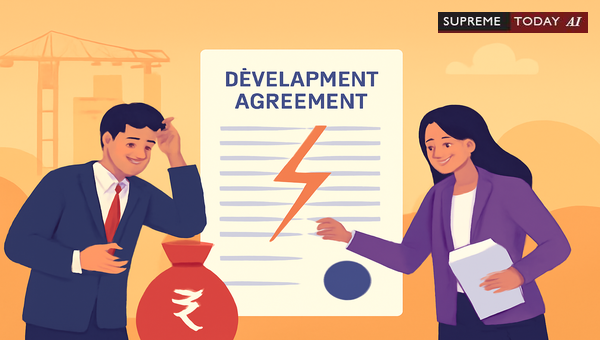
: How to Claim Damages in India
In the fast-paced world of real estate development, agreements between landowners and developers are the backbone of ambitious projects. But what happens when one party fails to uphold their end of the bargain? A violation of development agreement can lead to significant financial losses, delays, and disputes. If you're facing such a situation, understanding your right to is crucial.
This comprehensive guide addresses the key question: Violation of Development Agreement . We'll break down the legal principles under the , types of damages, evidence requirements, and insights from recent cases. Note: This is general information and not specific legal advice. Consult a qualified lawyer for your case.
Understanding Breach of Development Agreements
Development agreements typically outline obligations like timelines, construction standards, profit-sharing, and project scope. A breach occurs when a party—often the developer—fails to perform, such as through delays, substandard work, or unilateral termination. The aggrieved party, usually the landowner, can seek remedies under contract law.
The core principle is compensation for losses directly caused by the breach. Courts aim to restore the innocent party to the position they would have enjoyed had the contract been fulfilled. This includes (e.g., rental value during delays) and if the breaching party knew the property's intended use. 2000 4 Supreme 373
For instance, in cases involving joint ventures, courts have examined claims for lost development profits. One source notes: Whether the 2nd Defendant is entitled to claim loss of development profit... the 2nd Defendant's claim concerns RM126,026.
Types of Damages: Liquidated vs. Unliquidated
Damages fall into two main categories, each with distinct proof requirements:
These are pre-agreed sums in the contract, serving as a . They provide certainty and avoid lengthy court assessments. However, courts scrutinize them to ensure they're not penalties. If valid, they're enforceable without proving actual loss. 2015 0 Supreme(Del) 208
These are not fixed and must be proven based on actual losses. The claimant bears the burden to demonstrate:- The breach occurred.- Resultant and quantifiable loss.
Assessment focuses on direct consequences, like lost rental income or profits. For delays, damages may be calculated based on the rental value of the property during the period of delay. 2000 4 Supreme 373
In a Development Authority case, incorrect quantification of damages by the was held not to constitute '' or ',' emphasizing fair assessment. 2025 0 Supreme(SC) 668
and Other Non-Pecuniary Claims
Claims for or emotional distress are typically not compensable in development agreement disputes under Indian law. Courts consistently rule that such damages are unjustified unless explicitly stipulated in the contract. 2000 4 Supreme 373
This aligns with broader contract law, prioritizing economic losses over subjective suffering.
Evidence and Legal Proceedings
Success hinges on robust evidence. Key requirements include:- Documentation: Emails, meeting notes, amendments, and the original agreement.- Proof of Breach: Timelines, site reports, or expert testimonies.- Quantification of Loss: Financial records, valuations, market rental rates.
Civil courts or arbitration (if provided) adjudicate claims. For , courts verify if they're a genuine pre-estimate. 2015 0 Supreme(Del) 208
Recent cases underscore proof's importance. In one, damages were restricted to Rs. 35,000 per month for violations of sanctioned plans, with claims dismissed.
Another involved a counter- under a development agreement dated , questioning readiness and willingness to perform. 2024 0 Supreme(Mad) 890
Invalidation of agreements often follows breaches. For example, a development agreement was cancelled via legal notice, leading to arbitration for remedies. 2023 0 Supreme(Telangana) 279
Insights from Key Cases
Proof of Actual Loss Essential: Damages awarded without substantiation were challenged successfully. Damages awarded without proof of actual damages were challenged. 2024 0 Supreme(Bom) 262
Joint Development Disputes: In a joint venture, claims for non-implementation included Rs. 2.86 lakhs for undelivered property share and indemnification for investments. 2025 0 Supreme(Kar) 416
Arbitration Scrutiny: Tribunals must establish breach before assessing damages. Errors in quantification without liability findings lead to reversals.
Redevelopment Specifics: In cooperative housing redevelopments, courts reference precedents like Maya Developers v. Neelam R. Thakkar, stressing documented breaches. 2021 0 Supreme(Bom) 229
Forfeiture and Readiness: Defendants may forfeit advances only if plaintiffs fail readiness, per agreement terms. 2024 0 Supreme(Mad) 890
These cases highlight that while breaches trigger claims, unsubstantiated demands fail.
Practical Recommendations
To strengthen your claim:1. Document Everything: Maintain records of all interactions.2. Gather Evidence Early: Secure financials, expert reports, and impact correspondence.3. Choose Damage Type Strategically: Liquidated for speed; unliquidated for higher potential recovery.4. Issue Legal Notice: Demand performance or termination before suing.5. Engage Experts: Valuers for loss quantification; lawyers for strategy.
At the most, plaintiff can claim the damages for breach of any terms and conditions of the re-development agreement, if it is proved by the documentary evidence. 2019 0 Supreme(Bom) 2183
Conclusion and Key Takeaways
A violation of a development agreement opens the door to damages claims, but success demands proof of breach and loss. offer predictability, while unliquidated require detailed evidence. rarely qualifies, and courts demand substantiation to avoid reversals.
Key Takeaways:- Prove direct losses like rent or profits. 2000 4 Supreme 373- Distinguish liquidated (pre-fixed) from unliquidated (assessed). 2015 0 Supreme(Del) 208- Document meticulously for court or arbitration.- Learn from cases: No breach, no damages.
Real estate disputes can be complex—seek professional advice promptly. Stay informed, protect your interests, and ensure agreements are breach-proof from the start.
References: 2000 4 Supreme 373 2015 0 Supreme(Del) 208 2025 0 Supreme(SC) 668
2023 0 Supreme(Cal) 1000 2024 0 Supreme(Mad) 890 2021 0 Supreme(Bom) 229 2019 0 Supreme(Bom) 2183
2025 0 Supreme(Kar) 416 2024 0 Supreme(Bom) 262 2023 0 Supreme(Telangana) 279
#DevelopmentAgreement, #ContractBreach, #ClaimDamages















