


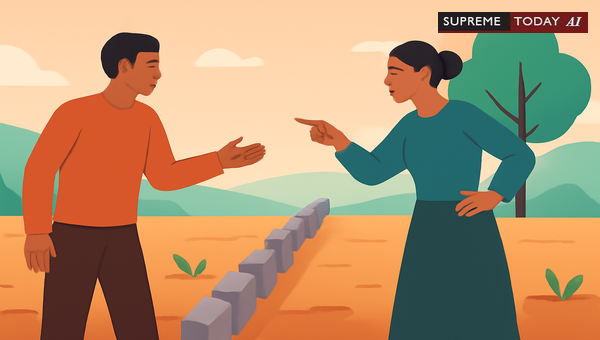
Planting Stones in Joint Land: Is It ?
In property disputes, especially involving co-owned land, actions like planting stones can spark heated conflicts. Picture this: one co-owner decides to mark boundaries or improve the shared kand (a term often referring to agricultural land or fields in regional contexts) by planting stones. Does this simple act amount to ? The question at the heart of many such cases is: if Planted Stones in the Kand. I’d Not a ?
This blog dives deep into the legal nuances, drawing from established precedents and related cases. We'll clarify when such actions are permissible exercises of rights and when they veer into unlawful territory. Note: This is general information based on case analyses and not specific legal advice. Consult a qualified lawyer for your situation.
Main Legal Finding
Generally, a who plants stones in joint land does not commit , provided the act falls within their lawful rights as a co-owner and does not constitute an act of or unlawful interference with another 's . 2023 0 Supreme(All) 1757
This principle upholds the fundamental equality among co-owners, allowing reasonable use and enjoyment of the property without needing consent for every minor improvement—unless it harms others.
Key Points to Understand
- Not Inherently : Planting stones, as a form of use or boundary marking, is typically permissible for co-sharers.
- Context Matters: Legality hinges on whether it leads to (exclusive ) or detriment to fellow co-owners.
- Co-Owner Rights: Includes planting, improving, or even constructing on joint land, absent exclusionary intent. 2011 0 Supreme(Mad) 354
Detailed Legal Principles on
Co-owners share equal rights to possess, use, and enjoy joint property. Courts have consistently ruled that benign acts on shared land do not equate to .
For instance, one key document states: If a is raising construction on the joint land without the consent of the other co-sharers, he can be injuncted from doing so, but the question of whether such act constitutes depends on whether it amounts to or is detrimental to others.2023 0 Supreme(All) 1757
Similarly: A co-owner can raise construction over joint land being in of that parcel of land. The law permits a to enjoy the land, including planting or construction, unless such acts amount to or are detrimental to the rights of other co-sharers.2011 0 Supreme(Mad) 354
Planting stones aligns with these rights if it's for improvement or demarcation, not exclusion. Unlike strangers, co-sharers enter with inherent title-based permission, making mere entry non-trespassory.
Planting Stones Specifically: or Legitimate Use?
In the context of kand or joint fields, planting stones often serves practical purposes like boundary indication or land preparation. Courts view this as a non-exclusive act unless it physically blocks access or claims sole ownership.
Related cases reinforce this. For example, in boundary disputes, surveyors or owners planting stones during official processes do not automatically if aligned with rights. Destruction of such stones can even escalate disputes, but planting by co-owners typically does not. 2022 Supreme(Online)(MAD) 8743 notes protections around planted survey stones, emphasizing rights.
However, intent plays a role. requires intent to intimidate, insult, or annoy beyond mere entry. Mere planting without malice? Likely lawful for co-sharers.
When Does It Become or Detriment?
Not all acts are protected. Exceptions arise when planting stones:- Results in : Exclusive appropriation excluding others. A is entitled to object to another exclusively appropriating land to himself to the detriment of other co-sharers, but the remedy depends on the circumstances.2023 0 Supreme(All) 1757- Causes damage or interference: Diminishes property value or utility.- Involves malicious intent: During disputes, planting to hinder others may qualify as . 2024 Supreme(Online)(MAD) 1740 highlights implanted stones during litigation as potential .
One case clarifies analogous acts: The ballast was never the property of the assessee; there was no transfer of property in the ballast... acts like quarrying or breaking stones from railway land do not constitute unless they amount to illegal acts like .1970 0 Supreme(SC) 203
Co-sharers planting teak or papaya saplings have similarly been protected, as entry aligns with ownership rights, not criminal intent.
Insights from Boundary Disputes and Related Cases
Boundary stones frequently fuel litigation. Official surveys plant stones to demarcate, and their destruction (e.g., during construction) sparks claims—but not always if surveys aren't final.
Co-owners erecting stones as elders did are seen as evidence of claims, not , unless wrongful. 2024 Supreme(Online)(Tel) 38610
In one instance, petitioners alleged via unauthorized entry and damage, but procedural lapses undermined claims. 2024 Supreme(Online)(TEL) 20779;
Co-sharers locking rooms or maintaining property? Often not .
These cases underscore: Co-sharers enjoy access rights; acts like planting are presumptively okay absent .
Exceptions and Limitations
- or Damage: Triggers claims and possible injunctions.
- No Consent for Major Changes: Construction may need halt if objected to, but minor acts like stones often don't.
- Remedy Preference: suits over injunctions, unless clear exclusion. 2021 Supreme(Online)(KER) 4327
Practical Recommendations
- Act Prudently: Get consent for improvements to avoid disputes.
- Document Intent: Show plantings are for joint benefit, not exclusion.
- Seek : Ideal for resolving usage conflicts.
- Follow Procedures: Use civil suits; police may not intervene in title disputes.
Conclusion and Key Takeaways
Planting stones in joint kand by a is generally not —it's a right of use, protected unless it ousters or harms others. Courts prioritize equality, intent, and context, as seen in precedents like 2023 0 Supreme(All) 1757, 2011 0 Supreme(Mad) 354, and boundary cases.
Key Takeaways:- Rights include reasonable enjoyment; stones often qualify.- Watch for signals to avoid liability.- Disputes? first, not criminal complaints.
References:1. 2023 0 Supreme(All) 1757: construction and .2. 2011 0 Supreme(Mad) 354: Permissible acts on joint land.3. 1970 0 Supreme(SC) 203: Stone-related acts and .4.
, 2024 Supreme(Online)(TEL) 20779,
,
, 2022 Supreme(Online)(MAD) 8743, 2024 Supreme(Online)(MAD) 1740,
, 2021 Supreme(Online)(KER) 4327, 2024 Supreme(Online)(Tel) 38610,
.
Word count: 1028. Always seek professional legal counsel.
#CoSharerRights, #LandTrespass, #PropertyLaw















