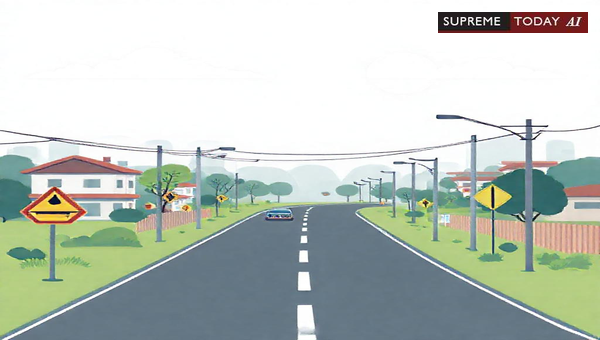
Legal Criteria for Determining Whether a Housing Colony Road Qualifies as a Public Road
The distinction between a public road and a private road within a residential colony often leads to significant legal disputes, especially regarding maintenance responsibilities, access rights, and land valuation. The core of the conflict usually centers on whether a road, though located within a specific housing development, has transitioned into the public domain through government investment or official designation.
A common question that arises in these disputes is: Road in Colony is Public Road when State Fund is Used in Making that Road? Understanding the answer requires an analysis of funding sources, maintenance records, and the jurisdiction of municipal authorities.
The Impact of State Funding on Road Status
Generally, the use of government resources is a primary indicator of a road's status. When a road in a colony is constructed using state funds, it is typically recognized as a public road 2017 0 Supreme(Mad) 2991 and 1997 0 Supreme(Raj) 1210. However, funding alone may not be the sole deciding factor; the road must also be designated or maintained as such by relevant authorities 2017 0 Supreme(Mad) 2991.
In the context of infrastructure development, the legal recognition of a road as public is often tied to the procedure followed during its creation. For instance, the construction of roads or over-bridges (ROBs) that are funded by the state and executed following proper legal procedures typically qualifies those structures as public 2016 0 Supreme(Mad) 621 and 2017 0 Supreme(HP) 1021. Conversely, if a road is built through unauthorized or illegal construction, even if it is located within a colony, such a road does not automatically confer public status and may instead lead to legal actions against the builders 02100022073.
Distinguishing Public Roads from Private Society Roads
Not every road within a residential layout is public. Many colonies operate as private entities where the internal infrastructure is managed by a resident welfare association or a private society.
Roads that are not maintained by the government or officially designated as public—such as those belonging solely to private societies or individuals—are categorized as private roads 2017 0 Supreme(Mad) 2991. A critical legal distinction is found in the maintenance record: a road belonging to a society and not maintained by the corporation is not deemed a public road 2017 0 Supreme(Mad) 2991.
To determine if a street within a colony has public status, courts often look at whether the street falls under the jurisdiction of municipal authorities and is recognized under relevant legislation, such as the Corporation Act 1971 0 Supreme(Del) 143. Internal roads that are maintained privately do not qualify as public roads unless there is an explicit designation by the municipal authority or a statutory order.
Land Valuation and the Kuchha Road Distinction
The classification of a road also plays a pivotal role in land acquisition and compensation disputes. The nature of the road—whether it is a pucca (tarred) road or a kuchha (unpaved) road—can affect how the land is valued.
In certain land acquisition cases, courts have noted that while a kuchha road may be a public road, it may not be given the same weight as a major highway or a fully developed internal road in a hypothetical layout. For example, it has been observed that a kuchha road cannot be given more importance than an internal road in hypothetical layout when determining compensation under the Land Acquisition Act 2011 0 Supreme(Bom) 1169. This indicates that while a road may be public in terms of access, its physical development and classification impact its legal and economic valuation.
Zoning, Urban Planning, and Legal Conversions
The status of a colony road is not always static. Urban planning and statutory changes can alter the legal nature of a road over time. When colonies are converted from residential to commercial zones or other types of zones under statutory provisions, the roads within those colonies may either retain or lose their public status 1997 0 Supreme(Raj) 1210. These changes are typically governed by government orders and the outcomes of specific legal proceedings.
Furthermore, the distinction between public and private layouts is crucial when dealing with illegal encroachments. In cases involving private layouts, the authority of government officials to regularize constructions may be limited. It has been held in some instances that a Chief Minister does not have the authority to issue directions to regularize constructions in private layouts 2015 0 Supreme(Bom) 937, emphasizing that the legal regime governing public land differs sharply from that of private developments.
Public Interest and Road Congestion
The classification of a road as public also brings it under the purview of wider public interest laws. For instance, requirements regarding abutting road width and car parking are strictly enforced on public roads to prevent congestion on public roads causing severe inconvenience to the public at large 2006 0 Supreme(Mad) 2120. If a colony road is deemed public, the residents cannot unilaterally waive planning requirements that would otherwise impact the general public's movement.
Key Takeaways for Identifying Road Status
To determine whether a colony road is legally a public road, the following factors are generally considered:
- Funding Source: Was the road constructed using state or municipal funds?
- Maintenance: Is the road currently maintained by a government body or a private society?
- Official Designation: Is the road listed as a public street under the Corporation Act or other municipal laws?
- Legal Procedure: Was the road constructed following legal land-use and development procedures?
- Jurisdiction: Does the municipal authority exercise regulatory control over the road?
In conclusion, a colony road typically becomes a public road when it is constructed with state funds, officially recognized, and maintained by government authorities. Roads owned or maintained exclusively by private entities remain private unless explicitly designated otherwise by law. Because these determinations depend heavily on specific municipal records and court rulings, these general principles should be applied to the specific facts of each case.
#PropertyLaw #UrbanPlanning #PublicInfrastructure #MunicipalLaw