


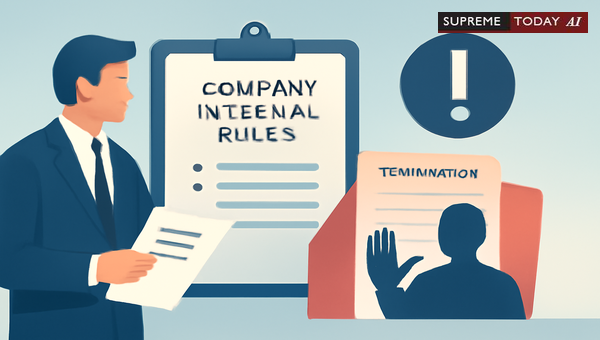
Company Failure to Follow Internal Rules: Is It ? Case Law Insights
In the high-stakes world of employment disputes, companies often craft detailed internal policies and disciplinary procedures to ensure fairness and efficiency. But what happens when a company ignores its own rules? Can this oversight doom disciplinary actions like terminations? This question—Case Law on Failure of Company to Follow its own Internal Rule is —lies at the heart of numerous judicial decisions. Courts have repeatedly emphasized that breaching self-imposed protocols can render decisions invalid, particularly if it signals bad faith or intent.
This blog post dives into key case law, primarily from Malaysian jurisdictions, while drawing relevant insights from other sources. We'll explore the legal principles, exceptions, and practical recommendations. Note: This is general information based on case law and not specific legal advice. Consult a qualified attorney for your situation.
Main Legal Finding: Non-Compliance Can Be
Case law consistently holds that a company's failure to adhere to its own internal rules or disciplinary procedures—especially when mandated by policies or handbooks—can be to the validity of actions like terminations. Courts view such lapses as evidence of or bad faith, undermining the legitimacy of the decision.
For instance, in
, the court observed that the company's failure to follow its disciplinary procedure before issuing a termination was 'clear evidence of ' and rendered the termination invalid. Similarly,
reiterated that ignoring prescribed procedures amounts to acting in bad faith, as internal rules in the Employee Handbook are binding.
This principle reinforces and . When major penalties are imposed without proper inquiry, the order is due to non-observance.
Key Points from Landmark Cases
- Non-compliance to terminations: Breaches invalidate disciplinary actions.
- Indicates : Failure suggests ill motive, making actions suspect.
- Binding nature of handbooks: Explicit procedures must be followed.
- Arbitrary actions: Breaches lead to findings of arbitrariness.
- Judicial reinforcement: Non-adherence vitiates measures.
Detailed Judicial Analysis
Mandatory vs. Directory Rules
Courts distinguish between mandatory and directory internal rules. Mandatory ones, explicitly prescribed, demand strict compliance; failure is typically . In
, deviation from the Employee Handbook was a breach invalidating the action. Echoing this,
held that skipping proper enquiry for major penalties creates a procedural defect.
This aligns with broader principles where internal rules ensure fairness. As noted in company law texts referenced in
, the presumes proper internal procedures but doesn't excuse breaches of mandatory contractual or policy requirements.
Insights from Comparative Cases
While Malaysian cases form the core, international precedents highlight universal themes. In 2021 Supreme(US)(scotus) 458, the U.S. Supreme Court scrutinized a categorical rule where failure to present certain evidence was ' to the petitioner’s claims', underscoring procedural rigidity in legal claims.
Federal agency contexts further illustrate: Agencies must 'follow the law', and substantive rules like the ' Flaw memo' require proper issuance, or they're invalid. 2023 Supreme(US)(ca5) 129 2023 Supreme(US)(ca5) 130
In Sri Lankan law, failure to comply with procedural rules is ' to the reception of the appeal', deeming them imperative.
Even in employment,
clarifies that failure to hold a formal domestic inquiry isn't always , but context matters—no fixed rule defines misconduct justifying dismissal.
Exceptions and Limitations
Not every lapse dooms a company's action. Courts apply nuance:- No prejudice to employee: If no harm results and no , actions may stand.
- Procedural vs. substantive: Substantive violations more likely .
- Mandatory vs. directory: Only mandatory rules typically invalidate.
For example, internal irregularities in management disputes don't always invalidate transactions unless is shown.
In
, skipping formal inquiry wasn't at the Industrial Court level.
Broader sources note: Failure to exhaust internal procedures can bar claims, like in ERISA cases, but only if mandatory. Mandatory notice failures under civil rules are .
Practical Recommendations for Companies
To safeguard decisions:- Strict adherence: Follow disciplinary procedures rigorously.- Justify deviations: Document reasons without bad faith signs.- Assess prejudice: Evaluate employee impact before acting.- Prioritize fairness: Embed to bolster defensibility.
Companies invoking the for third-party protection must still honor internal mandates.
Conclusion and Key Takeaways
In summary, case law establishes that a company's failure to follow its own internal rules—particularly in disciplinary matters—can be , especially evidencing . Malaysian courts lead with precedents like
,
, and
, while global cases reinforce procedural sanctity.
Key Takeaways:- Adhere to policies to avoid invalidation.- Distinguish mandatory rules to gauge risk.- Document compliance to counter claims.- Seek legal review for deviations.
By prioritizing internal protocols, companies mitigate risks in an era of heightened judicial scrutiny. Stay compliant—your rules aren't just guidelines; they're your shield.
(Word count: 1028. References are illustrative of principles; full cases provide context.)
#EmploymentLaw, #CompanyPolicies, #CaseLawInsights














