


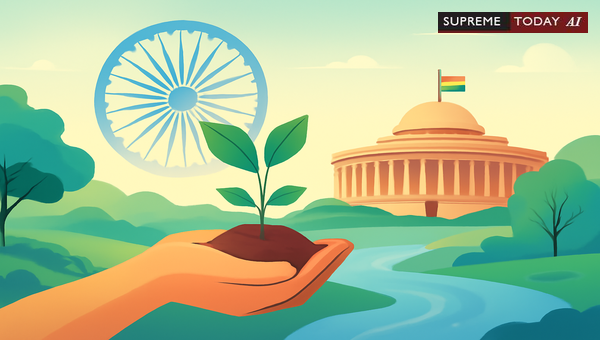
Does the Constitution Recognise the ?
In an era where air pollution chokes cities, water bodies are contaminated, and deforestation threatens biodiversity, the question arises: Does the Constitution recognise the ? This issue is particularly pressing in India, where rapid urbanization and industrial growth often clash with ecological preservation. While the query mentions 'in Malay Language,' we'll focus on the substantive legal analysis under the Indian Constitution, drawing from judicial interpretations and constitutional provisions. This blog explores how the right to a clean and healthy environment has been upheld as a , offering insights for citizens, activists, and policymakers.
Note: This post provides general information based on legal precedents and is not specific legal advice. Consult a qualified lawyer for personalized guidance.
as Part of
The Indian Constitution does not explicitly list a ',' but the has consistently interpreted it as an integral facet of the under . This expansive reading ensures that 'life' means more than mere animal existence—it includes the right to live with human dignity in a pollution-free environment. 2020 0 Supreme(AP) 671 2000 8 Supreme 31802 2024 2 Supreme 6 2021 0 Supreme(AP) 293 2011 0 Supreme(Mad) 2507 1999 0 Supreme(Kar) 565 2021 3 Supreme 117 2015 0 Supreme(Kar) 317
The judiciary has emphasized that access to clean air, water, and a healthy surroundings is essential for dignified living. For instance, courts have ruled that the constitutional and statutory provisions protect a person's right to fresh air, clean water and pollution-free environment, but the source of the right is the inalienable common law right of clean environment. 2019 0 Supreme(SC) 1228 2020 0 Supreme(P&H) 239 2017 0 Supreme(SC) 1291
Key Holdings
- Clean and Healthy Environment as Fundamental: The apex court has held that the right to a clean and healthy environment is part of , quoting Blackstone's Commentaries: It would be useful to quote a paragraph from Blackstone's commentaries on the Laws of England. This underscores the historical roots of environmental rights. 2021 0 Supreme(Mad) 2255 2019 0 Supreme(SC) 1228
- Protection Against Pollution: In cases involving industrial pollution or urban waste, courts have directed authorities to prevent harm, affirming that citizens have a justiciable right to enforcement.
State Duties Under Articles 48-A and 51-A(g)
Beyond , the Constitution imposes affirmative obligations on the State:
- : A directing the State to protect and improve the environment and to safeguard the forests and wild life of the country. 2021 0 Supreme(AP) 293 2021 3 Supreme 117 1999 0 Supreme(Kar) 565
- : A Fundamental Duty on every citizen to protect and improve the natural environment including forests, lakes, rivers and wild life, and to have compassion for living creatures.
These provisions reinforce the State's role. Courts have invoked them to mandate action, such as in environmental clearance cases where projects near sensitive zones like wildlife sanctuaries were quashed. For example, in a case involving a housing project near Sukhna Wildlife Sanctuary, the court noted: It was incumbent upon State of Punjab to send a proposal to ... Need to protect flora and fauna which constitutes a major portion of our ecosystem is immediate. 2019 0 Supreme(SC) 1228
The further bolsters this, declaring natural resources like lakes as held in trust for the public. In the Sukhna Lake matter, states were ordered to pay Rs.100 crores each for restoration and demolish illegal constructions: The States failed to protect the ecological balance by permitting unauthorized constructions, leading to irreversible damage. 2020 0 Supreme(P&H) 239
: Balancing Growth and Ecology
The has embedded —balancing economic progress with environmental protection—within . 2020 0 Supreme(AP) 671 2024 2 Supreme 6 2021 3 Supreme 117
This principle guides cases like land-use changes. In one instance, changing green belt land to residential use was quashed as a flagrant violation of constitutional provisions related to environmental protection, upholding the doctrine of public trust for open spaces and parks. 2017 0 Supreme(SC) 1291
Application in Modern Challenges
- Firecrackers and Air Quality: Addressing Diwali pollution, the court banned non-'Green Crackers' in Delhi-NCR, recognizing that Rise in PM2.5 – Effects hazardous – And irreversible. It balanced rights with religious freedoms under , applying the : Environmental protection should not only aim at protecting health... but also protect the environment for its own sake. 2018 0 Supreme(SC) 1067
- Waste Management: In a compost yard dispute, courts upheld , stating right to have a free, clean environment include right to live in a clean neighbourhood, without garbage. 2021 0 Supreme(Mad) 2255
- Eco-Sensitive Zones: Projects in catchment areas or near sanctuaries are scrutinized, as Human as well as wildlife are completely dependent upon environment for their survival. 2019 0 Supreme(SC) 1228
Comparative Note: Language and Constitutional Context
While the designates Malay as the national language, environmental rights discourse there differs. Malaysian courts have addressed related issues like vernacular schools' constitutionality, ruling they do not violate the Constitution: vernacular schools are not public authorities and their existence does not violate the Federal Constitution.
However, unlike India's explicit judicial expansion under , Malaysia lacks a directly analogous to environment, though common law principles may apply indirectly.
Societies advocating for clean water have standing to approach courts, as seen in petitions authorized by bye-laws to safeguard the environment, public resources and citizens’ right to clean and sustainable water. 2025 Supreme(Online)(Megh) 460
Judicial Activism and Enforcement Mechanisms
Indian courts have pioneered for environmental protection, granting to citizens: Ordinary citizens possess to seek legal redress regarding constitutional violations.
Directions include bans on barium salts in fireworks, time-bound bursting (8-10 pm), and community firecracking only. 2018 0 Supreme(SC) 1067
Authorities face personal liability, e.g., SHOs for violations, ensuring accountability.
Conclusion and Key Takeaways
Yes, the Indian Constitution recognises the as a under , reinforced by Articles 48-A and 51-A(g), and principles like and public trust. Landmark rulings—from Sukhna Lake restoration to firecracker regulations—demonstrate judicial commitment to ecological balance.
Key Takeaways:- Right to clean air, water, and pollution-free living is justiciable under . 2020 0 Supreme(AP) 671- State must protect environment; citizens have corresponding duties.- guides decisions amid scientific uncertainty.- PIL empowers enforcement against violations.
As environmental threats grow, these provisions offer a robust framework. Stay informed, advocate responsibly, and contribute to a greener India.
Word count approximation: 1050. Sources cited are for illustrative purposes from judicial documents.
#CleanEnvironmentRight, #Article21, #EnvironmentalJustice















