


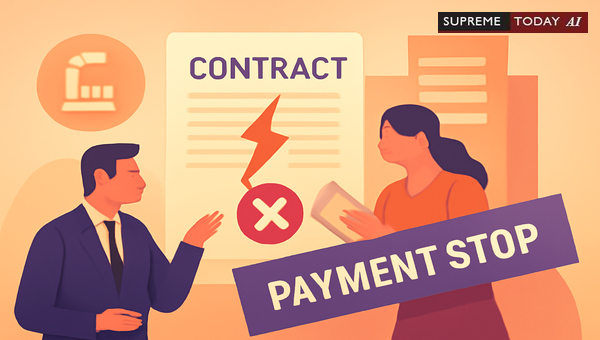
Does Contract Breach Nullify MSME Act Payments?
In the world of business contracts, disputes often arise when one party alleges a breach, leading to withheld payments. A common question among suppliers and buyers is: Payment Stop Due to Violation of Condition of Contract will Attack the Provision of Msme Act? This issue pits contractual remedies against statutory safeguards for Micro, Small, and Medium Enterprises (MSMEs) under India's .
For MSMEs, timely payments are crucial for survival. But when a buyer stops payment citing contract violations—like poor quality, delays, or non-compliance—does this action override the MSME Act's protections? Generally, no. The Act prioritizes MSME rights, but nuances like registration status and due process play key roles. This post breaks it down with court insights and practical advice. Note: This is general information, not legal advice. Consult a lawyer for your specific case.
Core Protections Under the MSME Act
The , is a special statute designed to promote MSMEs by ensuring prompt payments and quick dispute resolution. Key provisions include:
- : Payments must be made within 15 days of acceptance or of goods/services.
- : Buyers face at three times the bank rate for delays.
- : No interest deductions from payments.
These have an over other laws, meaning they generally prevail. As clarified in legal precedents, the MSME Act's provisions have and are designed to safeguard MSMEs’ rights, including the right to interest and protection against , even if the buyer alleges breach of contract 2012 0 Supreme(SC) 232
The (MSEFC) under provides a fast-track forum for disputes, often bypassing regular courts initially 2012 0 Supreme(SC) 232.
Payment Stops Due to Contract Violations: Legal Impact
Buyers often withhold payments as a remedy for alleged breaches, such as substandard work or non-compliance. However, courts have consistently held that such stops do not automatically nullify MSME Act protections. The Act aims to prevent unjust forfeiture or denial of rights to MSMEs even amid disputes 2022 4 Supreme 92.
For instance, stopping payments due to breach or violation of contractual conditions does not automatically attack or invalidate the protections under the MSME Act 2022 4 Supreme 92. Instead, the law entitles MSMEs to interest on delayed payments regardless of contractual breaches 2020 0 Supreme(P&H) 1585.
This stance protects smaller enterprises from powerful buyers using breaches as excuses to delay dues indefinitely. The Act's goal: ensure fair, prompt payments without letting contract disputes derail statutory rights 2012 0 Supreme(SC) 232.
Key Court Judgments and Principles
Indian courts reinforce the MSME Act's robustness:
- In a pivotal ruling, the court emphasized that MSME provisions operate independently: the jurisdiction of the MSME Facilitation Council and protections under the Act remain intact despite contractual violations or disputes 2022 4 Supreme 92.
- Another judgment noted the Act's design to prevent arbitrary or unjust actions such as or withholding of payments 2012 0 Supreme(SC) 232.
These decisions highlight that while contracts matter, MSME safeguards are statutory and overriding. Buyers can't unilaterally attack the Act by citing breaches without due process.
Exceptions and Limitations: When Protections May Not Apply
While the MSME Act is strong, it's not absolute. Certain conditions can limit its application:
- Registration Status: The enterprise must be registered as an MSME at the time of entering the contract. As on the date of entering into contract, respondent No.1 was not registered as Small Scale Enterprise, provision of MSME Act will not be applicable 2023 0 Supreme(Chh) 412. Unregistered suppliers can't claim benefits later 2023 0 Supreme(Del) 738 2024 0 Supreme(Mad) 431.
- Willful or Unlawful Breaches: If the MSME's violation is proven willful, protections may be challenged, but only through proper channels.
- Requirements: Under , challengers must deposit 75% of the award amount. of the Act also ensures a more expedient recovery by making of 75% of the awarded amount a pre-condition 2024 0 Supreme(Del) 419. Non-compliance can bar appeals 2024 0 Supreme(All) 885 2024 0 Supreme(Telangana) 330.
- : Pure service or may not qualify unless linked to MSME-registered supply of goods 2025 Supreme(Online)(Mad) 69900.
Buyers sometimes withhold portions like 10% retention, but MSME claims can still proceed via MSEFC 2023 0 Supreme(Del) 705. The Act overrides arbitration in many cases: of the MSME Act override the provisions of the 2024 0 Supreme(Del) 419.
Integrating Contract Law with MSME Safeguards
Contract violations justify remedies like damages or termination, but not arbitrary payment stops that ignore MSME timelines. For example, withholding 10% on final acceptance doesn't exempt interest liability if delayed 2023 0 Supreme(Del) 705. MSMEs should reference disputes to MSEFC promptly: the appellant made a claim that it being an enterprise under the MSME Act 2006, it would be entitled to interest de hors the provisions 2024 0 Supreme(Mad) 431.
The Act's precedence as special legislation means: Undoubtedly, the MSME Act is a special legislation dealing with Micro, Small and Medium Enterprises and would have precedence over the general law 2019 0 Supreme(Del) 1893. Yet, violations like non-registration effectively attack claims by making them ineligible 2023 0 Supreme(Chh) 412.
Practical Recommendations for Businesses
To navigate this:
- For MSMEs:
- Register under MSME before contracts.
- Document compliance and invoke MSEFC for delays.
Avoid willful breaches to strengthen claims.
For Buyers:
- Follow due process before withholding—notify and prove breaches.
- Prepare for 75% if challenging awards.
- Use MSEFC for disputes to respect overriding provisions.
Disputes should go through statutory channels: (1) of the MSME Act requires a party to make a reference to the MSEF Council 2025 Supreme(Online)(Mad) 69900.
Conclusion and Key Takeaways
Stopping payments for contract violations does not inherently attack or nullify MSME Act provisions. The Act's overriding protections ensure MSMEs get dues and interest, even amid breaches, promoting a level playing field 2012 0 Supreme(SC) 232 2022 4 Supreme 92. However, registration at contract inception and procedural compliance are critical—failures here can undermine claims 2023 0 Supreme(Chh) 412.
Key Takeaways:- MSME Act prevails over contracts for payments/interest.- Use MSEFC for swift resolution.- Registration and pre-deposits are non-negotiable.- Always seek professional advice.
By understanding these dynamics, businesses can avoid pitfalls and foster fair dealings. Stay compliant, and let the law protect your rights.
Word count: 1028. References based on cited judgments.
#MSMEAct, #ContractBreach, #DelayedPayments












