


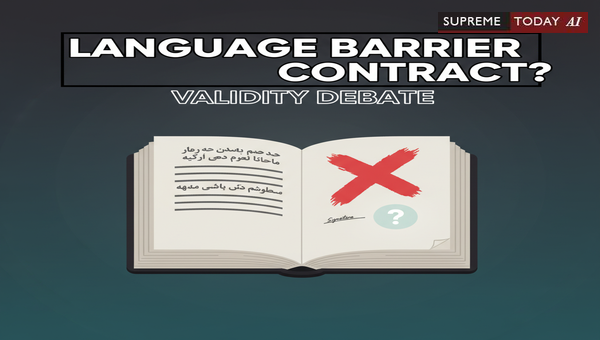
Does Signing in Another Language Mean No Understanding?
In today's globalized world, contracts and legal documents are often signed across language barriers. But does simply signing a document in a language you don't speak automatically mean you didn't understand its contents? This question——lies at the heart of many contract disputes. Understanding this principle can protect your rights or help you avoid costly litigation.
This blog post dives into the legal nuances, drawing from established principles like the plea of . We'll explore key requirements, real-world applications, and insights from various judgments. Note: This is general information, not legal advice. Consult a qualified attorney for your specific situation.
Understanding the Plea of
The defense of (Latin for it is not my deed) is a powerful tool in contract law. It allows a signatory to challenge a document's validity if they were fundamentally mistaken about its nature when signing. However, this plea is not easily granted and comes with strict requirements. 2023 7 Supreme 508
Key Requirements for a Successful Plea
To succeed with , the following must typically be proven:
: The signatory must belong to a class of persons who, through no fault of their own, cannot understand the document's purpose due to blindness, illiteracy, or another disability. 2023 7 Supreme 508
: There must be a about the document's contents and practical effects. 2023 7 Supreme 508
: The signed document must be radically different from what the signatory intended to sign. 2023 7 Supreme 508
The rests squarely on the party raising the defense. Mere carelessness or failure to read does not suffice—courts emphasize personal responsibility in signing documents. 2023 7 Supreme 508
A common misconception is that signing in a foreign language alone voids the contract. Legal documents clarify that . 2020 2 Supreme 499 2024 1 Supreme 250
Factors like misspelling the signatory's name or an unusual signing style may indicate lack of understanding, but they are not decisive on their own. 2024 1 Supreme 250
This principle underscores that signing represents assent to the terms, not just a mechanical act. As one source notes: ... . 2023 Supreme(Online)(Mad) 73025
Insights from Case Law and Judgments
Courts worldwide have repeatedly distinguished between the act of signing and true comprehension, especially in multilingual contexts.
Signing vs. Understanding English
Multiple judgments highlight: and it cannot be said that if one signs in English, therefore he has full understanding of the language. ... It is pointed out that the mere signing of documents in English does not automatically translate to the detenue having a working knowledge of English.
2022 0 Supreme(Del) 1219 2022 Supreme(Online)(DEL) 3972
This reinforces that language alone doesn't presume comprehension. Similarly, in Rameshwar Prasad (): and .
Evidence of Comprehension
Understanding can be shown through verbal, non-verbal responses, or prior explanations. In a will case: Lawyer Tan (DW1), the solicitor who prepared the will, said he had read and explained the will to him, and he indicated his understanding through verbal and non-verbal responses.
Conversely, language barriers may require translations: The Appellant also contends that due to his inability to read and understand the English language, he required a Sinhala translation of the Agreement, which was not given to him. 2025 Supreme(SRI)(SC) 9743
Practical Implications in Contracts
In contract execution: Moreover, by signing the agreement the plaintiff immediately became bound to complete the work within six months from that date. This clause strongly supports the argument that the contract automatically became operative as soon as the plaintiff signed the document.
Courts look at context—prior knowledge, explanations, or conduct—to determine if assent was informed.
Application to Real-World Scenarios
Consider a business owner signing a supplier agreement in English, despite primarily speaking Hindi. Without evidence of disability, , or a , the plea would likely fail. The language difference alone isn't enough. 2020 2 Supreme 499 2024 1 Supreme 250
Instead, courts examine:- Signatory's Capabilities: Literacy, prior exposure to the language.- Explanations Provided: Was the document read or translated?- Circumstances of Signing: Pressure, haste, or unusual signatures (e.g., misspellings). 2024 1 Supreme 250- Post-Signing Conduct: Actions consistent with understanding the terms.
One case notes: It is but strange that a person who is conversant and signing in the english language would have signed another document in urdu; normal trend, conduct and human nature suggests that a person would continue to sign in the same language. 2010 0 Supreme(Del) 578
These factors ensure fairness while upholding contract sanctity.
Broader Legal Context
Related concepts include execution meaning more than signing: . 2023 Supreme(Online)(Mad) 73025
In consumer or patent disputes, mere expectations or inventions don't automatically alter validity, mirroring the need for evidence beyond superficial indicators. 2023 0 Supreme(Del) 8451
Affidavits often clarify: I do sign in English but text /pleadings caused by my Counsel are explained to me in Punjabi language for proper understanding before signing. 2016 0 Supreme(Del) 1929
Key Takeaways
- Language Isn't Decisive: Signing in a different language doesn't automatically imply non-understanding. Focus on elements. 2020 2 Supreme 499 2023 7 Supreme 508
- Burden on Claimant: Prove disability, mistake, and radical difference. 2023 7 Supreme 508
- Seek Explanations: Always ensure documents are explained, especially across languages, to avoid disputes.
- Evidence Matters: Verbal confirmations, conduct, and context build or refute understanding.
In conclusion, while language barriers pose risks, courts prioritize evidence of comprehension over the signature's script. This balanced approach protects vulnerable parties without undermining contractual reliability. For personalized guidance, reach out to a legal professional.
#NonEstFactum #ContractLaw #LegalSignatures















