


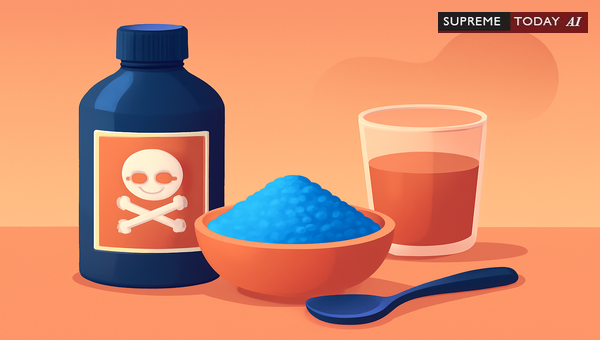
Is Possession of Copper Sulphate a Crime in India?
In the world of chemicals and agriculture, copper sulphate is a common substance used as a fungicide and pesticide. But what happens when law enforcement questions its possession? Many individuals, from farmers to industrial workers, wonder: Whether Possession of Copper Sulphate is a Crime under Indian law. The answer isn't a simple yes or no—it's nuanced, depending on context, intent, and usage.
This blog post dives deep into the legal landscape, drawing from court judgments, statutes like the , and real-world cases. We'll clarify when possession is lawful and when it crosses into criminal territory. Note: This is general information based on legal precedents and not specific legal advice. Consult a qualified lawyer for your situation.
Legal Classification of Copper Sulphate
Copper sulphate, a blue crystalline compound, has legitimate applications in agriculture, industry, and water treatment. Under Indian law, it is explicitly recognized as an insecticide and fungicide. The , lists it in its Schedule, allowing regulated possession and use for pest control.
For instance, packaging and labeling evidence confirms its status as a pesticide
. Courts have affirmed this: copper sulphate is classified as an insecticide and fungicide (1987 0 Supreme(Ker) 264'>'1987 0 Supreme(Ker) 264',
'>'
') 1987 0 Supreme(Ker) 264. In tax exemption cases, its second sale was held exempt when used lawfully as a pesticide 1987 0 Supreme(Ker) 264.
Similarly, authorities granting exemptions understand that copper sulphate is included in the expression 'insecticide/pesticide' 2004 0 Supreme(Kar) 324. This classification underscores that for authorized purposes is typically permissible.
When Does Possession Become Criminal?
Possession alone does not constitute a crime. Criminal liability arises only with evidence of unlawful intent or use. Key principles from courts:
- Lawful Contexts: Used as a preservative, pesticide, or in manufacturing—possession is legal. or use of copper sulphate as a preservative or pesticide is lawful 2022 0 Supreme(Gau) 1123.
- Unlawful Contexts: When deployed as poison, in illegal manufacturing, or trafficking.
The lies with the prosecution to show illegal purpose, not just possession 2023 0 Supreme(Del) 4924 1990 0 Supreme(Raj) 435. The law recognizes or involvement in certain cases... However, for general possession, the burden is on the prosecution to prove illegal intent 1987 0 Supreme(Ker) 264.
Copper Sulphate as Poison: Criminal Cases
Copper sulphate's toxicity makes it dangerous if misused. Administering it to cause harm is a crime under the , particularly sections on poisoning and voluntarily causing hurt.
In one case, the court held that administering copper sulphate with knowledge of its poisonous nature and causing harm amounts to an offence
. It recognized copper sulphate as a dangerous poison when intentionally given to harm 1987 0 Supreme(Ker) 264.
Scientific notes reinforce this: Copper sulphate is obtained by reaction of copper and sulphuric acid and it is a brilliant blue salt which readily diss... 2020 0 Supreme(Ker) 206, highlighting its solubility and detectability in forensic analysis.
Possession in Illicit Activities: Insights from Other Cases
Context matters greatly. Possession linked to crimes elevates it to offense:
Illicit Liquor Manufacturing: Copper sulphate appears in seized spurious liquor, mixed with harmful substances like furfural and urea. This leads to charges under the Excise Act and IPC. Courts deny bail in such cases due to its role in producing poisonous alcohol 2022 Supreme(Online)(MP) 178 2024 Supreme(Online)(MP) 51416 2024 Supreme(Online)(MP) 42522. Possession of Copper Sulphate in connection with illegal activities such as manufacturing or possessing spurious or poisonous liquor is considered a criminal offense.
Theft and Scrap: Cases involve copper scrap used to manufacture copper sulphate, but possession of the end product isn't criminal unless tied to theft or evasion 2008 0 Supreme(Ker) 439 2001 6 Supreme 319. The respondent-assessee purchased copper scrap for use in the manufacture of copper sulphate 2008 0 Supreme(Ker) 439; tax issues arose, not criminality per se.
Commercial and Partnership Disputes: Firms manufacturing copper sulphate operate legally, with disputes resolved civilly 2021 Supreme(Online)(KER) 41210. The firm was engaged in the manufacture and sale of copper sulphate—no inherent crime.
Regulated Products: In beverages like 'Tata Copper Water,' trace copper sulphate complies if labeled properly and meets standards 2023 Supreme(Online)(DEL) 12221 2025 Supreme(Online)(SCDRC) 2360. Environmental monitoring keeps copper levels in water ≤5 mg/L 2025 Supreme(Online)(NGT) 576.
Other snippets show non-criminal contexts, like metal theft involving copper pieces (not sulphate) 2023 0 Supreme(Gau) 94 2024 Supreme(Online)(AP) 16020, or solubility in forensics 2020 0 Supreme(Ker) 206.
Evidence and
Courts emphasize context:- Lawful Indicators: Proper registration, labeling, agricultural use
.- Criminal Indicators: Intent to poison, illicit mixing, lack of documentation.
Evidence of unlawful intent or activity is necessary to classify possession as a crime, not itself 1987 0 Supreme(Ker) 264. In sales tax matters, entries distinguish it as 'insecticides and pesticides' over general chemicals 1991 0 Supreme(Kar) 202.
Recommendations for Compliance
To avoid issues:- For Users (Farmers, Businesses): Maintain registration under Insecticides Act, proper labeling, and documentation of legitimate use.- For Authorities: Prove unlawful intent beyond possession—examine context, traces, witness statements.- General Advice: Store securely, use PPE, dispose per environmental norms.
Key Takeaways and Conclusion
Possession of copper sulphate is not inherently a crime under Indian law. It's lawful for agriculture (pesticide/fungicide), industry, and regulated products 1987 0 Supreme(Ker) 264
. Criminality emerges in poisoning
, illicit liquor 2022 Supreme(Online)(MP) 178, or proven unlawful intent 2022 0 Supreme(Gau) 1123.
Summary Points:- Recognized under —lawful for approved uses.- IPC applies to misuse as poison.- Prosecution must evidence illegal purpose.- Contexts like spurious liquor make possession criminal.
In conclusion, context is king. Lawful possession supports India's agricultural needs; misuse invites penalties. Stay informed, compliant, and consult professionals for specifics. This analysis draws from precedents like 1987 0 Supreme(Ker) 264,
,
, ensuring a balanced view. #CopperSulphateLaw, #IndianCriminalLaw, #LegalIndia















