SupremeToday Landscape Ad
AI Thinking

AI Thinking...

Searching Case Laws & Precedent on Legal Query.....!

Scanned Judgements…!

Checking relevance for Harish Kumar Khurana VS Joginder Singh...

2022 3 Supreme 517 : In cases where the first medical opinion is not conclusive, the court must direct for a second medical opinion. The document establishes that when there is no medical evidence on record to establish negligence, the mere reliance on a magisterial enquiry or personal perception is insufficient. The court emphasized that in cases involving medical negligence, especially where the treatment fails or the patient dies, the adjudicating authority cannot automatically assume negligence. Instead, the court must rely on expert medical evidence. The document explicitly states that ''''To indicate negligence there should be material available on record or else appropriate medical evidence should be tendered.'''' Furthermore, it clarifies that ''''the principle of res ipsa loquitur could be made applicable and not based on perception'''' only when the negligence is so glaring. The court also noted that ''''the very questions raised by the NCDRC at issue Nos.2 to 7 would indicate that in the present fact situation the first operation performed by the same team of doctors in the same hospital was successful and the unfortunate incident occurred when the second operation was scheduled. Hence what was required to be determined was whether medically, the second operation could have been conducted or not in that situation and whether the medical condition of the patient in the present case permitted the same.'''' This confirms that when the first medical opinion is not conclusive, the court must seek a second medical opinion to determine the medical facts, as the adjudicating authority is not an expert in medicine and cannot form an independent medical opinion without expert evidence.Checking relevance for Ram Swaroop VS State of Rajasthan...

Checking relevance for Ramanand Yadav VS Prabhu Nath Jha...

Checking relevance for Union of India VS Ram Prakash...

Checking relevance for Shyam VS State Of M. P. through P. S. Bercha...

Checking relevance for Umesh Singh VS State of Bihar...

2013 3 Supreme 457 : When a medical opinion is not conclusive or is inconsistent with other credible evidence, particularly ocular evidence, the court is not bound to accept it as final. The court must independently assess the credibility and consistency of all evidence, including medical opinions, and may reject a non-conclusive medical opinion if it lacks logic, objectivity, or probability. In such cases, the court may direct the taking of a second medical opinion if the first is found to be inconclusive or unreliable, especially when it conflicts with credible eyewitness testimony. This principle is grounded in the established legal doctrine that medical opinions are not the ''''last word'''' and must be tested by the court for their probative value and consistency with the overall evidence.Checking relevance for SATYA NARAIN SINGH VS U. P. PUBLIC SERVICE TRIBUNAL...

2007 0 Supreme(All) 1888 : Under Subsidiary Rule 96(b) of the Leave Rules, in cases of illness necessitating leave beyond one month, the sanctioning authority should obtain a second medical opinion from the authorised medical attendant, except in cases covered by Clause (c). The rule mandates that a second medical examination be arranged on the earliest possible date after the first medical opinion. This indicates that when the first medical opinion is non-conclusive or when leave exceeds one month, the authority is required to seek a second medical opinion. Furthermore, the rule implies that the court or authority may direct the obtaining of a second medical opinion if the first is deemed non-conclusive, particularly in cases where the illness is prolonged or the nature of the condition is uncertain. The requirement for a second medical opinion is not discretionary in such cases and must be followed to ensure proper assessment of the employee''''s medical condition.Checking relevance for St. John''''s English Primary School, Mohan Nagar VS Education Officer, (Primary), Zilla Parishad...

Checking relevance for St. John’s English Primary School VS Education Officer, (Primary), Zilla Parishad, Nagpur...

2020 0 Supreme(Bom) 114 : Under the relevant rules, if the authority competent to sanction leave determines that a second medical opinion is necessary, it may, at its discretion, secure a second medical opinion by arranging for the applicant to be medically examined by a qualified medical officer (such as a Superintendent in Government Medical Hospitals, Civil Surgeon, District Medical Officer, or Medical Officer of Zilla Parishads, Municipal Councils, or Municipal Corporations). The second medical examination must be conducted on the earliest possible date after the first medical opinion was given. The authority must forward the original medical certificate to the medical officer conducting the re-examination. This provision establishes a procedural mechanism for obtaining a second medical opinion when deemed necessary by the competent authority, and implies that the court or authority may direct such a second opinion if the first is found to be non-conclusive.Checking relevance for Rajan VS State of Kerala...

2004 0 Supreme(Ker) 581 : If the genuineness of a medical certificate under Rule 117 of Part I Kerala Service Rules is doubted, the competent authority must first require the applicant to obtain a second medical opinion from a Civil Surgeon, District Indigenous Medical Officer, or Chief Medical Officer (as applicable), as per Rule 118(a). Only if the second medical opinion is also found unacceptable may the case be referred to the Medical Board. The court held that directing the petitioner directly to obtain a Medical Board opinion—without first securing a second medical opinion from a Civil Surgeon—was a procedural error and not in accordance with the rules. Therefore, when the first medical opinion is not conclusive or its genuineness is doubted, the court must direct the applicant to obtain a second medical opinion before considering referral to a Medical Board.


AI Overview

AI Overview...

  • Necessity of Second Medical Opinion - Main points and insights Courts have emphasized that in cases involving medical negligence or complex medical issues, a first medical opinion alone may not suffice for conclusive determination. Judicial authorities are often advised to direct for a second independent medical opinion to ensure fairness and accuracy. For instance, the Supreme Court and various High Courts have highlighted that before any opinion could be rendered by the Medical Board...the accused/Non-Applicants approached this Court under Section 482 of the CrPC, assailing the order of cognizance...a complaint alleging criminal medical negligence by doctors should not ordinarily set the criminal law in motion, unless an independent opinion is sought ["2026 Supreme(Online)(Del) 1253"]. Similarly, the Supreme Court in Sunita and Ors. (2023) stated that to hold a medical practitioner liable for negligence, a higher threshold limit must be met...the expert ‘Medical Board’ opinion...established that the surgery performed...has no direct nexus to the complications ["

    Ratanmani Kesharwani VS Rajshekhar Krishna - Consumer

    "]. This underscores the importance of obtaining an independent medical assessment to substantiate claims of negligence or liability.
  • Legal standards and judicial approach Courts recognize that medical opinions can vary and should be evaluated for supportability and consistency. The ALJ's duty includes assessing the persuasiveness of medical opinions, especially when multiple opinions exist ["2025 Supreme(US)(ca7) 58"]. Moreover, courts have consistently held that the opinion of an expert being a guide to Court, it is the Court which must come to its own conclusion and that the Court is not justified in delegating its function to an expert ["2022 Supreme(SRI)(CA) 440"]. When there is a dispute or ambiguity, courts often remand cases for fresh medical opinions or direct independent medical examinations, reinforcing the principle that a conclusive medical opinion is essential before legal determinations are made ["1999 0 Supreme(Kar) 394"], ["

    Ratanmani Kesharwani VS Rajshekhar Krishna - Consumer

    "].
  • Judicial directives for second opinion Several judgments affirm that courts should not rely solely on initial medical opinions, especially in criminal or negligence cases, but must direct for a second or independent medical opinion when necessary. For example, in Ranjit Ahlawat (2012), the Court remanded the case for further enquiry under Section 202 Cr.P.C. and directed obtaining a medical opinion from a competent doctor or Medical Board ["2024 0 Supreme(Gau) 1706"]. Similarly, the Supreme Court has observed that the power to direct such tests must be exercised with utmost circumspection and only when the interests of justice imperatively demand such a procedure ["2026 1 Supreme 435"]. This approach aims to prevent miscarriage of justice and ensure that medical evidence is thoroughly examined through independent expert assessment.

Analysis and ConclusionThe collective legal perspective from the cited judgments underscores that in cases involving medical issues, especially allegations of negligence or complex diagnoses, courts are mandated to seek a second medical opinion to avoid reliance on potentially biased or inconclusive initial opinions. The courts' role is to independently evaluate medical evidence, and when there is any doubt or conflicting opinions, they must direct for an additional, independent medical assessment. This process safeguards the rights of both parties and promotes just and accurate adjudication. Therefore, the court must explicitly direct for a second medical opinion whenever the first opinion is non-conclusive or contested, aligning with principles laid down in Supreme Court and High Court judgments ["2026 Supreme(Online)(Del) 1253"], ["

Ratanmani Kesharwani VS Rajshekhar Krishna - Consumer

"], ["1999 0 Supreme(Kar) 394"].
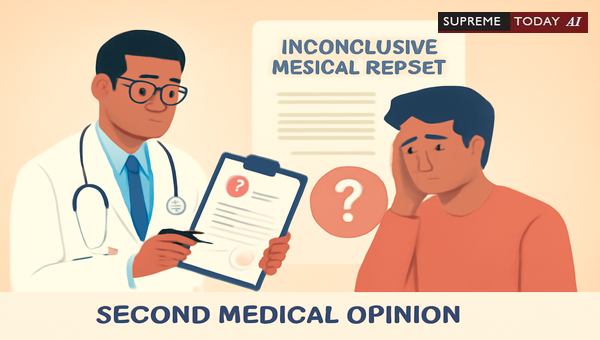
Judicial Authority to Mandate Second Medical Opinion on Doubtful Medical Certificates

When Courts Must Order Second Medical Opinion

In legal proceedings involving medical evidence, such as leave applications, negligence claims, or fitness assessments, the reliability of medical opinions is paramount. But what happens when the first medical opinion is non-conclusive? Does the court have a duty to direct a second one? This question often arises in disputes over medical certificates' genuineness or credibility, particularly under rules like the Kerala Service Rules (KSR).

This blog explores the legal framework, procedures, and judicial insights ensuring courts avoid arbitrary decisions based on doubtful medical evidence. We'll draw from key rulings and rules to provide clarity for litigants, professionals, and authorities.

Understanding the Core Legal Issue

The question at hand is straightforward yet critical: first medical opinion non conclusive court must direct for second medical opinion. Generally, yes—when a medical opinion lacks clarity, credibility, or raises reasonable doubt, courts typically must order a second opinion to uphold fairness and objectivity. This principle prevents miscarriage of justice and ensures decisions rest on reliable evidence. 2020 0 Supreme(Bom) 114

As outlined in relevant documents, a single inconclusive opinion is insufficient for final judgments, especially in cases tied to employment, negligence, or service rules. Courts play a pivotal role in scrutinizing such evidence, testing its genuineness before proceeding.

Key Legal Principles on Medical Opinions

Legal precedents emphasize that medical opinions must be clear, credible, and based on proper examination. If doubts persist:

  • The court has a duty to ensure reliability of medical evidence.
  • A first opinion that is not conclusive or appears doubtful triggers the need for a second one.
  • This aligns with procedural rules mandating sequential steps before escalation, like referral to a Medical Board. 2004 0 Supreme(Ker) 581

For instance, in 2020 0 Supreme(Bom) 114, the court clarified: > If the genuineness of the medical certificate produced under R.117 of Part I K.S.R, is doubted, it is only open to the authority to require the applicant to produce a second medical opinion under R.118(a) of the rules.

This underscores that courts cannot rely solely on a suspicious initial certificate; a second opinion is the mandated first recourse.

Procedure for Second Medical Opinion

The process is explicitly detailed in service rules, providing a structured path:

  1. Initial Challenge: When a certificate from an Assistant Surgeon (or equivalent) is produced and its genuineness is doubted, the authority may request a second opinion. 2007 0 Supreme(All) 1888

  2. Who Conducts It?: The second examination is typically by a Civil Surgeon or equivalent medical officer. Quote from 2007 0 Supreme(All) 1888: > In the case of certificate issued by an Assistant Surgeon...the authority competent to sanction leave may at its discretion, secure a second medical opinion by requesting a Civil Surgeon...to have the applicant medically examined.

  3. Timing: Arrange the second exam at the earliest possible date after the first. 2007 0 Supreme(All) 1888

  4. Escalation: Only if the second opinion also raises doubts, refer to a Medical Board. Direct jumps to a Board without a second opinion violate rules. 2004 0 Supreme(Ker) 581

This stepwise approach, rooted in 2007 0 Supreme(All) 1888 and 2004 0 Supreme(Ker) 581, ensures thoroughness without undue delay.

The Court's Role and Duty

Courts must scrutinize medical evidence proactively. If the first opinion is ambiguous, inconsistent, or suspicious, they are obliged to direct a second one. Failure to do so risks arbitrary or biased outcomes.

In 2020 0 Supreme(Bom) 114, the directive was clear: > If the genuineness of the medical certificate furnished in support of the leave seems to be bogus, you are directed to obtain and forward a second medical opinion from a Medical Board. (Note: This follows after initial doubts, reinforcing the sequence.)

Similarly, 2004 0 Supreme(Ker) 581 stresses: Proceeding directly to a Board skips the proper second-opinion step, making it procedurally flawed.

Insights from Related Cases on Medical Evidence

This principle extends beyond service rules into broader contexts like medical negligence and evidence evaluation, where courts often grapple with conflicting or inconclusive opinions.

  • Medical Negligence: In 2023 0 Supreme(Bom) 1141, courts noted: > There can be a genuine difference of opinion. Yet, for criminal liability under IPC Section 304A, gross negligence requires balanced scrutiny, not blind reliance on one view. Courts quashed FIRs absent prima facie gross negligence, highlighting the need for reliable opinions.

  • Conflicting Expert Views: Cases like 2024 0 Supreme(P&H) 238 affirm: > Before an inference of medical negligence is drawn, the court must hold not only existence of negligence but also omission or commission... Prima facie evidence justified proceedings despite no initial expert testimony, but multiple stages (like surgeries) were probed deeply.

  • Non-Conclusive Medical Proof: In age-determination under POCSO (2021 0 Supreme(Raj) 1285), medical opinions aren't conclusive alone: > The medical opinion is not conclusive proof of the age. Courts consider school records, favoring the accused if two views exist.

  • Review Medical Boards: 2025 Supreme(Online)(Raj) 15845 allows ignoring subsequent minor variations if the first board's opinion holds, but re-examination is possible post-review. 2024 Supreme(Online)(CAT) 4526 directed independent boards when initial fitness opinions were contested.

  • Disability and Fitness: 2022 0 Supreme(Bom) 139 involved retracted opinions, where courts intervened without second-guessing experts but ensured procedural fairness under RPwD Act.

These cases illustrate courts' consistent approach: Inconclusive or doubted medical evidence warrants further opinion, balancing expertise with justice.

In negligence defenses (2024 0 Supreme(MP) 637), higher criminal proof standards demand robust evidence; a single doubtful opinion falls short.

Exceptions and Limitations

Exceptions are narrow:- If the first opinion is unequivocally clear and credible, no second is needed.- Routine directions without prima facie doubt (e.g., paternity DNA tests in 2016 0 Supreme(HP) 1449) are avoided; strong cases only.

However, when ambiguity exists, courts typically must act to prevent errors.

Recommendations for Courts and Parties

  • Routinely direct second opinions for challenged certificates.
  • Adhere strictly to rules like R.117-118 KSR. 2007 0 Supreme(All) 1888 2004 0 Supreme(Ker) 581
  • Seek independent, cross-examinable sources for objectivity.
  • In negligence or fitness disputes, document doubts clearly before escalation.

Conclusion and Key Takeaways

When the first medical opinion is non-conclusive, doubtful, or not credible, courts generally must direct a second opinion to safeguard justice. This procedural safeguard, enshrined in rules and rulings like 2020 0 Supreme(Bom) 114, 2007 0 Supreme(All) 1888, and 2004 0 Supreme(Ker) 581, promotes reliable evidence and fair outcomes.

Key Takeaways:- Challenge doubtful certificates via second opinions from Civil Surgeons.- Courts scrutinize but don't substitute medical judgment—follow sequences.- Broader applications in negligence and evidence reinforce this duty.

This post provides general information based on cited sources and is not legal advice. Consult a qualified lawyer for specific cases.

References

  1. 2020 0 Supreme(Bom) 114: Duty for second opinion on doubted certificates.
  2. 2007 0 Supreme(All) 1888: Procedure for Civil Surgeon exam.
  3. 2004 0 Supreme(Ker) 581: Proper sequence before Medical Board.
#SecondMedicalOpinion, #CourtMedicalDuty, #LegalMedicalEvidence
Chat Download
Chat Print
Chat R ALL
Landmark
Strategy
Argument
Risk
Chat Voice Bottom Icon
Chat Sent Bottom Icon
SupremeToday Portrait Ad
logo-black

An indispensable Tool for Legal Professionals, Endorsed by Various High Court and Judicial Officers

Please visit our Training & Support
Center or Contact Us for assistance

qr

Scan Me!

India’s Legal research and Law Firm App, Download now!

For Daily Legal Updates, Join us on :

whatsapp-icon Back to top