


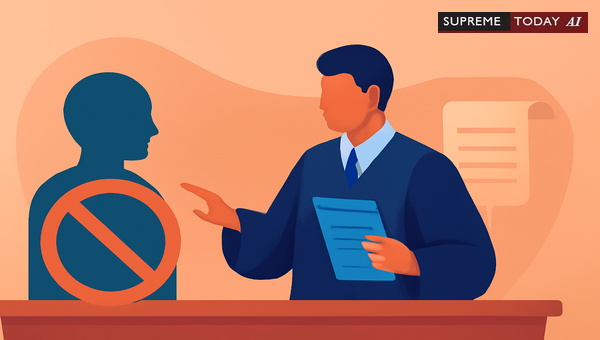
Can Courts Drop Witnesses in Civil Cases?
In the realm of Indian civil litigation, courts wield significant discretion to manage proceedings efficiently. A common query arises: In a civil case, can the court drop witnesses listed by the parties? This question touches on judicial powers under the , particularly Order XVI dealing with summoning and attendance of witnesses, and the court's under . While parties typically decide on witnesses, courts may intervene to prevent abuse and ensure justice.
This post delves into the grounds, limitations, and precedents for such actions. Note: This is general information based on legal principles and cases; it is not legal advice. Consult a qualified lawyer for case-specific guidance.
Relatedly, questions like In Domestic Violence Act if Aggrieved does Not Pray for Protection Order Whether Court can Pass that Order highlight broader powers in special statutes like the , where courts may grant reliefs proactively under Section 23. Similar discretionary principles apply across civil matters, including witness management.
Legal Framework for Actions
Indian courts possess to act (on their own motion) to meet the ends of justice, prevent , and promote efficiency. Under , courts can make orders necessary for justice not inconsistent with the Code. While CPC does not explicitly address dropping witnesses , principles from (rejection of plaint), (striking pleadings), and witness summoning provisions (Order XVI) inform this discretion.
Courts typically exercise this after framing issues or during evidence stage, ensuring only relevant testimony proceeds. As noted, Courts possess to ensure justice and prevent . This includes the ability to drop witnesses if their presence is deemed unnecessary for a fair trial 2021 0 Supreme(Raj) 1044 2021 0 Supreme(Raj) 1043 2021 0 Supreme(Raj) 544.
Key Grounds for Dropping of Witnesses
Courts may drop witnesses on several well-established grounds. Here's a breakdown:
Lack of Relevance: Testimony must pertain to pleaded facts and issues. Irrelevant witnesses waste court time. Courts assess during evidence stage if proposed evidence links to material issues.
Absence of Material Evidence: If a witness offers no substantial proof impacting case outcome, they may be dropped. This aligns with evidence admissibility under the .
Misuse of Process: Listing frivolous or harassing witnesses to delay or intimidate is abuse. Courts act to curb this, as the court can act to prevent the misuse of judicial processes. If it appears that the inclusion of certain witnesses is intended to harass or delay proceedings, the court may drop them 2021 0 Supreme(Raj) 1044.
: Prolonged trials burden the system. Dropping redundant witnesses promotes efficiency, especially in high-volume civil courts.
and Fair Trial: Broad discretion ensures fairness. For instance, The court can exercise this power either or upon the grounds spelt out in the application of the prosecution or the accused, provided the Magistrate is satisfied that recall or reexamination of a witness, or examination of any person as a witness is essential to the just decision of the case. This section confers a wide discretion on the court to act as the exigencies of justice require 2015 0 Supreme(Bom) 1900. Though from a criminal context, analogous to civil.
Additional grounds from precedents include:- Lack of Timely Exercise: power is to be exercised within a reasonable period 2024 Supreme(Online)(Telangana) 47837 2024 Supreme(Online)(Tel) 42741. Delays undermine fairness.- No Prescribed Time Limit but Reasonableness: Courts avoid stale actions; exercising after decades is unjustified 2024 Supreme(Online)(Telangana) 47471 2024 Supreme(Online)(Telangana) 49155.
Limitations and Procedural Safeguards
powers are not absolute:
Judicial Discretion Must Be Judicious: Cannot be arbitrary; reasoned orders preferred. Parties get hearing opportunity, upholding .
Opportunity for Parties: Generally, notice and arguments allowed before dropping. Parties involved in the case should generally be given an opportunity to present their arguments regarding the inclusion or exclusion of witnesses 2021 0 Supreme(Raj) 1043.
Legal Precedents Guide: Consistency via prior rulings. In civil suits, unlike criminal where jury abandonment diluted some principles, courts rely on discretion 2024 0 Supreme(Chh) 373.
Procedural Fairness: Dropping without notice or on unreasonable grounds may be set aside. Propriety and caution demands that before initiating suo-moto proceedings... 2018 0 Supreme(P&H) 425 2018 0 Supreme(P&H) 130.
Inapplicability in Certain Contexts: Not for committing cases to sessions without basis 2024 Supreme(Online)(Kar) 37110 2024 Supreme(Online)(KAR) 23282.
Integrating Other Contexts: Contempt and Special Cases
powers shine in contempt: Unlike the cases of where normally it is the aggrieved party which seeks initiation of contempt proceedings, in cases of the proceedings are generally initiated suo-moto by the Court 2018 0 Supreme(P&H) 425. This underscores proactive judicial role.
In land assignment civil suits, High Courts limit to reasonable periods 2024 Supreme(Online)(Telangana) 47837. Similarly, for witness dropping, timeliness matters.
Practical Tips for Litigants
- Prepare Witness Lists Carefully: Justify relevance in applications under .
- Anticipate Scrutiny: Courts increasingly focus on efficiency post-COVID backlogs.
- Seek Review if Dropped: File applications under Section 151 or appeal.
Conclusion and Key Takeaways
Yes, courts can drop witnesses in civil cases on grounds like irrelevance, lack of material evidence, misuse, and , guided by and discretion 2021 0 Supreme(Raj) 1044 2021 0 Supreme(Raj) 1043 2021 0 Supreme(Raj) 544. However, exercise is cautious, with fairness paramount.
Key Takeaways:- Prioritize relevant, material witnesses.- actions promote efficiency but require justification.- Timeliness and notice are crucial.
For Domestic Violence Act scenarios, courts may analogously use discretion for protection orders, emphasizing victim protection. Stay informed on evolving jurisprudence.
References:- 2021 0 Supreme(Raj) 1044 2021 0 Supreme(Raj) 1043 2021 0 Supreme(Raj) 544- 2024 Supreme(Online)(Telangana) 47837 2024 Supreme(Online)(Kar) 37110 2015 0 Supreme(Bom) 1900 2018 0 Supreme(P&H) 425
#SuoMotoPowers #CivilLawIndia #LegalBlog












