


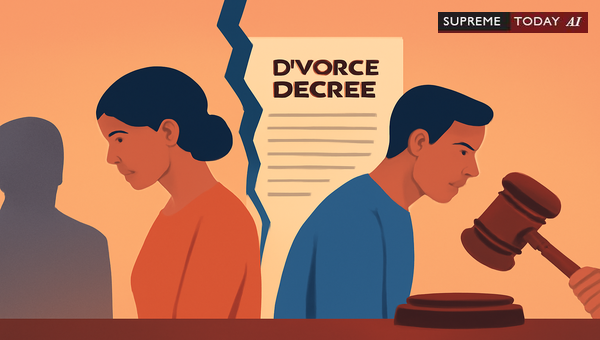
Key Cross-Examination Points for Husband's Divorce Under Special Marriage Act
Divorce proceedings under the can be emotionally charged, especially when the husband seeks a decree based on cruelty by the wife. A common question arises: Which points have to be reflected in the cross-examination for granting the divorce decree in favour of the husband in terms of the Special Marriage Act? This blog explores the critical elements, drawing from established legal principles to help understand how courts evaluate such cases. Note that this is general information and not specific legal advice—consult a qualified lawyer for your situation.
Understanding Cruelty as a Ground for Divorce
Under , cruelty—whether physical or mental—is a valid ground for divorce. The petitioner's conduct must be proven , making it unreasonable for the spouses to live together. Courts emphasize that the wife's behavior should cause or to the husband. 2023 0 Supreme(Del) 6038
Cross-examination plays a pivotal role in substantiating these claims. It must elicit admissions or contradictions from the wife that confirm specific instances of cruelty, going beyond mere allegations. The goal is to demonstrate persistence, severity, and impact on the husband's mental peace.
Legal Standard of Proof in Matrimonial Cases
Matrimonial disputes are civil in nature, requiring proof on a , not . As noted in judicial precedents, matrimonial cases are civil in nature and will be standard of proof in trial of Matrimonial cases under and not proof which is applicable in criminal trials. 2023 0 Supreme(Pat) 985 Though this references the , the principle applies analogously to the Special Marriage Act due to similar provisions on cruelty.
Key Points to Reflect in Cross-Examination
Effective cross-examination focuses on concrete evidence rather than generalities. Here are the primary points, supported by legal findings:
- Conduct: Establish that the wife's actions are so severe that the husband cannot reasonably be expected to live with her. 2023 0 Supreme(Del) 6038
- Mental or Physical Harm: Prove conduct causing , distress, or a . Trivial irritations do not qualify—the conduct must be such that it inflicts , distress, or torture, and should be more than ordinary disagreements or irritations.
- Persistence and Unjustifiability: Highlight a pattern of behavior affecting the husband's safety and peace. 1988 0 Supreme(Cal) 273
- Specific Instances of Cruelty: Probe verbal abuse, neglect, false accusations, or denial of conjugal rights. 2023 4 Supreme 492
Detailed Cross-Examination Strategies
1. Instances of Verbal Abuse or Insults
Question the wife on specific episodes of vulgar language or derogatory remarks causing distress. Cross-examine the wife on any allegations of vulgar language, insults, or derogatory remarks that caused mental distress. 2005 1 Supreme 626
2. Neglect and Indifference
Elicit details on her failure to support during illness or emotional neglect, which courts view as cruelty. 2007 3 Supreme 26
3. False Allegations and Malicious Acts
Confront her with false claims of infidelity or misconduct, as these inflict .
4. Denial of Conjugal Rights
Establish deliberate refusal of intimacy or cohabitation, amounting to cruelty. 2023 4 Supreme 492
5. Overall Impact
Demonstrate a hostile environment leading to anxiety: the conduct created a hostile environment, leading to , which the court recognizes as a basis for divorce. 1988 0 Supreme(Cal) 273
These points align with Supreme Court observations that cruelty is a question of fact and degree, depending on its effect on the complaining spouse. Cruelty may be physical or corporeal or mental... Ultimately, it is a matter of inference to be drawn by taking into account nature of conduct and its effect on complaining spouse. 2023 0 Supreme(Pat) 985
Insights from Related Case Law
While focused on the Special Marriage Act, principles from analogous cases under other personal laws reinforce these strategies. For instance, courts reject divorce where cruelty isn't proven through specific evidence, emphasizing no advantage from one's own wrong. In one ruling, a spouse cannot take advantage of his or her own wrong by maltreating the other spouse and driving them out of the matrimonial home, and then seeking divorce on the grounds of cruelty and desertion. 1996 0 Supreme(P&H) 848
In ex parte proceedings or restoration applications, proper service and cross-examination evidence are crucial, as seen where summons service led to upholding a divorce decree. 2024 0 Supreme(Del) 358
Moreover, must be distinguished from ordinary wear and tear: Mere trivial irritations, quarrels between spouses, which happen in day-to-day married life, may also not amount to cruelty. 2023 0 Supreme(Pat) 985 Cross-examination should avoid generalities, focusing on corroborated instances to meet the preponderance standard.
Under the Special Marriage Act, appeals under highlight the need for robust cross-examination, as incomplete evidence can lead to reversals. 2024 0 Supreme(Del) 358
Exceptions and Common Pitfalls
Not all conduct qualifies: trivial quarrels or mutual disagreements fail. The behavior must be . Delays in filing or lack of corroboration weaken cases, as in instances where husbands waited years without proof, leading to denials. 2023 0 Supreme(Pat) 985
Courts also scrutinize ulterior motives, ensuring no self-induced separation. Evidence beyond pleadings is inadmissible, underscoring preparation. 2023 0 Supreme(Pat) 749
Practical Recommendations for Cross-Examination
To strengthen the husband's case:- Prepare Specific Incidents: List dates, witnesses, and impacts.- Establish Pattern: Show repetition over time.- Highlight Distress: Use medical records or witness testimonies.- Corroborate: Leverage documents or third-party accounts.
These steps ensure the court finds the conduct , justifying dissolution. 2023 0 Supreme(Del) 6038
Conclusion and Key Takeaways
In summary, cross-examination under the Special Marriage Act for a husband's divorce decree hinges on proving the wife's cruelty through grave, persistent acts causing mental harm. By focusing on specific, evidenced instances like abuse, neglect, and false claims, advocates can build a compelling case. Remember, each matter turns on facts—courts apply flexibly but demand substance over rhetoric.
Key Takeaways:- Prioritize 's proof over trivia.
- Use targeted questions for admissions.- Integrate precedents for persuasive arguments.
For personalized guidance, reach out to a family law expert. This overview aims to inform, not advise.
References:- 2023 0 Supreme(Del) 6038,
,
, 1988 0 Supreme(Cal) 273, 2023 4 Supreme 492, 2005 1 Supreme 626, 2007 3 Supreme 26, 2023 0 Supreme(Pat) 985, 2024 0 Supreme(Del) 358, 1996 0 Supreme(P&H) 848 #SpecialMarriageAct, #DivorceCruelty, #FamilyLawIndia












