
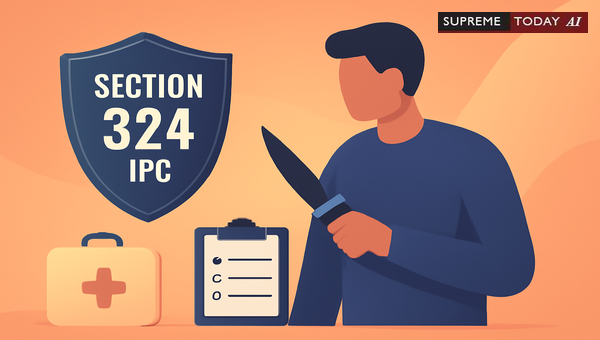
SupremeToday Landscape Ad
AI Thinking

AI Thinking...

Searching Case Laws & Precedent on Legal Query.....!

Scanned Judgements…!

Checking relevance for Kuldip Yadav VS State of Bihar...

Checking relevance for Rekha VS State of Maharashtra...

Checking relevance for Dinesh Kumar VS State of Rajasthan...

Checking relevance for Birbal Nath VS State Of Rajasthan...

Checking relevance for Dalip Singh VS State Of Punjab...

Checking relevance for Mahavir Singh VS State of Haryana...

Checking relevance for Mukesh Singh VS State of Uttar Pradesh...

Checking relevance for Shoukkath, S/o Moidunny VS State Of Kerala...

2020 0 Supreme(Ker) 247 : Under CrPC Section 231(2) the court may defer or recall a witness for further cross‑examination, and the accused must avail this right; failure to do so precludes a claim of prejudice. CrPC Section 157(1) obliges the investigating officer to send a report ‘forthwith’ when he suspects a cognisable offence. The judgment also highlights that a delay in the FIR reaching the court undermines the trustworthiness of the investigation and can be used to question the investigating officer about manipulation of the First Information Report, political pressure, and the timeliness of the report. These provisions can form the basis of cross‑examination of the investigating officer in an IPC 324 case.Checking relevance for Krishna Lal Agrawal, S/o Late Gouri Shankar Lal Agrawal VS State of Jharkhand...

Checking relevance for Vakil VS State of Haryana...

Checking relevance for Baljinder Singh @ Kaka VS State of Punjab...

Checking relevance for Mayandi VS State of Tamil Nadu...

2019 0 Supreme(Mad) 3402 : The judgment details the cross‑examination of the Investigation Officer in an IPC‑324 case, highlighting key lines of questioning that can be used:1. Did you file a charge‑sheet in this matter? (He admitted he had not filed any charge‑sheet.)2. Did you recover the alleged weapon (the aruval) used in the assault? (He admitted the weapon was not recovered.)3. Did you examine any independent or neighboring land‑owner witnesses regarding the incident? (He admitted no independent witnesses were examined.)4. Did you record the prior complaint lodged by the first accused and was a referred charge‑sheet served on him? (He could not confirm service of the referred charge‑sheet.)5. Did you personally accompany the constable to the hospital and verify the injury of the first accused? (He confirmed accompanying but did not produce related documents.)6. Did you obtain any blood‑stained cloth or other forensic evidence from the first accused? (He admitted receiving a blood‑stained cloth but no further forensic analysis.)7. Did you investigate the motive, including the alleged long‑standing enmity between parties? (He acknowledged the enmity as a motive.)These points can form the basis of a thorough cross‑examination of the Investigation Officer to challenge the prosecution’s case under Section 324 IPC.Checking relevance for Rabikant Murmu VS State Of Jharkhand...

Checking relevance for Rohit Sahota VS State of Punjab...

Checking relevance for Ambika Prasad VS State (Delhi Administration)...

Checking relevance for Manish Dixit: Devender K. Sharma: State Of Rajasthan VS State Of Rajasthan: State Of Rajasthan: Sharad Dhakar Alias Bantu...

Checking relevance for Ramesh Kumar @ Babla VS State of Punjab...

Checking relevance for Mukesh Singh VS State (Narcotic Branch of Delhi)...

2020 8 Supreme 19 : The investigation officer, even if he is also the informant/complainant, is treated as a witness and is subject to cross‑examination. To challenge his testimony in an IPC‑324 case you should focus on establishing any bias or prejudice, inquire into the procedures he followed during the investigation, and question whether his dual role affected the fairness of the inquiry. The courts have held that bias must be proved on facts and that the officer’s testimony can be relied upon only if it is shown to be free from prejudice.Checking relevance for Rajendra Shantaram Todankar VS State Of Maharashtra...

Checking relevance for Rakesh VS State Of Haryana...


AI Overview

AI Overview...

  • Section 324 IPC - Main Points and Insights:
  • The offence under Section 324 IPC involves voluntarily causing hurt using dangerous weapons or means likely to cause death 2024 0 Supreme(Ker) 500, 2025 0 Supreme(Ker) 1414.
  • In several cases, courts have examined whether the injuries caused qualify as hurt under Section 324 or grievous hurt under Section 325, with some cases noting that the ingredients of hurt and grievous hurt overlap, and Section 324 can be considered a minor offence compared to Section 307 or 325 2024 0 Supreme(Kar) 95, 2024 0 Supreme(Ker) 500.
  • The weapon used, injuries sustained, and intent are crucial for framing charges under Section 324.
  • Courts have also considered whether the weapon was recovered and whether injuries were simple or grievous, impacting the classification of the offence 2023 0 Supreme(Del) 341, 2024 0 Supreme(Ker) 500.

  • Analysis and Conclusion:

  • The legal interpretation of Section 324 IPC centers around voluntary hurt caused by dangerous means, with courts differentiating it from grievous hurt (Section 325) or attempted murder (Section 307).
  • Many judgments emphasize that if injuries are simple and caused with a dangerous weapon, conviction under Section 324 is appropriate.
  • The courts have also scrutinized whether the facts justify framing charges under Section 324 or require more serious charges like Section 307 or 302, based on injury severity and intent.
  • In cases where injuries are minor or the weapon not recovered, courts tend to uphold convictions under Section 324, viewing it as a lesser but distinct offence from grievous hurt or attempt to murder.

References:- 2024 0 Supreme(Ker) 500, 2025 0 Supreme(Ker) 1414, 2024 0 Supreme(Kar) 95, 2023 0 Supreme(Del) 341

Strategic Cross-Examination in Section 324 IPC Proceedings for Hurt by Dangerous Weapons

Cross-Examination Questions for Section 324 IPC: A Comprehensive Guide

In the realm of Indian criminal law, Section 324 of the Indian Penal Code (IPC) addresses serious allegations of voluntarily causing hurt by dangerous weapons or means. If you're a lawyer defending a client charged under this section, crafting the right cross-examination questions can make all the difference in challenging the prosecution's case. A common query from legal professionals is: Question for Cross in 324 Ipc—highlighting the need for targeted questions to probe intent, weapon nature, injuries, and witness credibility.

This blog post dives deep into Section 324 IPC, offering practical cross-examination strategies, key legal principles, and insights from landmark cases. Whether you're preparing for trial or seeking to quash proceedings, understanding these elements is crucial. Note: This is general information and not specific legal advice. Consult a qualified lawyer for your case.

Understanding Section 324 IPC: The Basics

Section 324 IPC punishes voluntarily causing hurt using instruments likely to cause death, such as firearms, knives, or acids. It is punishable with imprisonment up to three years, or fine, or both. Importantly, post the 2005 Cr.P.C. amendment, it is a non-compoundable offence—meaning the victim cannot simply settle it out of court without court permission. 2013 0 Supreme(UK) 246 2014 0 Supreme(UK) 174

The offence hinges on three core ingredients:- Voluntary act: The accused must intend to cause hurt.- Dangerous weapon or means: Defined as anything likely to cause death (e.g., gun, sword). 2024 0 Supreme(Ker) 500 2025 0 Supreme(Ker) 1414- Hurt caused: Simple hurt suffices; grievous hurt falls under Section 325 IPC.

Courts differentiate it from graver offences like Section 307 (attempt to murder) or Section 326 (grievous hurt by dangerous means). For instance, The question arises for consideration is whether the act of the appellants falls within the ambit of Section 307 of IPC or 324 IPC.

Anil Kumar Singh @ Pappu VS State of U. P. - Allahabad

Key Legal Principles Governing Section 324 IPC

Non-Compoundable Nature and Court Discretion

Prior to 2005, Section 324 was compoundable with court permission. Now, it's generally non-compoundable, but courts retain discretion to quash FIRs or proceedings if it secures justice and prevents abuse of process. This stems from precedents like Kulwinder Singh's case, emphasizing compromise in non-compoundable offences. 2009 0 Supreme(P&H) 1337

Differentiation from Related Sections

  • Vs. Section 307 IPC: If intent to murder is absent and injuries are simple, Section 324 applies.

    Anil Kumar Singh @ Pappu VS State of U. P. - Allahabad

  • Vs. Section 326 IPC: Section 326 requires grievous hurt, while 324 covers simple hurt. It is to be pointed out that Section 326 IPC is similar to Section 324 IPC... The only difference is that the words 'Grievous Hurt' were substituted for the term 'Hurt' in Section 324. 2014 0 Supreme(Mad) 2078
  • Common with Section 34 (Common Intention): Often charged alongside, as in cases questioning if Section 34 attracts conviction under 304 Part-II & 324 IPC. 2024 0 Supreme(Chh) 738

In cross-cases, like one under Sections 324, 326 IPC, prior enmity or mutual altercations are probed. 2024 0 Supreme(Guj) 1610

Effective Cross-Examination Questions for Section 324 IPC

Cross-examination under Section 324 should dismantle the prosecution's narrative on intent, weapon, injuries, and circumstances. Here are suggested questions, categorized for strategic use:

1. Probing Intent and Knowledge

  1. Can you describe your actions leading up to the incident? What was your intention at that moment?
  2. Were you aware that the object you used could cause serious injury?

These elicit admissions of self-defense or lack of mens rea (guilty mind).

2. Nature of the Weapon

  1. What type of weapon or means did you use during the incident?
  2. How did you acquire this weapon, and what was its intended use?

Challenge if the 'weapon' was innocuous or not 'dangerous'. Courts scrutinize recovery of weapons. 2023 0 Supreme(Del) 341

3. Injury Assessment

  1. Can you explain the nature of the injuries sustained by the victim?
  2. Were you aware of the potential consequences of your actions on the victim's health?

Distinguish simple vs. grievous hurt: A single blow may, in some cases, entail conviction under Section 302 IPC, in some cases under Section 304 IPC and in some other cases under Section 326 IPC. 2024 0 Supreme(AP) 317

4. Witness Testimonies

  1. Are you familiar with the testimonies provided by witnesses regarding the incident?
  2. How do you respond to the claims made by witnesses about your behavior during the altercation?

Highlight inconsistencies, especially in cross-cases with enmity. 2022 4 Supreme 753

5. Compromise and Settlement

  1. Have you attempted to reach a compromise with the victim or their family regarding this incident?
  2. What steps have you taken to address the grievances of the victim?

Useful for quashing petitions, as courts consider settlements. 2009 0 Supreme(P&H) 1337

6. Prior Incidents and Context

  1. Have you been involved in any similar incidents in the past?
  2. How do you believe this incident compares to any previous altercations you may have had?

Reveal motives like land disputes. 2022 4 Supreme 753

Integrating Case Law Insights

Judgments emphasize evidence quality:- Weapon and Injuries: Conviction upheld if firearm injuries proven despite enmity. Thus, the charge of Section 324 IPC stands established against the two appellants. 2022 4 Supreme 753- Charge Framing: Courts amend charges to include Section 324 if facts fit. 2015 0 Supreme(Del) 2762- Punishment: Typically 1-3 years RI, as in multiple counts with Section 34. 2015 0 Supreme(Mad) 2125

Under BNS (replacing IPC), similar provisions apply: Reading Section 324 of IPC as well as under Section 118(1) of the BNS... 2024 0 Supreme(Ker) 1113

Strategies for Defense in Section 324 Cases

  • Self-Defense Plea: Argue under Section 96-106 IPC if provocation existed.
  • Quashing via High Court: Leverage compromise and discretion. 2013 0 Supreme(UK) 246
  • Medical Evidence: Cross-examine doctors on injury reports to downgrade severity.

Prepare for overlaps: If no grievous hurt, avoid escalation to 326/307. 2024 0 Supreme(Kar) 95

Conclusion and Key Takeaways

Mastering cross-examination questions for Section 324 IPC involves focusing on intent, weapon lethality, and contextual factors like compromise. While non-compoundable, courts may quash proceedings judiciously, offering defense avenues. 2009 0 Supreme(P&H) 1337 2013 0 Supreme(UK) 246

Key Takeaways:- Prioritize questions on voluntary intent and dangerous means.- Use medical/witness contradictions to weaken prosecution.- Explore settlements for quashing, citing precedents.- Differentiate from 307/326 based on injury intent.

Stay informed on evolving jurisprudence. For tailored advice, engage a criminal lawyer. This guide equips you with tools for robust defense in Section 324 IPC matters.

#Section324IPC, #CrossExamination, #IPCLaw
Chat Download
Chat Print
Chat R ALL
Landmark
Strategy
Argument
Risk
Chat Voice Bottom Icon
Chat Sent Bottom Icon
SupremeToday Portrait Ad
logo-black

An indispensable Tool for Legal Professionals, Endorsed by Various High Court and Judicial Officers

Please visit our Training & Support
Center or Contact Us for assistance

qr

Scan Me!

India’s Legal research and Law Firm App, Download now!

For Daily Legal Updates, Join us on :

whatsapp-icon Back to top







