Searching Case Laws & Precedent on Legal Query!
Scanned Judgements…!



Searching Case Laws & Precedent on Legal Query!
Scanned Judgements…!
Ownership of Property of Deity - When land or immovable property is dedicated to a deity under Hindu law, the full ownership automatically vests in the deity itself, which is treated as a juristic person or legal entity. The Shebait or manager does not hold ownership rights; instead, they act as trustees or administrators. Therefore, transfer or sale of such property by the Shebait is invalid unless explicitly authorized by law or religious statutes. 2023 0 Supreme(Ker) 549, 2025 Supreme(Bom) 756,
SUDARSAN DALEI vs STATE OF ORISSA - Orissa
, 2023 0 Supreme(Raj) 743, 2023 0 Supreme(Raj) 735Legal Status of Deity as a Perpetual Minor - Deities are considered perpetual minors, meaning they cannot directly hold or transfer property rights. Any attempt by a Shebait or manager to register property in their name or transfer it is legally invalid, and such properties remain trust or trust-like properties of the deity. Courts have consistently held that no individual can acquire khatedari or proprietary rights over properties dedicated to a deity, especially if such transactions are fraudulent or against public policy. 2023 0 Supreme(Raj) 743, 2023 0 Supreme(Raj) 735, 2023 0 Supreme(Ker) 549
Role of Revenue Records and Trustees - Revenue entries (e.g., in land records) are evidence of possession or claim but do not confer ownership rights. Altering revenue records does not transfer title; the true ownership remains with the deity. The management by Shebait or trustees is limited to administration and cannot override the deity's ownership. Any sale or transfer purportedly by the Shebait without lawful authority is invalid. 2025 Supreme(Bom) 756, 2023 0 Supreme(Raj) 1281, 2023 0 Supreme(HP) 385
Protection Against Fraudulent Transactions - Transactions entered into fraudulently by Pujaris or Shebaits that attempt to transfer deity property are legally void and against public policy. Courts have emphasized that the deity’s property cannot be deprived through such unlawful acts, and any such transactions can be challenged in courts. The law also protects the interests of minors or incapacitated entities, including deities, preventing transfer rights to third parties. 2023 0 Supreme(Raj) 1281, 2023 0 Supreme(Raj) 743, 2023 0 Supreme(Raj) 735
Legal Remedies and Suitability - In cases of wrongful transfer or possession, suits can be filed on behalf of the deity by worshippers or next friends, but courts generally do not deliver possession directly to individuals claiming rights unless proper legal title is established. The courts recognize the unique status of deity properties and restrict transfer rights accordingly. 2023 0 Supreme(HP) 385, 2023 0 Supreme(Raj) 2275
Analysis and Conclusion:A deity acquires title to immovable property automatically through dedication; the property becomes trust property owned by the deity as a juristic entity. The Shebait or manager acts as a trustee and cannot transfer or sell the property unless explicitly authorized by law or religious statutes. Any fraudulent or unlawful transfer attempts are deemed invalid, and courts uphold the deity’s ownership rights, emphasizing that revenue records or administrative acts do not alter the fundamental legal status. Protecting the deity’s property from unlawful transfers is a recognized legal principle, ensuring that title remains with the deity and that only lawful procedures can effect transfers or claims.
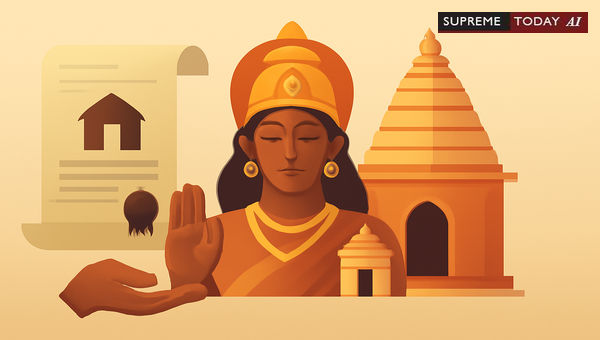
In the realm of Hindu law, deities hold a unique legal status that allows them to own property, much like human individuals or corporations. But how exactly can a deity acquire title to immovable property, such as land or temples? This question often arises in disputes over temple lands, family endowments, and religious trusts. Understanding this process is crucial for trustees, worshippers, and legal practitioners navigating property rights under Indian jurisprudence.
This article explores the mechanisms, legal protections, and limitations surrounding a deity's acquisition of immovable property title. While this provides general insights based on judicial precedents, it is not legal advice—consult a qualified attorney for specific cases.
A deity is recognized as a capable of holding property, including immovable assets like land. Courts have consistently affirmed this status, allowing deities to sue and be sued in their own name. For instance, deities are treated as legal entities with perpetual existence. 1997 0 Supreme(Raj) 730
However, deities are also deemed perpetual minors, meaning they cannot manage their affairs independently. They require a guardian, such as a (manager or trustee), to act on their behalf. This status underscores the need for strict oversight to prevent mismanagement. 2009 0 Supreme(Ori) 129 2014 0 Supreme(Ori) 9
As noted in judicial observations, the deity is a and disabled person and property belonging to such minor and disabled person... 2021 0 Supreme(Ori) 281 This protects the deity from unauthorized dealings, ensuring property remains safeguarded for religious purposes.
Deities can acquire title through several established legal avenues. Here's a breakdown:
One primary method is through issued directly in the deity's name. In the case of Kallalagar Archana Manibam, a title deed was executed in favor of the deity, firmly establishing ownership. Such documents provide clear, registrable proof of title under property laws. 2023 0 Supreme(Mad) 1061
Under Hindu law, immovable property dedicated to a deity vests automatically in the deity as full ownership. When land is offered via , the or manager serves merely as a trustee, not the owner. Ownership of Property of Deity - When land or immovable property is dedicated to a deity under Hindu law, the full ownership automatically vests in the deity itself, which is treated as a or legal entity. 2023 0 Supreme(Ker) 549 2025 Supreme(Bom) 756
Revenue records may reflect possession but do not confer title—true ownership lies with the deity. Altering such records does not transfer rights. 2025 Supreme(Bom) 756 2023 0 Supreme(Raj) 1281
Transactions must comply with statutes like the , which prohibits without authority. Courts recognize the deity's ownership, invalidating non-compliant transfers. 2023 0 Supreme(Mad) 1061
Gifts or transfers require proper registration under the . For example, Under no gift of immovable property having value of more than Rs. 100/- can be made by unregistered document and so the deity did not acquire any right, title and interest on the basis of Ext.-A. 2014 0 Supreme(Gau) 671
Deity property is heavily protected due to its status:
Even worshippers without personal interest can approach courts to safeguard the deity. 2015 0 Supreme(Ori) 106 Courts intervene to ensure dealings benefit the deity. 2023 0 Supreme(Mad) 1061 2009 0 Supreme(Ori) 129
Claims ignoring these protections, such as individual assertions over dedicated land, fail for lack of title documents. 2023 0 Supreme(Bom) 1665
Judicial intervention is pivotal. Courts can declare void and restore possession to the deity. Trustees and state bodies, like boards, oversee management to prevent squandering. 2021 0 Supreme(Ori) 281
In partition or inheritance disputes, temple property remains separate, unaffected by family divisions. 2023 0 Supreme(Bom) 1665
To navigate these complexities:- Document all endowments via registered deeds in the deity's name.- Conduct regular audits of property management for compliance.- Seek court approval for any , adhering to acts.- Engage legal experts in disputes, as even third parties may file protective suits. 2023 0 Supreme(HP) 385 2023 0 Supreme(Raj) 2275
In summary, while deities can hold immovable property, stringent legal frameworks ensure their assets serve religious perpetuity, not personal gain. For tailored guidance, professional legal counsel is essential.
References: 1997 0 Supreme(Raj) 730 2023 0 Supreme(Mad) 1061 2009 0 Supreme(Ori) 129 2014 0 Supreme(Ori) 9 2017 0 Supreme(Ori) 1404 2021 0 Supreme(Ori) 281 2016 0 Supreme(Bom) 1313 2015 0 Supreme(Ori) 106 2014 0 Supreme(Gau) 671 2023 0 Supreme(Ker) 549 2025 Supreme(Bom) 756 2023 0 Supreme(Raj) 743 2023 0 Supreme(Raj) 735 2023 0 Supreme(Bom) 1665 2023 0 Supreme(HP) 385 2023 0 Supreme(Raj) 1281
#DeityPropertyLaw, #HinduEndowments, #ImmovablePropertyTitle


In this case the petitioner would contend that respondents No. 12 and 13 although produced Exts.R12(d), R12(e) and R12(f), none of those documents would help them to show that the title to the said 65 cents of property was ever divested from the Deity. ... It is submitted that the Karam Ozhivu Property entered in the name of the Deity cannot be transferred. It may be noted that since the land belongs to t....

Thus, even if a Vahiwatdar gets the Devasthan Inam entry deleted, he does not acquire any right to sell or transfer the land. The land remains trust property, dedicated to the deity. ... (ix) A vahiwatdar cannot acquire ownership simply by getting the revenue records altered. Revenue records are only evidence of title, not title itself. Especially when revenue entries are modified contr....

property of the family deity and sentiment upon which the immovable property has deity desirous to transfer immovable property of the shifted from the title holder in favour of the deity, the immovable property may not be squandered in p style="position:absolute
property of the family deity and sentiment upon which the immovable property has deity desirous to transfer immovable property of the shifted from the title holder in favour of the deity, immovable property by way of endowment would span style="font-family:TimesNewRoman

The object is laudable and based on public policy and, therefore, the deity cannot be deprived of his property by such a transaction, which has fraudulently been entered upon by the Pujari himself. ... He further submits that since the Deity is a perpetual minor in respect of the properties held by it, no right, title or interest can accrue in favor of any transferee, under any circumstances whatsoever, therefore, the lear....
The object is laudable and based on public policy and, therefore, the deity cannot be deprived of his property by such a transaction, which has fraudulently been entered upon by the Pujari himself. ... It was also submitted that as per the settled proposition of law, the Deity is a perpetual minor and in respect of the properties held by it, no right, title or interest can accrue in favor of the any transferee; therefore, ....

However, where a suit is filed by a next friend on behalf of the deity itself, a problem arises: in a suit for the recovery of property on behalf of the idol, the court cannot deliver possession of the property to the next friend. ... The object is laudable and based on public policy and, therefore, the deity cannot be deprived of his property by such a transaction, which has fraudulently been entered upo....

It has nothing to do with the partition of the immovable property. He would submit that the plaintiffs have failed to produce on record any document of title in support of the their claim of exclusive ownership. Mr. ... They had never acquired title over the property of the temple. ... to decide any question regarding title to the particular property. ... The applicatio....

Distinctively, it is not a case where any individual or a couple of transactions have been assailed on the ground that Mohatmim/Manager of the deity had transferred the immovable property belonging to deity(idol) without any legal necessity and against its interest. ... Since in the facts of instance case, the challenge of the petitioner is not to any particular transactions where the property of a #HL_ST....
He also submitted that the respondent No.6 Gorakhnath had no right, title or interest nor could he ever acquire the same hence sale deed executed by him in favour of the petitioner is of no consequence and thus the petitioner also could not claim any right title and interest in the Doli land as the person ... (iv) Whether any person can acquire right by adverse possession in the lands of aforesaid nature against the holder....

If any person claims to have acquired any right in the property belonging to the deity, the transaction is required to be ignored being illegal and the deity becomes entitled to recover the possession. The deity cannot be divested of any title or right of immovable property in violation of the statutory provisions. The reason is that the deity is a perpetual minor and disabled person and property belonging to such minor and disabled person incapable to cultivate the holding, ....
The deity cannot be divested of any title or rights of immovable property in violation of the statutory provisions. The manager/trustee/pujari and ultimately the State authorities are under obligation to protect the interest of such a minor or physically disabled person. In order to protect its interest even a worshiper having no interest in the property may approach the authority or Court.”
Consequently, transferee gets no valid title nor does he acquire any rights or interests in the immovable property.” In unflinching words, it was held that, “the transfer despite the order of injunction had no legal effect and such transfer was illegal and cannot be recognized.

The manager/trustee/pujari and ultimately the State authorities are under obligation to protect the interest of such a minor or physically disabled person. The deity cannot be divested of any title or rights of immovable property in violation of the statutory provisions. In order to protect deity’s interest even a worshiper/sebayat having no interest in the property may approach the authority or Court.

The Ext.-C registered Raydad and/or Ext.-L sale deed executed by Amrit Lal Singha in favour of PW2 are also of no value inasmuch as the Ext.-1 has overriding effect over the documents. Under Section 122 and 123 of the Transfer of Property Act no gift of immovable property having value of more than Rs. 100/- can be made by unregistered document and so the deity did not acquire any right, title and interest on the basis of Ext.-A. Ext-1 is a Khaitan issued under the provision o....


An indispensable Tool for Legal Professionals, Endorsed by Various High Court and Judicial Officers
Please visit our Training & Support
Center or Contact Us for assistance

Scan Me!
India’s Legal research and Law Firm App, Download now!


For Daily Legal Updates, Join us on :



 Back to top


