


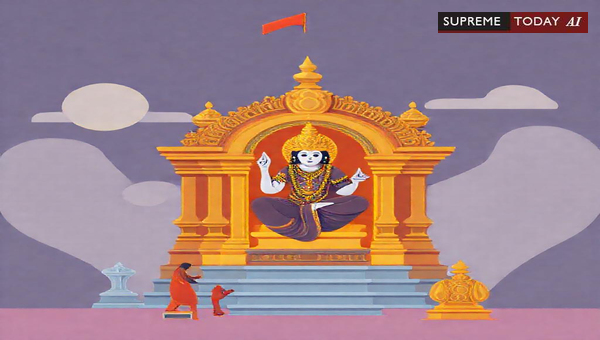
What Legally Happens When a Consecrated Deity Is Removed From Its Temple Sanctum
When a is taken out of a temple, devotees and temple administrators often ask a crucial question: what will be the status of the deity once it has been removed from the temple? Indian courts have developed a nuanced body of law answering this question, balancing the religious sanctity of the consecrated image with practical needs such as repairs, renovations, and even public infrastructure projects.
The Idol as a : A Personality That Survives Removal
Under Hindu law, an idol that has been consecrated and installed in a temple is recognized as a — a legal entity capable of holding property, initiating litigation, and being the subject of legal relations. This status is not dependent on the idol's continuous physical presence at a single location.
The Supreme Court has made it clear that the legal personality conferred on the idol is an embodiment of the of the endowment, and that purpose survives even the destruction or absence of the idol 2019 8 Supreme 1. In other words, removing the deity from the temple does not extinguish the endowment or the idol's legal personality. Property rights, temple assets, and obligations tied to the deity remain enforceable even while the idol is physically absent or relocated.
It is also well settled that the temple itself, when properly represented by its manager or trustee, can be recognized as a juridical person — but a structure treated as a dwelling place of the deity may not acquire that status without an idol being installed 2016 0 Supreme(Mad) 3940. This underlines how central the consecrated deity is to the legal identity of the temple.
Constitutional Protection:
Removal of a deity is not merely a secular or administrative act. It touches the core of Hindu religious faith. The courts have repeatedly held that worshippers place great store by rituals and ceremonies, and these practices cannot be dismissed as irrational or superstitious 1972 0 Supreme(SC) 167.
Key constitutional protections include:
- — guarantees freedom of conscience and the right to freely profess, practise, and propagate religion
- — protects the right of to manage their own affairs in matters of religion
Any State action or private act that results in the defilement, pollution, or unauthorized removal of a may be prima facie invalid under these provisions. Courts have also recognized that the right to worship is not at any and every place, so long as it can be practised effectively, unless the right to worship at a particular place is itself an integral part of that right 2018 0 Supreme(SC) 952. Where worship at a specific consecrated site is integral to the faith, removing the deity from that site directly wounds the religious sentiments of devotees.
Temporary Removal vs. Permanent Removal: The Distinction
The law draws a sharp line between temporary and permanent removal, guided by and Agamic principles.
When Temporary Removal Is Permissible
- The idol may be removed temporarily for repairs, renovations, or rituals (), provided the public consents
- The image should generally not be removed to another place even for , though temporary removal for effecting repairs is allowed
- In no case can the image be permanently shifted to another place, as doing so would be against the doctrine of and Hindu religious belief 2022 0 Supreme(AP) 541
- Notably, an idol can be removed permanently only where the idol itself is damaged, not where the temple is merely dilapidated 2022 0 Supreme(AP) 164
When Removal Violates the Law
The Madras High Court has held that relocating a deity without valid necessity is against Hindu sentiment and violates of the Constitution, reaffirming the Supreme Court's position that permanent removal of an idol without unavoidable necessity is impermissible 2025 0 Supreme(AP) 335. Relocation for purposes such as road widening or administrative convenience, without religious sanction, has been treated as effectively constructing a new temple rather than continuing the original endowment.
Judicially Permitted Translocation
There is limited room for courts to permit relocation. has been held permissible where it is done without , with all due respect, and with appropriate ceremonies conducted for the purpose 2022 0 Supreme(AP) 164. Courts have also directed that where a deity's statue is found in an inappropriate location, it should be removed and installed within the temple premises rather than on public pathways 2026 Supreme(Online)(Mad) 33837. In disputes between community factions, courts have encouraged the community to decide the place of the deity together, noting that the manner of worship does not change from shifting the deity from one place to another 2022 0 Supreme(Kar) 445.
Who Controls the Deity's Property After Removal?
The deity's legal personality also shapes property management. The pujari is a servant of the deity, and temple property vests in the deity without intermediaries claiming ownership rights 2026 Supreme(Online)(MP) 3379. A pujari's appointment does not confer status, and pujaris can be removed for mismanagement or indiscipline 2026 Supreme(Online)(MP) 3379. In private temples, the deity is treated as a — often analogized to a minor — and must be represented by a , such as the or manager, who acts only as a guardian without proprietary rights 2026 Supreme(Online)(MP) 37260.
Practical implications when a deity is removed include:
- Temple property remains vested in the deity; the endowment continues to subsist
- The or authorized manager acts on the deity's behalf
- Any interested person may sue on behalf of the deity as if the temple or property is mismanaged
- Agamic rules regarding who may touch or move the idol continue to apply
Key Takeaways
- The legal personality survives — removal, destruction, or intermittent presence of the idol does not terminate the endowment or the deity's juristic status 2019 8 Supreme 1.
- Permanent removal is generally impermissible without religious justification, damaged idol, unavoidable necessity, and prescribed ceremonies.
- Temporary removal for repairs is allowed with public consent and adherence to Agamic rituals.
- Constitutional safeguards under protect devotees' rights, and unauthorized relocation may attract judicial scrutiny.
- Property rights remain intact — the or manager holds the deity's property as guardian, not as owner.
Temple disputes involving removal of deities are highly fact-sensitive, and outcomes depend on Agamic requirements, the nature of the endowment, and the consent of the worshippers. This article is general information and not legal advice; anyone facing a specific temple or deity dispute may wish to consult a qualified advocate familiar with endowment law.
#TempleLaw #HinduIdol #JuristicPerson #Article25 #ReligiousFreedom









