


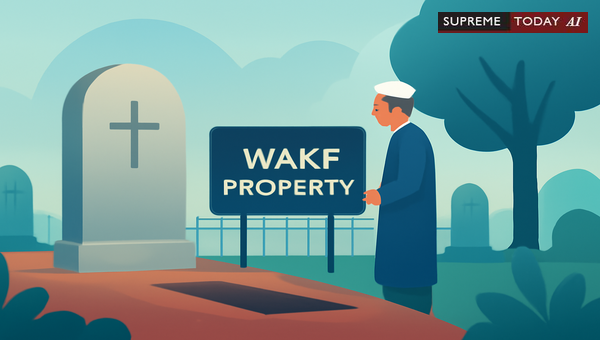
No for Graveyard Land in India
In property disputes, few issues are as sensitive as those involving land used as a graveyard. Imagine a landowner seeking to enforce a sale agreement for a plot that's been a burial ground for generations. Can a court grant —forcing the buyer or seller to complete the deal? The short answer, under Indian law, is typically no. This post delves into the legal question: No on Graveyard. We'll examine why courts prioritize public and religious rights over private contracts, drawing on key principles, case laws, and practical insights.
Disclaimer: This article provides general information based on legal precedents and is not a substitute for professional legal advice. Consult a qualified lawyer for your specific situation.
Overview of and Graveyard Land Use
is an where courts order parties to fulfill contractual obligations, especially when monetary damages are inadequate, such as for unique real estate. However, graveyard land stands apart due to its sacred and public character.
Under Indian law, land used as a graveyard—particularly if public or dedicated as wakf (religious endowment)—is . Courts have long held that such land cannot be repurposed without due process, protecting community burial rights. This stems from principles of , , and historical usage. 2007 0 Supreme(All) 3196 1925 0 Supreme(All) 141
Key Legal Principles Protecting Graveyard Land
1. Designation
A plot becomes a through long-term community use for burials. Once established, it gains protected status:- Public rights make the land .- Conversion for other uses (e.g., buildings or sale) requires rigorous legal scrutiny.
A graveyard that has been used by the public for burial over a long period can be classified as a . This classification grants the public rights over the land, making it ... 2007 0 Supreme(All) 3196 1925 0 Supreme(All) 141
In one case, The graveyard situated in the plaint schedule property is a . Courts ruled defendants could not obstruct burials based on sectarian disputes, affirming every individual's civil right to decent burial. 2022 0 Supreme(Ker) 822
2. Status
Many graveyards qualify as , dedicated irrevocably for religious purposes:- Established via (long-standing use), no formal deed needed.- Cannot be sold, gifted, or repurposed.
Land designated as a graveyard is often treated as , meaning it is dedicated for religious purposes and cannot be sold or repurposed. The dedication can be established through ... 2004 0 Supreme(All) 140 2007 0 Supreme(All) 3196
Zamindars (landlords) lose rights once wakf status is confirmed. A zamindar (landlord) cannot claim rights over a graveyard once it has been established as such. The land becomes a wakf, and the zamindar's rights are extinguished. 1925 0 Supreme(All) 141
3. Denial of
Courts dismiss claims for graveyard land, prioritizing community rights:- Burial and ceremonies take precedence over private agreements.- Even valid contracts yield to public interest.
The courts have consistently held that once a land is established as a graveyard, any claims for regarding its use for other purposes... are likely to be dismissed. 2000 0 Supreme(AP) 823 2016 0 Supreme(MP) 654
Relatedly, forms under for suits () require reading the plaint holistically, but graveyard status overrides. 2019 0 Supreme(Ori) 127
Insights from Case Law and Disputes
Public Use and Shared Management
Graveyards serving multiple communities demand shared oversight. Unilateral actions, like tree cutting or encroachment, invite challenges. In multi-faith or inter-community sites, management rights are collective. 2007 0 Supreme(All) 3196 1925 0 Supreme(All) 141
Villagers using government land as a graveyard without formal allotment still assert rights: Land admeasuring Ac.2.00 gts., is used for graveyard by the villagers. The Government never allotted the said land for the purpose of grave yard. People are using it. 2024 Supreme(Online)(TEL) 21936
Encroachment and Pathway Disputes
Modern cases highlight encroachments by private entities, like academies on ancestral graveyards. Petitioners seek demarcation via revenue maps, but ambiguities persist. Long-standing easements for access paths to graveyards are often upheld. 2024 0 Supreme(J&K) 19
Disturbing graves risks criminal liability under ; exhumation requires strict procedures. Unauthorized removals are rare and contested. 2025 Supreme(Online)(Mad) 49902 2024 Supreme(Online)(KAR) 38710
One ruling noted burial rights persist unless explicitly relinquished: ...the deceased relinquished his right to be buried after accordance with the faith professed by him, yet the said right of burial...
Counterarguments: Private Ownership Claims
Parties may claim private ownership or family rights, but public use evidence prevails. Historical records trump recent assertions. Some parties may argue that a graveyard is privately owned... However, evidence of public use... typically outweighs such claims. 2007 0 Supreme(All) 3196 2004 0 Supreme(All) 140
Lack of clarity on specific graveyards complicates matters: There is no clarity as to which graveyard is referred to above. 2017 0 Supreme(Del) 1890
Practical Recommendations for Legal Strategy
If involved in graveyard land disputes:- Establish Public Nature: Collect evidence of historical burials, witness testimonies, and revenue records.- Prove Wakf Status: Highlight ; no deed required.- Counter Private Claims: Use precedents showing community rights supersede.- Seek Demarcation: Approach revenue authorities or civil courts for boundaries and easements.- Avoid Unauthorized Actions: Encroachment or disturbance invites suits; follow Cr.P.C. for exhumations.
In suits, prior failure to claim relief (e.g., under ) bars later attempts. 2017 0 Supreme(Mad) 3004
Conclusion and Key Takeaways
Indian law robustly protects graveyard land as public or , rendering claims untenable. Courts balance property rights with sacred communal interests, emphasizing historical use over contracts. Key takeaways:- Public graveyards are ; wakf dedication is presumed from long use. 2007 0 Supreme(All) 3196- Community burial rights prevail; encroachments face legal hurdles. 2022 0 Supreme(Ker) 822- Disputes require evidence like maps and testimonies for resolution.
For property owners or communities, early legal intervention preserves these sites. References include 2000 0 Supreme(AP) 823, 1925 0 Supreme(All) 141, 2007 0 Supreme(All) 3196, 2016 0 Supreme(MP) 654, 2004 0 Supreme(All) 140, 2022 0 Supreme(Ker) 822, 2024 Supreme(Online)(TEL) 21936, 2024 0 Supreme(J&K) 19, and others noted.
Stay informed on evolving land laws—protecting graveyards safeguards cultural heritage.
#SpecificPerformance, #GraveyardLaw, #WakfProperty















