


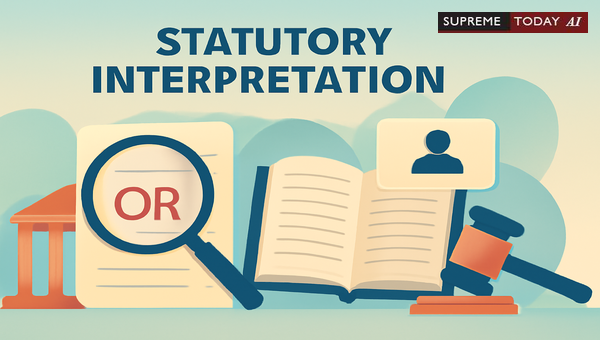
Does 'Or' in Statutes Mean or ?
In the intricate world of , few words carry as much weight as or. Does it simply present alternatives, or does it invoke restrictive principles like ? The question, The Word or Ordinarily Implies Not , lies at the heart of many legal disputes. Understanding this distinction is essential for lawyers, judges, and anyone navigating legislation, as misinterpretation can alter outcomes dramatically.
This post explores the nature of or, when may or may not apply, and key judicial insights. Note: This is general information based on precedents and should not be taken as specific legal advice. Consult a qualified attorney for your situation.
The Power of 'Or' in Legal Texts
Typically, or functions as a conjunction, signaling alternatives that stand independently. Courts have long upheld this view to preserve . Reading or as and could lead to absurd results, undermining the statute's purpose. 2024 0 Supreme(All) 124 2023 0 Supreme(All) 306
For instance, precedents emphasize that or allows separate consideration of options. The word or is typically understood as , allowing for alternatives. It is used to present options that can be considered independently. 2024 0 Supreme(All) 124 2023 0 Supreme(All) 306. This approach ensures statutes are not overly narrowed without clear textual support. 2021 0 Supreme(All) 252
Understanding the Principle
(of the same kind) is a applied when a general phrase follows specific ones, limiting the general to the class of the specifics. However, it requires a distinct or category among the specifics. Without this, the principle does not apply, and general words retain their broad scope. 1971 0 Supreme(SC) 259 2010 0 Supreme(Kar) 1150
McCardie J. articulated this caveat: the rule of the can not be applied unless there be some broad test for the ascertainment of .
ABDUL THASSIM v. EDMUND RODRIGO ()
. In the case of , the doctrine was scrutinized, holding that diverse specifics preclude its use.ABDUL THASSIM v. EDMUND RODRIGO ()
When or connects items, courts assess if specifics form a coherent class. If not, or remains . In cases where or is used, it is essential to determine if the context suggests a need for interpretation. If the specific words are diverse or do not exhaust the category, the general words retain their broader meaning. 2023 0 Supreme(All) 306 1957 0 Supreme(Pat) 175
Examples Where Fails
- , : Other offence in unlawful assembly provisions does not mean with preceding mischief and criminal trespass. It encompasses all offenses against person or property.
- Constitutional Interpretation: Other authorities is not restricted with enumerated bodies, as a facet of . Craies on Statute Law notes: The rule is one to be applied with caution.
Contextual Interpretation: Plain Meaning Prevails
Statutory language must be read in context. If clear and unambiguous, apply its plain meaning without . 2022 0 Supreme(Ker) 916 2022 0 Supreme(All) 1588. Courts caution against the principle if it contradicts . 1971 0 Supreme(SC) 259 2010 0 Supreme(Kar) 1150
Phrases like often resist . In cases, has wide import, but context may limit their scope. Educational institutions were held as establishments under , not confined to industrial, commercial, or agricultural types. 2011 0 Supreme(Mad) 1411 2011 0 Supreme(Mad) 21. The court rejected restrictions, noting: It also appears that the words '' have not been usually considered . 2011 0 Supreme(Mad) 21
Contrastingly, in some civil procedure contexts, otherwise may be construed with affidavits for interim injunctions under . The word 'otherwise' is to be construed . No cross-examination is typically contemplated beyond affidavits or supporting documents. 2018 0 Supreme(Raj) 552
Ramsahay Palsaniya VS Bharat Petroleum Corporation Limited (Government of India Enterprise)
In sales tax matters, in covered depreciation as equivalent to hire charges, rejecting narrow in penal-like statutes. 2011 0 Supreme(AP) 688
Practical Implications for Legal Practitioners
When arguing :- Prioritize Context: Always examine the full statute. Clear language trumps canons. 2022 0 Supreme(Ker) 916- Test for : Verify if specifics share a common class before invoking .
ABDUL THASSIM v. EDMUND RODRIGO ()
- Avoid Absurdity: or prevents unreasonable narrowing. 2021 0 Supreme(All) 252- Consider Related Doctrines: may interplay but yields to plain text.These principles apply across domains, from penal codes to labor laws like the and . 2011 0 Supreme(Mad) 1411
Key Takeaways and Recommendations
- Or ordinarily implies alternatives, not restrictions. 2024 0 Supreme(All) 124
- Apply cautiously, only with a clear and supportive context. 1971 0 Supreme(SC) 259
- guides: Plain meaning rules unless ambiguity demands canons. 2022 0 Supreme(All) 1588
Recommendations:- Review full statutory context before construing or.- Cite precedents like Magnhild for requirements.
ABDUL THASSIM v. EDMUND RODRIGO ()
- In disputes, argue unless specifics compel otherwise.References: 2022 0 Supreme(All) 1588 2023 0 Supreme(All) 306 2022 0 Supreme(Ker) 916 1971 0 Supreme(SC) 259 2010 0 Supreme(Kar) 1150 2024 0 Supreme(All) 124 2021 0 Supreme(All) 252 1957 0 Supreme(Pat) 175
ABDUL THASSIM v. EDMUND RODRIGO ()
2018 0 Supreme(Raj) 552
Ramsahay Palsaniya VS Bharat Petroleum Corporation Limited (Government of India Enterprise)
2011 0 Supreme(AP) 688 2011 0 Supreme(Mad) 1411 2011 0 Supreme(Mad) 21.This analysis underscores the nuanced balance in . Stay informed on evolving precedents to strengthen your legal strategy.
#StatutoryInterpretation, #EjusdemGeneris, #LegalInterpretation















