


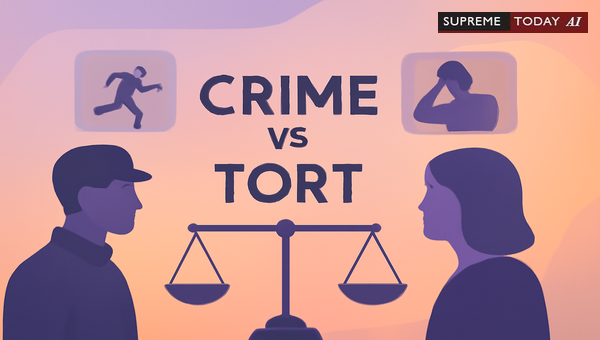
Crime vs Tort: Essential Differences Explained
In the realm of law, many people often confuse and , especially when an incident leads to both criminal charges and civil lawsuits. Understanding the difference between crime and tort is crucial for anyone navigating legal matters, whether as a victim, accused, or simply seeking knowledge. A crime typically involves harm to society, prosecuted by the state, while a tort is a private wrong where an individual seeks compensation. This post breaks down these concepts comprehensively, drawing from legal principles and case insights.
What is the Difference Between Crime and Tort?
At its core, the difference between crime and tort lies in their nature, purpose, and remedies. are public wrongs offenses against the state or society, whereas are civil wrongs that infringe on private rights. Let's explore this step by step.
Definition and Nature
Crime: A crime is defined as a of public law that is considered an offense against society as a whole. It is prosecuted by the state, and the legal proceedings aim to punish the offender. typically involve a degree of () and are subject to penalties such as imprisonment or fines 2023 0 Supreme(HP) 434 1987 0 Supreme(All) 117.
Tort: A tort is a civil wrong that causes harm or loss to an individual, for which the injured party may seek compensation through . do not require the same level of intent as and can occur due to or of 1914 0 Supreme(All) 25 1992 0 Supreme(Raj) 328.
As noted in legal scholarship, There is indeed no fundamental or inherent difference between a crime and a tort. The difference is one of degree only, and the early history of the shows how words which now suggest a real distinction began rather as symbols of emotion than as terms of scientific classification 2018 7 Supreme 1 2016 3 Supreme 598. This highlights that while distinct, the lines can blur.
Legal Proceedings
Criminal Proceedings: Initiated by the state against an individual accused of committing a crime. The outcome can result in , which serves to deter future offenses and uphold public order 2023 0 Supreme(HP) 434 2007 4 Supreme 288.
Civil Proceedings: Initiated by an individual seeking compensation for harm caused by another's actions. The focus is on restoring the injured party to their original position, often through monetary 1914 0 Supreme(All) 25 1992 0 Supreme(Raj) 328.
In criminal cases, the state bears the responsibility, emphasizing societal protection. Civil tort cases, however, empower the victim to pursue justice directly.
Key Distinctions
Here are the primary differences, outlined for clarity:
Nature of Wrong: are offenses against the state or public, while are violations of private rights 1914 0 Supreme(All) 25 2007 4 Supreme 288.
Intent: typically require , whereas can arise from or , where intent is not a factor 2023 0 Supreme(Ker) 45 1987 0 Supreme(All) 117. For instance, the moral culpability of in focuses on '', '', and '', differing from criminal intent 2014 0 Supreme(Mad) 1509.
Outcome: Criminal cases result in (e.g., imprisonment), while tort cases result in compensation for 2023 0 Supreme(HP) 434 1992 0 Supreme(Raj) 328.
Parties Involved: In criminal law, the state is the prosecutor, while in tort law, the injured party is the plaintiff seeking redress 2007 4 Supreme 288 1992 0 Supreme(Raj) 328.
Burden of Proof: The burden in criminal cases is '', while in tort cases, it is '' 1914 0 Supreme(All) 25 1992 0 Supreme(Raj) 328. This higher standard in reflects their punitive nature.
Examples and Overlaps
An act can be both a crime and a tort. For instance, theft is a crime against the state and also a tort () against the individual whose property was taken 2023 0 Supreme(HP) 434 1987 0 Supreme(All) 117.
Motor vehicle accidents provide real-world illustrations. In cases where drivers cause accidents, criminal charges (e.g., rash driving under ) may arise alongside tort claims for compensation. Courts have distinguished: The essential components of are three: '', '' and '' 2014 0 Supreme(Mad) 1509 2014 0 Supreme(Mad) 1038. Here, reduces compensation but does not bar claims, unlike outright criminal liability 2025 Supreme(Online)(Ker) 22780.
in accidents share liability jointly and severally, allowing victims to recover fully from one party, who may then seek contribution
. This shows ' focus on remedy over .
Public wrongs like affect society broadly: Every public offence is also a private wrong, and somewhat more – Affects individual, and the community alike 2016 3 Supreme 598. Yet, not all moral wrongs are ; for example, adultery was decriminalized as it better fits civil remedies like divorce 2018 7 Supreme 1.
Nuances from Case Law
U.S. cases echo these distinctions, noting exceptions like in contexts 2025 Supreme(US)(scotus) 5391. In India, defamation straddles both: criminal under for public order, civil for reputation damage under 2016 3 Supreme 598. Courts uphold criminal defamation as serving public interest, balancing free speech 2016 3 Supreme 598.
In claims, tribunals assess : the former involves multiple parties, reducing shares proportionally; the latter diminishes claimant recovery but does not dismiss claims 2025 Supreme(Online)(Ker) 22780.
Practical Implications
Understanding these differences helps in:- Deciding whether to report to police (crime) or file a civil suit (tort).- Advising on dual proceedings, e.g., after an assault leading to charges and personal injury suit.- Recognizing joint tortfeasor liability in accidents for full recovery.
When situations involve both, clarify the framework: criminal for , tort for compensation 2023 0 Supreme(HP) 434.
Conclusion and Key Takeaways
The distinction between crime and tort lies primarily in the nature of the wrong, parties involved, proceedings, and outcomes. protect society through ; restore individuals via . While overlaps exist—like in theft or accidents—each follows its path.
Key Takeaways:- : State vs. accused, , beyond reasonable doubt, .- : Plaintiff vs. defendant, suffices, , compensation.- Overlaps possible; pursue both if applicable.
This is general information and not specific legal advice. Consult a qualified attorney for your situation.
For cases involving potential , , or both, professional guidance is essential to navigate appropriately.
#CrimeVsTort #LegalBasics #LawDifferences















