


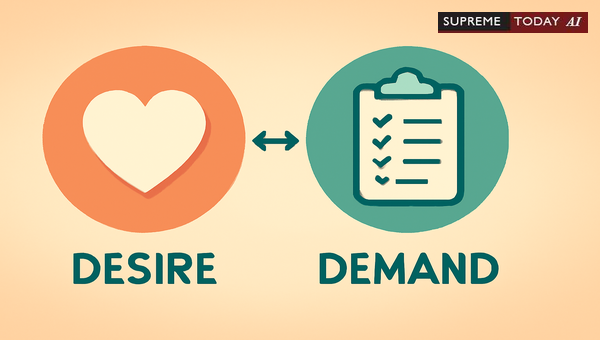
Desire vs. Demand: Key Legal Differences Explained
In the realm of law, words carry significant weight. What might seem like a subtle distinction between everyday terms can determine the outcome of legal proceedings. A common question arises: What is the difference between legal terms 'desire' and 'demand'? Understanding this divide is particularly vital in areas like landlord-tenant disputes, contract enforcement, and claims for rights.
This blog post breaks down these terms, drawing from judicial interpretations and case precedents. We'll explore their definitions, applications, and why courts rigorously differentiate them. Note: This is general information and not specific legal advice. Consult a qualified attorney for your situation.
Defining 'Desire' in a Legal Context
Legally, desire refers to a subjective wish, preference, or inclination without any inherent legal obligation or enforceability. It represents a personal aspiration that does not create rights or impose duties on others.
- Subjective Nature: Desire is often tested subjectively but must still meet objective standards in court to have any weight. For instance, a landlord's mere 'desire' to reclaim property for personal use rarely suffices for eviction.
- No Legal Enforceability: Courts consistently hold that a 'desire' alone cannot form the basis for legal action. As noted in case law, It is different from a wish, a desire or a hope nor can it amount to a claim or demand on the ground of a right. 2022 0 Supreme(MP) 440
In eviction scenarios under acts like the , judges emphasize that a landlord's requirement must be a ',' not just a desire. 2016 0 Supreme(All) 3346 2016 0 Supreme(All) 2961
Understanding 'Demand' in Legal Terms
In contrast, demand implies a formal, assertive request backed by a legal right or obligation. It typically requires a specific claim that, if unmet, can lead to enforceable remedies.
- Formal and Objective: A demand must be clear, definite, and supported by evidence. For example, under the , a demand notice must specify the 'cheque amount' to be valid: In the notice, demand has to be made for the ‘cheque amount’ and therefore, notice sans such demand would fall short of legal requirement. 2024 2 Supreme 581
- Legal Consequences: Valid demands can trigger actions like eviction or payment enforcement. In landlord cases, a 'demand' tied to need—proven through efforts to find alternatives—may succeed. 2000 0 Supreme(Raj) 1316
Demands appear in various contexts, such as maintenance waivers where parties explicitly state they shall not demand... maintenance in capacity of a divorced wife.
2022 0 Supreme(Guj) 1252
Key Differences: Desire vs. Demand
The distinction boils down to enforceability, intent, and judicial scrutiny:
| Aspect | Desire | Demand ||---------------------|---------------------------------|---------------------------------|| Nature | Subjective wish or preference | Assertive, formal claim || Legal Weight | Insufficient for action | Can lead to remedies if || Testing | Often dismissed if not genuine | Objectively assessed || Examples | Wanting property without need | Specific payment or eviction request|
- Objective vs. Subjective: Courts apply an objective test to demands. The Supreme Court has ruled that a landlord's requirement must be tested objectively and not merely on their desire. 2000 0 Supreme(Raj) 1316
- Requirement: Mere desire does not create rights: This at the most could be the desire of the plaintiff to have this property... mere plea is not sufficient, it has to be proved. 2025 0 Supreme(SC) 593
Other precedents reinforce: There is a marked distinction between ‘desire’ of a person and his/her ‘requirement’. 2024 Supreme(Online)(Bom) 8253 And, Though it is settled law on the subject that there is a difference between desire and requirement. 2017 2 Supreme 426
Applications in Landlord-Tenant Disputes
This difference shines in eviction cases, where landlords must prove ' need' rather than desire.
- Required: Eviction cannot rest on 'desire to set up a new business' without evidence. Courts demand proof of necessity and alternatives explored. 2000 0 Supreme(Raj) 1316 2016 0 Supreme(All) 3346 2016 0 Supreme(All) 2961
- Case Insights: The material evidence... establishes... the and the necessity... and not the mere desire. It is settled legal position that there is a difference between the desire and the . 2017 0 Supreme(Kar) 1436
- Requirement Defined: Requirement means when objectively seen there must be the necessity... It is not a sheer desire only. 2017 2 Supreme 426
In one ruling, a family's need for premises was upheld as , distinguishing it from whim. Similar scrutiny applies elsewhere, like property deals where unproven demands fail. 2025 0 Supreme(SC) 593
Broader Legal Contexts
Beyond rentals:
- Contracts and Payments: Demands for interest or reductions must align with terms: Demand with respect to interest... cannot be held to be legal. 2025 0 Supreme(Pat) 172
- Wills and Property: A testator's 'genuine desire' may avoid unearned increase demands, but only if natural and proven. 2024 Supreme(Online)(Del) 33703
- Pledge and Ownership: Legal texts highlight differences in rights, akin to desire (no claim) vs. demand (enforceable lien). 2022 0 Supreme(SC) 445
Even in employment, terms like 'appointment' vs. 'joining' show nuanced distinctions. 2015 0 Supreme(Raj) 295 2015 0 Supreme(Raj) 294
Legal Consequences and Best Practices
- For Desires: They rarely succeed; courts quash claims based solely on wishes.
- For Demands: Success hinges on proof—specificity, evidence, and objectivity. Conclusive and definite demand must be proved beyond any reasonable doubt. 2024 0 Supreme(Bom) 1192
Recommendation: In arguments, bolster demands with evidence of and alternatives. Avoid relying on desires, as they lack legal traction.
Conclusion: Why the Distinction Matters
Grasping the gap between desire (a non-binding wish) and demand (a potentially enforceable claim) is essential for legal strategy. Courts safeguard against abuse by requiring objective bona fides, especially in sensitive areas like evictions.
Key Takeaways:- Desire is subjective and insufficient for legal relief.- Demand requires formality, proof, and genuineness.- Always test claims objectively to align with precedents. 2000 0 Supreme(Raj) 1316 2016 0 Supreme(All) 3346 2016 0 Supreme(All) 2961
Stay informed, but seek professional advice tailored to your case. Understanding these terms empowers better decisions in legal matters.
#LegalTerms, #DesireVsDemand, #LawBasics















