


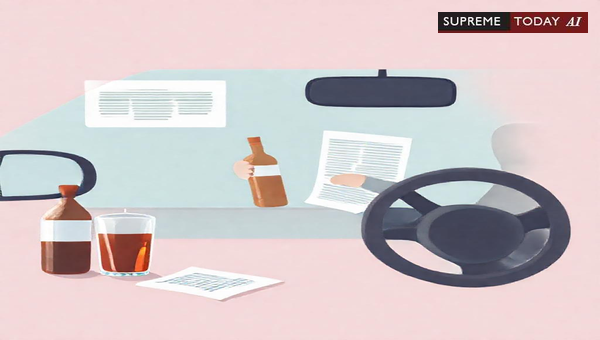
When an Insurer Denies a Motor Claim Alleging Drink Driving With No Police Case and Only Photos of a Liquor Purchase
Imagine your car meets with an accident, you file an , and the insurer repudiates it on the ground that the driver was drunk — yet no FIR was lodged, no or blood test was conducted, and the entire case rests on photographs showing that liquor was purchased somewhere before the trip. Can such a rejection survive scrutiny before a ? The short answer, based on judicial precedent, is generally no. This article examines the legal position on rejecting an on the ground of drink and drive in the absence of a police complaint, where the only evidence is photographs of liquor purchase.
The Core Rule: Burden Lies on the Insurer
An insurance policy's for driving is a defence that the insurer must affirmatively prove. The insured is never required to prove a negative — that the driver was sober. As the has consistently held, to avoid liability the insurer must establish that the policy condition was breached 2004 1 Supreme 243. In the alcohol context, this means the insurer must show:
- That the driver consumed alcohol;
- That the consumption impaired his ability to drive; and
- That this contributed perceptibly to the accident.
Photographs of a liquor purchase address, at best, an inference of the first element. They say nothing about the quantity consumed, the timing, the driver's individual tolerance, or any actual impairment of driving ability.
Is Not Indispensable — But Something Must Replace It
The drew a clear distinction between the criminal offence under of the and the contractual standard under an 2021 0 Supreme(SC) 259. The criminal provision requires alcohol exceeding 30 mg per 100 ml of blood, proved through a or blood test. The , by contrast, requires a factual finding that the driver was under the influence — measured by the impact of alcohol on that particular driver, not by a fixed blood-alcohol threshold.
The Court clarified that if a test was not performed for any reason, the insurer is not barred from proving its case otherwise. Absence of prosecution under does not automatically doom the insurer's defence. But the flip side is that the insurer must then fill the evidentiary gap with credible material — and mere photographs of liquor purchase fall well short of that mark.
Why Photographs of Purchase Are Weak Evidence
A photograph showing liquor being bought proves only possession or purchase. It does not establish:
- Consumption — the liquor may have been for others or consumed later;
- Quantity and timing — nothing links the purchase to impairment at the moment of the accident;
- Impact on the driver — the same quantity affects different people differently, depending on food, body weight, and tolerance.
As the put it, being under the influence is a question of fact, to be decided with reference to the impact of consumption of alcohol on the particular driver, and it must be shown that the drink at least contributed in a perceptible way to causing the accident 2021 0 Supreme(SC) 259.
Consistent Findings of Consumer Commissions
Consumer fora across levels have repeatedly rejected repudiations founded on thin alcohol evidence:
- A held that a post-mortem report noting only a smell of alcohol, without quantified blood results or a medical report, cannot establish that the driver was under the influence
MOHAN SINGH VS CITYBANK N. A. - Consumer (2008)
. A companion ruling held that mere consuming of alcohol is not a ground to repudiate insurance claim in the absence of blood or medical evidenceBranch Manager, National Insurance Co. Ltd. VS Sobha Balamurali, Thekkediyath House - Consumer (2012)
. - The has held that consumption of liquor is not itself the test for applying the exclusionary clause — the policy contemplates something more than merely consumption of liquor, and based merely on breath smelling of alcohol, without proof of influence, was unsustainable
New India Assurance Co. Ltd. VS Ashminder Pal Singh, Through his Attorney, Sh. Balwant Singh
. - Where no or blood test report was produced at all, the Commission found the insurer had failed to discharge its burden of proving the exclusion with at least basic evidence, amounting to
Manager IFFCO Tokio General Insurance Co. Ltd. VS Vellilathodi Mujeeb
. - Conversely, where a driver's acquittal under was proved, courts have treated the acquittal as evidence that the driver was not under the influence, and was upheld as unjustified
NATIONAL INSURANCE CO. LTD. VS DHIRAJ SHARMA
.
By analogy, photographs of purchase are even weaker than a post-mortem note about smell — they do not even establish consumption, let alone impairment.
The Role of the Manner of the Accident and
The has acknowledged that a truly inexplicable accident — a car on a wide, nearly empty road, without the slightest excuse, mounting a footpath, striking a pole and wall, overturning and catching fire — may, along with other circumstances, point to the driver being under the influence 2021 0 Supreme(SC) 259. However, the doctrine of cannot by itself prove intoxication; the manner of the accident can only reinforce other evidence. Standing alone, an unexplained crash plus liquor purchase receipts is typically not enough.
When May Succeed
- Contemporaneous medical evidence: a reading, , or, in fatal cases, a post-mortem with quantified blood alcohol concentration. In one case, a reading of 59 µg/100 ml, converted using the scientific blood-to-breath ratio of 2100:1, was held to exceed the 30 mg limit under , justifying
Dayaram Agrawal VS New India Assurance Co. Ltd.
. - Police observations: recorded signs such as slurred speech, unsteady gait, or odour of alcohol in the FIR or accident report.
- Corroborating testimony or CCTV linking drinking to the accident, combined with an otherwise inexplicable manner of collision.
- where the driver survives but refuses testing or fails to cooperate — facts especially within the insured's knowledge may be required to be explained, without shifting the initial burden.
Practical Takeaways for Policyholders
- Demand strict proof of impairment — mere suspicion, purchase bills, or smell-of-alcohol observations are generally insufficient.
- Highlight the absence of any breath test, blood test, medical report, or proceeding.
- Present alternative causes such as mechanical failure, road defects, or obstruction, supported by evidence.
- If the insurer repudiates arbitrarily without credible evidence, a complaint for may be maintained before the .
Conclusion
The absence of a police complaint under does not, by itself, prevent an insurer from raising the drink driving exclusion — but it removes the strongest objective evidence. In that situation, photographs of liquor purchase alone cannot discharge the insurer's heavy burden of proving that the driver was under the influence. Judicial precedent consistently requires medical, scientific, or reliable corroborative proof linking alcohol consumption to actual impairment and to the accident. Where that proof is missing, is likely to be set aside as arbitrary. This article is intended as general information and not a substitute for advice tailored to the specific facts of any claim.
#MotorInsurance #DrinkAndDrive #InsuranceClaimRejection #ConsumerProtectionAct #OwnDamageClaim












