


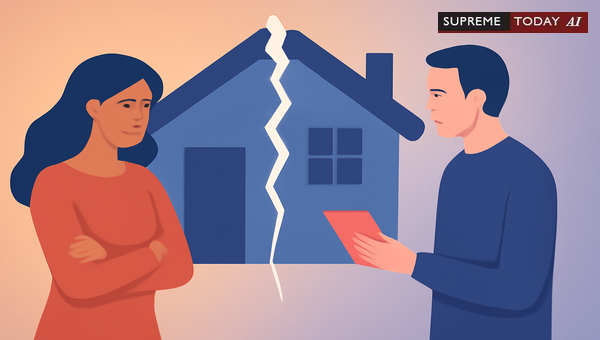
Can Husband Sell Property with DV Act ? Case Laws Explained
Introduction
In domestic disputes, one common question arises: Can a husband sell property when a is passed in a DV Act case? This issue often surfaces amid emotional and legal battles under the (). The Act safeguards women's rights to reside in the , raising concerns about property sales, evictions, or conflicting civil court orders.
This blog post breaks down the legal framework, key judicial precedents, and the interplay between DV Act residence orders and . We'll explore why such orders typically protect the woman's right to stay, preventing unilateral actions like property sales by the husband. Note: This is general information based on case laws and statutes, not specific legal advice. Consult a qualified lawyer for your situation.
Understanding Residence Orders Under the
The provides robust protections for women facing domestic violence. Central to this is the in the , defined under as a household where the woman has lived with the respondent, even temporarily, with some permanency 2012 0 Supreme(Ker) 552 2013 0 Supreme(Ker) 760.
- : Grants every woman in a the in the , irrespective of her title or ownership 2012 0 Supreme(Ker) 552.
- : Prohibits dispossession or exclusion except through 2012 0 Supreme(Ker) 552.
- : Allows courts (typically ) to issue residence orders, restraining the respondent from evicting the woman or in ways that affect her rights 2012 0 Supreme(Ker) 552.
These orders create a higher, protected right that cannot be easily defeated. The has emphasized that residence orders under the confer superior protections compared to routine civil remedies 2012 0 Supreme(Ker) 552.
Key Judicial Precedents: Husband Cannot Sell Property
Landmark cases clarify that a binds the husband, preventing sales or transfers that undermine the woman's residency.
S.R. Batra Case
In S.R. Batra's case, the held that residence orders cannot be enforced against properties owned solely by in-laws if not a ',' but affirmed the Act's protective intent for genuine shared households 2013 0 Supreme(Ker) 760. The Court noted: the definition of is exhaustive and that the legislative intent was to provide higher protection for women, making such residence rights superior to that seek to exclude her from the household 2013 0 Supreme(Ker) 760.
This underscores that once a is passed, the husband cannot sell the property without court permission, as it would violate restraints.
Precedence Over
Civil courts may issue injunctions for property protection, but they do not override DV Act orders. As per judicial analysis: An injunction granted by a that seeks to restrain entry into or possession of the cannot override the statutory right of residence conferred by the 2012 0 Supreme(Ker) 552 2017 0 Supreme(Ker) 315.
In 2025 Supreme(Online)(Ker) 30147, the court observed: It is true that the 2nd defendant has obtained Ext.B9 from the under of the DV Act... Suit for is a procedure established by law referred in Section 17 (2) of the DV Act to evict or exclude the aggrieved person, even if she obtains a under of the DV 2025 Supreme(Online)(Ker) 30147. However, this highlights that civil suits must follow due process and cannot bypass DV protections; the prevails unless vacated.
Interplay Between Civil Courts and DV Act Proceedings
Civil courts handle property disputes, injunctions against trespass, or sales, but must respect DV Act orders. Key insights from sources:
- Do Not Automatically Override: A civil injunction aiming to exclude the woman is subordinate. Courts must ensure consistency with PWDV rights, as the Act is in addition to and not in derogation of other laws 2012 0 Supreme(Ker) 552.
- Jurisdictional Nuances: DV proceedings are typically before (criminal courts), while civil suits are in civil/family courts. Per 2025 Supreme(Online)(Ker) 51058, interim injunctions on construction or property use can be modified but do not nullify DV residence orders 2025 Supreme(Online)(Ker) 51058.
- Challenging Conflicting Orders: If a civil court issues an order conflicting with a DV (e.g., allowing sale), it can be challenged under or via higher courts. The DV order's protective nature takes precedence 2012 0 Supreme(Ker) 552 2025 Supreme(Online)(Ker) 30147.
In DR. SITANSHI SHARMA vs VANDANA SHARMA & ORS. - Delhi 2021_DHC_2940, the reviewed a trial court order alongside a DV application for residence orders, reinforcing that DV rights integrate into civil suits without being overridden DR. SITANSHI SHARMA vs VANDANA SHARMA & ORS. - Delhi 2021_DHC_2940.
Additionally, proceedings' validity isn't affected by location; civil judges can accept plaints at chambers or residences if judicially sound
.
Practical Implications for Husbands and Wives
- For Husbands: Cannot sell or alienate property under a without Magistrate's permission. Attempts may lead to contempt or DV Act violations.
- For Wives: Protected from eviction; can seek enforcement via police if dispossessed.
- Resolution Steps:
- File to modify/vacate the under .
- Prove no or non- status.
- Approach higher courts for stays, but DV rights generally prevail initially.
The 's intent is paramount protection, as noted: residence rights under the are higher rights that cannot be defeated by without following proper legal procedures 2012 0 Supreme(Ker) 552 2013 0 Supreme(Ker) 760.
Conclusion and Key Takeaways
Generally, a husband cannot sell property when a is passed under the DV Act. This stems from Sections 17 and 19, bolstered by precedents like S.R. Batra, which prioritize women's residence rights over conflicting 2013 0 Supreme(Ker) 760. Civil orders may coexist but do not negate DV protections unless explicitly modified through due process 2012 0 Supreme(Ker) 552 2025 Supreme(Online)(Ker) 30147.
Key Takeaways:- Residence orders restrain property alienation affecting the woman's stay.- are subordinate; challenge via proper channels.- Seek legal counsel promptly—outcomes depend on facts like proof.
Disclaimer: Laws evolve, and cases are fact-specific. This post references judgments like 2012 0 Supreme(Ker) 552, 2013 0 Supreme(Ker) 760, 2017 0 Supreme(Ker) 315, 2025 Supreme(Online)(Ker) 30147, and others for educational purposes. Always consult a lawyer.
#DVActIndia, #ResidenceOrder, #WomensRightsLaw

















