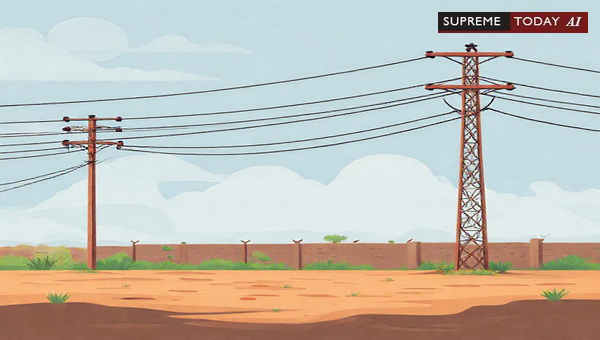
Legal Recourse for the Unauthorized Installation of Electric Poles and Power Lines on Private Property
The sanctity of private property is a fundamental right, yet landowners often find themselves in conflict with utility companies when infrastructure, such as electric poles or high-tension wires, is installed on their land without consent. This situation typically arises when electricity boards or contractors prioritize the rapid expansion of the power grid over the procedural requirements of land acquisition and permission. When these installations happen without the owner's knowledge or agreement, it leads to significant legal disputes regarding property devaluation, safety concerns, and the violation of ownership rights.
A common point of contention for many property owners is the question: Electric poles without permission in private land—is this legal, and what can be done?
The Legality of Unauthorized Infrastructure Installations
Under the framework of Indian law, the unauthorized installation of electric poles and appliances on private land, or the passing of overhead lines without the explicit permission of the landowner, is generally considered unlawful 1999 0 Supreme(Pat) 1277 and 2011 0 Supreme(Mad) 895 and 2014 0 Supreme(Gau) 447 and 1996 0 Supreme(Mad) 563 and 2020 0 Supreme(Guj) 603. Such actions may constitute a violation of several critical regulatory frameworks, including the Indian Telegraph Act, the Indian Electricity Rules, and various local municipal laws.
The legal standing of a landowner in these scenarios is strong. When a utility provider bypasses the necessary consent process, the landowner is typically entitled to seek the total removal of the infrastructure and may file for damages resulting from the unauthorized trespass and use of their land 1999 0 Supreme(Pat) 1277 and 2011 0 Supreme(Mad) 895.
Mandatory Permissions and the Right to Compensation
The erection of electric poles is not a right that utility boards can exercise arbitrarily. Generally, prior consent from the landowner is a prerequisite for such installations. According to the Central Amendment Act, 2003, electricity boards are required to obtain the necessary permission before erecting poles on private land 2007 0 Supreme(Mad) 3144 and 2011 0 Supreme(Mad) 895 and 1996 0 Supreme(Mad) 563.
Beyond mere permission, landowners are entitled to claim fair compensation if their land is used for utility purposes. If the authorities fail to secure this permission or provide the required compensation, the landowner can initiate legal proceedings to seek:* Removal Orders: A court directive forcing the utility company to dismantle the poles and restore the land.* Damages: Financial compensation for the illegal occupation of the land and any resulting loss in property value.* Injunctions: Court orders to stop ongoing installation work.
Judicial Perspectives on Landowner Rights
Courts have consistently upheld the principle that the convenience of a utility provider does not override the legal rights of a property owner. In several rulings, the judiciary has emphasized that following due process is non-negotiable 2011 0 Supreme(Mad) 895 and 2020 0 Supreme(Guj) 603 and 1999 0 Supreme(Pat) 1277 and 2014 0 Supreme(Gau) 447.
For instance, in matters concerning high-tension wires and poles, the courts have observed that fixing poles and laying overhead electric lines without the permission of the District Magistrate and in the face of resistance from the landowner is unauthorized 1991 0 Supreme(Del) 545. This highlights that even if a utility company believes they have a general mandate, specific resistance from a landowner may trigger the need for formal permission from the District Magistrate to proceed.
Furthermore, legal precedents such as Mfs. Scindia Potteries Private Ltd. and Another v. M/s. Purolator India Ltd. and Others have reinforced the idea that the provisions of the Electricity Act and the Telegraph Act do not override the rights of landowners 1991 0 Supreme(Del) 545. This ensures that statutory powers granted to electricity boards are not used as a tool to bypass constitutional property protections.
The Issue of Shifting Charges and Transformers
A complex issue arises when a landowner requests the relocation of a transformer or pole that was installed without original consent. Utility companies often demand shifting charges to move the equipment. However, the legal obligation to pay these charges depends on the status of the landowner.
In a notable case involving the Tamil Nadu Electricity Supply Code, 2004, and the Tamil Nadu Electricity Distribution Code, 2004, the court addressed a dispute where a transformer was erected without the consent of the previous or current owner 2014 0 Supreme(Mad) 1143. The court determined that the landowner was not obligated to pay the shifting charges because they did not fall under the definition of a 'consumer' as per the relevant electricity supply code 2014 0 Supreme(Mad) 1143. Consequently, the court directed the respondents to shift the transformer from the petitioner's land to some other land within three months, without imposing any costs on the petitioner 2014 0 Supreme(Mad) 1143.
Exceptions and Special Considerations
While the general rule protects the landowner, there are specific exceptions where courts may rule against the removal of electric infrastructure. These cases typically involve:1. Social Forests: Areas designated for social forestry where the nature of land use allows for utility installations 2024 Supreme(Online)(MAD) 33334.2. Deemed Permission: Situations where permission was previously obtained from a legal predecessor or where the installation was deemed necessary for public safety and the landowner's objection is found to be without merit 2004 0 Supreme(Pat) 1144.
Despite these exceptions, the burden of proof generally lies with the utility provider to show that the installation was lawful and that all procedural requirements were met.
Summary of Legal Takeaways
When dealing with unauthorized electric poles on private land, landowners should keep the following points in mind:
- Consent is Primary: Utility boards typically must obtain explicit permission or follow a statutory acquisition process before using private land 2007 0 Supreme(Mad) 3144.
- Right to Shifting: If an installation was unauthorized, the owner may demand its removal or shifting without bearing the costs, provided they are not the consumer benefiting from that specific infrastructure 2014 0 Supreme(Mad) 1143.
- Judicial Remedies: Landowners can apply for a permanent injunction to restrain utility companies from digging pits or fixing poles without consent 1991 0 Supreme(Del) 545.
- Administrative Oversight: In cases of resistance, the role of the District Magistrate becomes crucial in determining whether the installation can legally proceed 1991 0 Supreme(Del) 545.
The legal framework generally favors the protection of private property against unauthorized utility encroachment. While the state has powers of eminent domain, these must be exercised through the proper legal channels, ensuring both permission and fair compensation are provided. This information is provided for general awareness and typically varies based on specific facts and local regulations.
#PropertyRights #ElectricityLaw #LegalRemedies #LandownerRights