




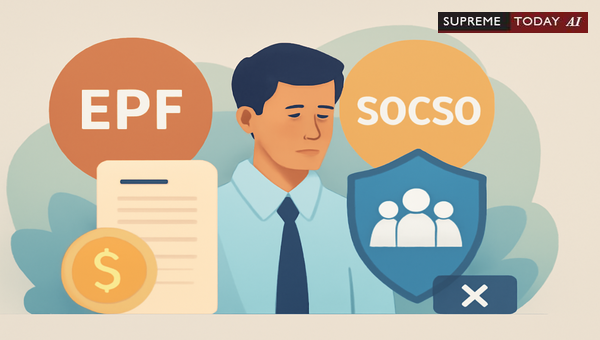
EPF & SOCSO Non-Payment on Request: Legal Status Explained
In today's dynamic workforce, many workers face uncertainties about their benefits, especially when it comes to mandatory contributions like the (EPF) and (SOCSO). Imagine working diligently for a company, requesting these essential contributions, yet receiving none. What is your legal status in such a scenario? This blog post delves into the legal status of personnel not paid EPF and SOCSO on their request, drawing from key legal principles and court precedents in Malaysia.
We'll explore the critical factors determining your rights, employer obligations, and practical steps forward. Note: This is general information based on legal precedents and not specific legal advice. Consult a qualified lawyer for your situation.
What Are EPF and SOCSO, and Why Do They Matter?
EPF, governed by the Act 1991, provides retirement savings through contributions from both employees and employers. SOCSO, under the , offers protection against work-related injuries, illnesses, and invalidity. These are cornerstone benefits for employees in Malaysia, ensuring financial security and social protection.
However, not everyone qualifies. The pivotal question is: Does a true exist? Without it, employers typically have no obligation to contribute, even if requested.
Determining the Employment Relationship: The Core Issue
The legal status of personnel not paid EPF and SOCSO on his request fundamentally depends on classifying the working arrangement. Courts emphasize : The legal relationship between the parties must be classified not by appearance but by reality.
Key Indicators of an
- Control and Direction: Does the employer dictate how, when, and where work is done?
- Payment Structure: Regular salary vs. project-based fees?
- Benefits and Deductions: EPF/SOCSO contributions, leave entitlements?
- Contract Terms: Written employment contract vs. service agreement?
In a notable case, the claimant admitted during cross-examination that there was no EPF and SOCSO contribution paid through the Company. The court ruled this awareness, coupled with lack of proof, meant no employment relationship existed, dismissing claims of under the . The claimant failed to prove they were a '' under , bearing the burden of establishing a .
Another precedent reinforces: Even if personnel pay their own contributions (covering both shares), this does not create an employer-employee tie.
vs. Employee
If classified as an , no EPF or SOCSO duties apply. Personnel aware of and accepting non-contributions may weaken their employee claim. Courts have held: The Claimant also admitted during cross-examination that there was no EPF and SOCSO contribution paid... actual status of the claimant's employment.
Employer Legal Obligations Under Malaysian Law
For confirmed employees, employers must remit contributions:- EPF: Employer share (13-14% typically) + employee share (11%).- SOCSO: Contributions for employment injury and invalidity schemes.
Failure breaches the employment contract and statutory duties. However, if no relationship exists, no breach occurs.
In contract scenarios, principals may require contractors to ensure EPF/ESI (similar to SOCSO) compliance for their personnel: In addition thereto, the respondent was also required to ensure that the personnel engaged were paid EPF and ESI. 2018 0 Supreme(Del) 2426 This underscores shared responsibility in labour chains.
Implications of Non-Payment
Non-contribution leaves personnel vulnerable:- No Retirement Benefits: Forfeited EPF savings growth.- Limited Injury Protection: No SOCSO claims for accidents.- Weaker Claims: In disputes like termination, lack of contributions evidences contractor status.
In bids, courts skip merits if status unproven: Court ruled that issues of ... need not be examined as Claimant was not an employee.
Related contexts highlight risks:- Tenders may demand EPF code proof, rejecting non-compliant bids. 2020 0 Supreme(Bom) 752- Harassment cases award EPF dues alongside compensation if employment confirmed. 2019 0 Supreme(MP) 517
Legal Recourse: What Can You Do?
If you suspect employee status:1. Gather Evidence: Contracts, payslips, emails requesting contributions, witness statements.2. Demand Compliance: Formally request EPF/SOCSO records.3. File Complaints: - or SOCSO for investigations. - for status disputes or dismissal claims.4. Court Action: Prove relationship to enforce contributions/back payments.
Personnel succeeding in status proof may secure dues, as in: she is entitled for EPF and other monetary dues (if still not paid). 2019 0 Supreme(MP) 517
Caution: Awareness without protest can imply acceptance, barring claims.
Practical Recommendations for Workers and Employers
For Personnel
- Clarify Status Upfront: Insist on written contracts specifying employee vs. contractor.
- Monitor Contributions: Regularly check EPF/SOCSO statements.
- Document Everything: Keep records of requests and responses.
- Seek Advice Early: Contact labour offices or lawyers.
For Employers
- Classify Correctly: Use multi-factor tests to avoid misclassification penalties.
- Comply Promptly: Remit contributions to evade fines.
- Communicate Clearly: Inform contractors of non-applicability.
Conclusion and Key Takeaways
The legal status of personnel not paid EPF and SOCSO on request turns on proving an . Mere requests don't suffice if reality shows contractor status, as courts prioritize evidence over labels. Proactive steps—documentation, clarification, and timely action—protect rights.
Key Takeaways:- Prove control, regularity, and mutual intent for employee status.
- Awareness of non-payment may claims. - Explore recourse via statutory bodies or courts.
Stay informed, assert rights, and secure your future. For personalized guidance, consult a Malaysian employment lawyer.
This post references general precedents like , , and others for educational purposes.















