


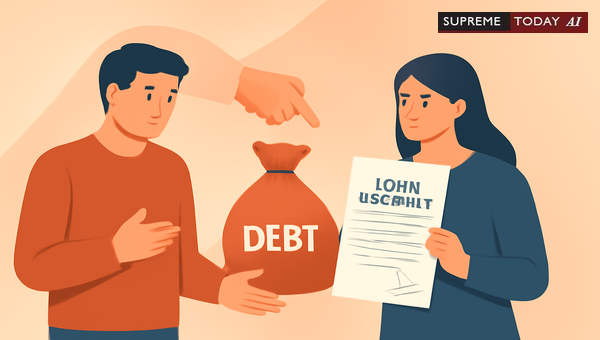
Can Husband Claim Loan from Wife in India? Legal Guide
In the realm of family finances, transactions between spouses often blur the lines between personal gifts and enforceable loans. A common question arises: Can a husband claim a loan from his wife? This issue frequently surfaces in marital disputes, divorce proceedings, or scenarios under Indian law. While emotional bonds exist, the legal system treats spouses as independent entities, requiring strict proof for such claims.
This blog post delves into the legal principles, key court rulings, and practical recommendations drawn from judicial precedents. Understanding these can help navigate financial matters within marriage effectively. Note: This is general information, not specific legal advice. Consult a qualified lawyer for your situation.
Overview of Spousal Loans in Indian Law
Indian courts emphasize that husbands and wives maintain separate legal identities. A loan from one spouse to another isn't automatically recoverable without evidence of intent to create a debt. Courts scrutinize documentation, intent, and context, especially in family law matters.
Key principles include:- Spouses are not for each other's debts.- Enforceability hinges on formal agreements.- Claims often redirect to rather than family proceedings.
Independent Legal Status of Spouses
A foundational rule is that spouses operate as distinct legal persons. One cannot be held responsible for the other's obligations absent explicit consent.
For instance, courts have ruled, by no stretch of imagination, it can be held that wife is liable for the loan of her husband 2012 0 Supreme(All) 2442. Similarly, By no stretch of imagination, it can be held that wife is liable for the loan of her husband. She cannot be made liable for....
. This underscores that marital status doesn't imply joint liability.
In consumer disputes, unauthorized debits from a wife's account to settle her husband's loan were reversed, affirming, One spouse is not bound by omission and commission committed by another spouse.
. Both have independent rights, and the wife wasn't a or .
Essential Requirements for Loan Agreements
To claim a loan successfully, robust evidence is crucial. Courts demand clear documentation proving the transaction was a loan, not a gift.
In one case, a husband's claim failed because the promissory note was not signed by her, leading to the conclusion that no valid loan existed 2016 0 Supreme(MP) 135. Without signatures or witnesses, such documents hold no weight.
Recommendations for Documentation:- Draft a written loan agreement specifying amount, repayment terms, and interest (if any).- Get it signed by both parties and notarized.- Maintain bank records or witness statements for transactions.
Loan Claims in Divorce Proceedings
Divorce amplifies financial disputes. However, typically decline past loan claims, directing parties to .
In divorce proceedings, claims for past spousal expenses, including loans, are generally not entertained... a claim for a debt is a civil claim HEMALATHA KOBALAKRISNAN vs JAYA GANESAN MURUGAN - High Court Malaya Shah Alam. This separation ensures focus on matrimonial relief, not .
Relatedly, in cases, unsubstantiated financial claims (like unpaid vehicle amounts) were dismissed due to lack of evidence supporting the petition 2016 0 Supreme(Bom) 2196.
Payments to Third Parties and Discharge of Loans
Complications arise when payments go through a spouse. Such transactions don't automatically discharge debts unless agreed.
Payments made to a third party (e.g., a wife) do not discharge the original loan obligation unless explicitly agreed upon. A court ruled that payments to the wife couldn't discharge the lender's claim 1996 0 Supreme(Kar) 381.
Liability: When Spouses Are Jointly Liable
Exceptions exist if a spouse acts as . Here, joint execution binds both.
In a banking dispute, the wife- was held jointly and severally liable with the borrower, regardless of the technical issues raised by the 2018 0 Supreme(Mad) 2850. The Appellate Tribunal's limit on her liability (Rs.30 lakhs) was overturned, affirming full responsibility upon signing a .
Contrastingly, mere marital ties don't create liability without such documents
.
Fraudulent Claims and Court Disapproval
Courts frown upon manipulative tactics to evade debts. Courts have expressed disapproval of attempts by spouses to evade loan repayment through fabricated claims or legal maneuvers. Such actions are viewed unfavorably 2002 0 Supreme(Pat) 1051.
In domestic violence contexts, unproven loan requests (e.g., Rs.50,000 for husband's treatment) fueled disputes but required evidence of shared household for relief 2018 0 Supreme(Cal) 178. Fabrications undermine credibility.
Additional Contexts: Property and Family Debts
Spousal independence extends to property. Wives retain in , unaffected by husband's debts unless proven otherwise 2024 0 Supreme(Mad) 2580. Daughters' equal shares post- amendments further highlight individual entitlements.
Conclusion and Key Takeaways
Generally, a husband may claim a loan from his wife only with ironclad proof of an enforceable agreement. Absent this, courts uphold spousal independence, dismissing claims lacking documentation or tainted by fraud.
Key Takeaways:- Treat intra-spousal transactions as formal loans with written proof to avoid disputes.- Pursue recovery in , not divorce forums.- Avoid using marriage to shield debts—courts prioritize contractual obligations.- If acting as , understand full joint liability.
For couples, clear financial boundaries prevent litigation. This analysis, based on precedents like 2012 0 Supreme(All) 2442 2016 0 Supreme(MP) 135HEMALATHA KOBALAKRISNAN vs JAYA GANESAN MURUGAN - High Court Malaya Shah Alam1996 0 Supreme(Kar) 381 2002 0 Supreme(Pat) 1051
2018 0 Supreme(Mad) 2850, clarifies the landscape. Always seek professional advice tailored to your facts.
Word count: ~1050. This post aims to educate on Indian family and contract law nuances.
#SpousalLoans #IndianFamilyLaw #LoanRecoveryIndia















