
 Back
Back





IN THE HIGH COURT OF KARNATAKA AT DHARWAD BENCH
S.R. KRISHNA KUMAR, C.M. POONACHA, JJ.
Lakshman S/o Rangappa Kanakani - Appellant
Versus
Kamalawwa W/o Mallappa Kamatagi - Respondent
Regular First Appeal No. 100091 of 2019
Decided On : 18-08-2025
| Table of Content |
|---|
| 1. challenge to the trial court judgment. (Para 1 , 2) |
| 2. background details of the parties and properties. (Para 3 , 4 , 5) |
| 3. issues framed by the trial court. (Para 6 , 8) |
| 4. arguments presented by the parties. (Para 9 , 10 , 11) |
| 5. considerations regarding specific issues raised. (Para 12 , 13) |
| 6. contention about the legality of the sale. (Para 14 , 15 , 16) |
| 7. court's exercise of powers under cpc. (Para 17 , 18) |
| 8. sale deed’s implications and responsibilities. (Para 19 , 20 , 21) |
| 9. conclusion on legality of sale for item no.1. (Para 22 , 23) |
| 10. final conclusions and orders given. (Para 24 , 25 , 26) |
| 11. court's final order regarding the appeal. (Para 27) |
JUDGMENT :
S.R. KRISHNA KUMAR, J.
1. This Regular First Appeal is filed by the appellant/defendant No.2 challenging the judgment and decree dated 29.11.2018 passed in O.S.No.15/2008 on the file of Senior Civil Judge and JMFC, Bilagi, [Hereinafter referred to as ‘the Trial Court’], whereby, the said suit filed by respondent No.1/plaintiff against appellant/defendant No.2 and respondent Nos.2 and 3/defendants No.1(A) and 1(B) was partly decreed by the Trial Court, thereby directing partition and separate possession to respondent Nos.1 to 3 of 1/3rd share each in the suit schedule properties and for other reliefs.
2. The parties will be referred to as per their ranking before the Trial Court, for the sake of convenience.
3. Briefly, the facts giving rise to the present appeal are as follows:
The respondent No.1/plaintiff-Kamalawwa is the daughter of late Mallappa Arakeri and respondent No.2/defendant No.1(a)–Tarawwa. They had one more daughter, respondent No.3/defendant No.1(b)-Laxmibai. During the lifetime of Mallappa, respondent No.1/plaintiff instituted the said suit against Mallappa/defendant No.1 and the appellant/defendant No.2, seeking for partition and separate possession of his alleged ½ share in the suit schedule landed properties, along with other reliefs. As per the plaint, the suit schedule properties comprise three items of landed properties, (i) R.S.No.83/1 measuring 07 acres 03 guntas, (ii) R.S.No.73/3 measuring 07 acres 20 guntas, both situated at Chikkahanchinal village of Bilagi Taluk; and (iii) a house property bearing VPC No.250, situated at Linganur village, Jamkhandi Taluk, Bagalkot District.
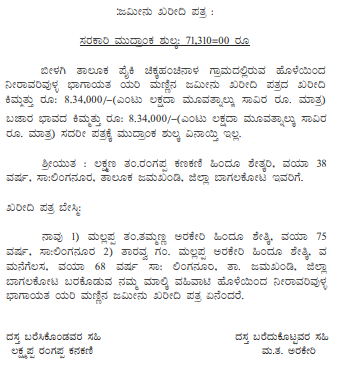
4. During the pendency of the suit, Mallappa expired after filing a written statement, wherein he specifically contended that he, along with respondent Nos.2 and 3, had sold Item No.1 of the suit schedule property in favour of the appellant/defendant No.2 herein, vide registered Sale Deed dated 27.06.2008 for legal necessity and benefit to the estate. It was contended that, prior to execution of the said Sale Deed by Mallappa/defendant No.1 along with his wife Tarawwa, in which respondent No.3-Laxmibai was a consenting witness, Mallappa had obtained a loan by mortgaging both items of suit schedule properties, vide Mortgage Deed dated 31.08.2005, executed by them in favour of the Corporation Bank. It was contended that, as per the terms and conditions of Sale Deed dated 27.06.2008, the appellant/defendant No.2 was liable to repay the loan obtained by Mallappa in respect of Item No.1 property, and consequently, during his life time, the plaintiff was not entitled to any share in the suit schedule properties, and sought for dismissal of the suit.
5. The appellant/defendant No.2 also filed a separate written statement disputing and denying the claim of the plaintiff and re-iterating that Mallappa/defendant No.1, as the Karta of joint family, had executed a Sale Deed in his favour. That the sale was for legal necessity and for the benefit of the estate, and was binding not only upon the plaintiff but also upon the other joint family members. Under these circumstances, the appellant/defendant No.2 also sought for dismissal of the suit.
6. Based on the pleadings of the parties, the Trial Court has framed the following issues on 09.02.2009 and additional issue on 27.04.2
AI
The Karta's sale of joint family property for legal necessity is binding on all family members, limiting liability to the specific item sold.

The burden of proving legal necessity for the alienation of ancestral property lies on the alienee, and the transaction must be for the family's benefit, binding all undivided family members.

The authority of a karta to sell joint family properties for legal necessity is upheld, restricting the plaintiffs' claims in a partition suit.

The sale of property cannot supersede joint family ownership claims without valid evidence of prior partition or separate acquisition.
The court reaffirmed that a sale deed executed for family and legal necessity by a joint family member is binding, barring challenge by family members after significant delay without sufficient cause....

The validity of a sale deed executed by a Hindu Undivided Family member is upheld when legal necessity is demonstrated, despite claims of ancestral rights by co-parceners.
The burden of proof lies with plaintiffs to demonstrate ownership rights, and valid alienation of property by family members for legal necessity cannot be contested without sufficient evidence.
The court ruled that the plaintiffs' claims over certain properties were invalid due to prior sales, emphasizing the necessity of declarations regarding property ownership in joint familial contexts ....

The legal principle established is that in cases involving the sale of joint family property, the burden of proving legal necessity lies with the purchaser only if the plaintiffs have properly pleade....



An indispensable Tool for Legal Professionals, Endorsed by Various High Court and Judicial Officers
Please visit our Training & Support
Center or Contact Us for assistance

Scan Me!
India’s Legal research and Law Firm App, Download now!


For Daily Legal Updates, Join us on :



 Back to top


