



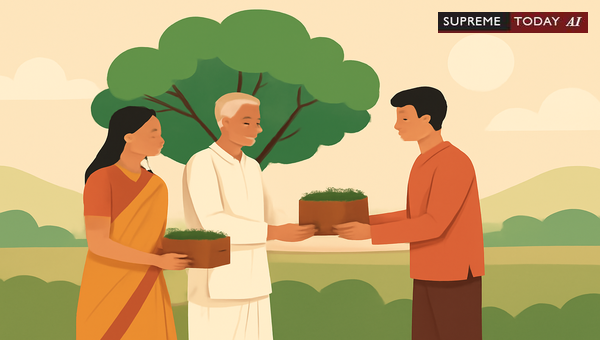
Equal Partition of Grandfather's Ancestral Land: What Hindu Law Says
In family disputes over property, one common question arises: Dada ki par pita nahi hua hai tab barabara bhag chahiye ki nahi ? (On grandfather's ancestral land, if the father has not legally partitioned it, should it be divided equally or unequally?) This issue strikes at the heart of principles under the , where rights vest by birth. Understanding this can prevent costly litigation and ensure equitable distribution.
This blog post breaks down the legal position, drawing from landmark and judgments. Note: This is general information based on established precedents and not specific legal advice. Consult a qualified lawyer for your case.
Understanding and Coparcenary Rights
refers to ancestral immovable property inherited from the grandfather (dada), forming part of the joint family estate under Mitakshara law. Sons (and now daughters post- amendments) acquire an interest by birth in such property. The father, as (manager), has limited powers over it—unlike self-acquired property, which he can dispose of freely.
Key principle: Absent a valid legal partition (), the property remains joint (), entitling coparceners to upon division. Unequal distribution by the father is typically invalid. This stems from ancient texts like Mitakshara, prohibiting arbitrary allotments. 1880 0 Supreme(SC) 9
Core Legal Finding: Equal Division is Mandatory
When no legal partition has occurred by the father, () are compulsory. The in Lakshman Dada Naik v. Ramchandra Dada Naik (1880) held: a father cannot by will make an unequal distribution of . 1880 0 Supreme(SC) 9 The and declared unequal bequests of grandfather's property invalid, mandating equal ownership will be declared.
Similarly, Girja Bai v. Sadashiv (1916) clarifies that partition requires unequivocal severance of status—no formal agreement needed, but a single coparcener's intent suffices. Without father-led legal partition, joint status persists, leading to . 1916 0 Supreme(SC) 31
Timeline of Key Principles
- Pre-1880 (Mitakshara Texts): from grandfather vests by birth; father cannot unequally partition. (Ch. I, Sect. 2, para 1,6,14) 1880 0 Supreme(SC) 9
- 1880: rules father cannot bequeath unequal shares of grandfather's movables/immovables. 1880 0 Supreme(SC) 9
- 1916: Intent severs joint status; equal division follows absent consent. 1916 0 Supreme(SC) 31
- Post-HSA: Father may will his undivided interest (), but ancestral undivided property demands equality. 2020 5 Supreme 641
Father's Limited Powers Over
The father can manage for or limited gifts through affection (), but not unequal bulk transfers excluding sons. In 1880 0 Supreme(SC) 9, the court rejected: gift of great bulk... to exclusion of other. : not within the power of Dada Naik... to bequeath the whole... to one son, and virtually to disinherit the other.
Gifts or partitions of without consent are void. 1993 0 Supreme(SC) 743 Unequal allotments stand invalid, reinforcing equal division. 2020 5 Supreme 641 quotes 1880 0 Supreme(SC) 9: coparcener cannot devise joint family property by will; interest passes by .
When Joint Status Persists: No Vidhik Batwara
Without a decree, registered deed, or division, the property remains undivided. On partition suit, courts enforce: the division must be strictly equal... alike binding according to the doctrine of every school. 1880 0 Supreme(SC) 9 (unequal) acts, even or by will, are void.
Severance by one coparcener's notice breaks unity of possession ( 1916 0 Supreme(SC) 31 ), but father's unilateral unequal act fails. Undivided ancestral demands equality. 2020 5 Supreme 641
Exceptions and Counterarguments
While rule, exceptions exist:- Valid Severance + Metes/Bounds: Post-severance, unequal possible if legally partitioned. 2020 5 Supreme 641- Limited Gifts: Small gifts through affection, not excluding others. 1880 0 Supreme(SC) 9- Self-Acquired Property: Father disposes unequally. (Not pushtaini)- Post-HSA Wills: allows willing undivided interest after severance, but question assumes no partition.
Counter: Father's gift through affection claim rejected for bulk ancestral. Limitation or irrelevant without prior suit. 1880 0 Supreme(SC) 9
Broader Context from Indian Courts
Indian courts consistently uphold family property equity, mirroring principles in other disputes. For instance, in dowry death cases under , courts scrutinize family conduct and evidence meticulously, emphasizing fairness (as in cases analyzing matrimonial cruelty jurisdiction under ). Similarly, juvenile justice bail decisions stress evidence-based risks, akin to proving partition validity. 2018 0 Supreme(All) 1606
In identification and evidence appreciation, courts demand clear proof, paralleling the need for documented severance in property suits. 2021 0 Supreme(All) 165 These reinforce that unsubstantiated claims (e.g., unequal partition) fail without robust evidence, promoting equal justice.
Practical Recommendations
- File Partition Suit: Courts will grant per precedents. 1880 0 Supreme(SC) 9
- Challenge Unequal Claims: Father's allotment likely void.
- Verify Records: Check revenue/mutation for joint status.
- Seek Family Settlement: Consent-based division avoids court.
Post-HSA, daughters too claim equal coparcenary rights—update your strategy.
Key Takeaways
- Equal Mandatory: No legal partition by father = in dada ki . 1880 0 Supreme(SC) 9 1916 0 Supreme(SC) 31
- Father Limited: Cannot unequally gift/will bulk ancestral. 2020 5 Supreme 641
- Joint Until Severed: Birth-right equality persists.
In summary, Mitakshara law prioritizes equity in . For personalized guidance, approach a Hindu law specialist. Stay informed to safeguard family legacy.
References:1. 1880 0 Supreme(SC) 9: Lakshman Dada Naik v. Ramchandra Dada Naik – Foundational on unequal invalidity.2. 2020 5 Supreme 641: Confirms will/gift limits.3. 1916 0 Supreme(SC) 31: Girja Bai v. Sadashiv – Severance rules.4. 1993 0 Supreme(SC) 743: Gifts void without consent.
#AncestralProperty #HinduLawPartition #PushtainiBhumi










