




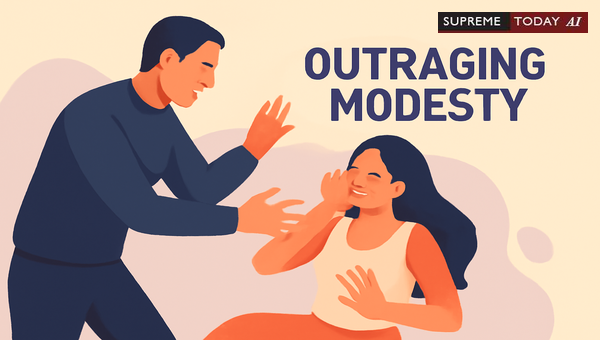
Elements of IPC Section 354: Outraging Woman's
In the realm of Indian criminal law, protecting women's dignity is paramount. (IPC) stands as a crucial provision against acts that or use to outrage a woman's . But what exactly constitutes this offense? Understanding the elements of Section 354 is vital for victims, legal professionals, and anyone navigating such cases. This article breaks down the key components, supported by judicial interpretations and case laws, to provide clarity.
Typically, courts scrutinize these elements rigorously to ensure justice while preventing misuse. Note that this is general information and not specific legal advice—consult a qualified lawyer for personalized guidance.
What Are the Essential Elements of ?
punishes whoever assaults or uses to a woman with the intent to outrage her . To establish a charge under this section, the prosecution must prove three core elements. These are derived from statutory definitions and judicial precedents. 2004 2 Supreme 5
1. The Victim Must Be a Woman
The first fundamental requirement is that the victim is a woman, irrespective of her age. This gender-specific protection underscores the law's focus on safeguarding female . Courts have consistently upheld this, emphasizing that the provision applies broadly. 2004 2 Supreme 5
2. Use of
The accused must employ against the woman. As defined under , involves moving a person's body or something in contact with it without consent, in a way likely to cause harm, discomfort, or annoyance. Simple touching without consent can qualify if it meets this threshold. 2004 2 Supreme 5
For instance, in cases involving unwanted physical contact, courts examine whether the act fits Section 350's definition to invoke Section 354.
3. or to Outrage
The most nuanced element is the —the guilty mind. The accused must act with the to outrage the woman's or with the that the act is likely to do so. Importantly, proof of deliberate is not mandatory; mere suffices. 2004 2 Supreme 5
2003 0 Supreme(Ori) 843
Mere that the of a woman is likely to be outraged is sufficient. This principle was clarified by the , shifting focus from strict intent to likelihood.
01100157323
2003 0 Supreme(Ori) 843itself is not rigidly defined—it evolves with societal norms and case circumstances. Courts adopt a contextual approach, inferring from the accused's behavior and surroundings.
01100157323
2003 0 Supreme(Ori) 843Judicial Interpretations and Key Case Laws
Indian courts have refined these elements through landmark rulings, ensuring balanced application.
Vidyadharan Vs. State of Kerala
In this case, it was held that the mere of likely outrage to suffices for establishing the offense under Section 354, without needing a deliberate to outrage.
01100157323
2003 0 Supreme(Ori) 843 The victim's testimony carries significant weight, similar to that of an injured witness, highlighting its reliability in such matters.Testimony and Evidence Standards
The 's (victim's) statement is pivotal but often requires , especially amid contradictions. In a case altering conviction from (rape) to Section 354, the court noted: Thus, it is important to discuss the elements of at this stage. In such a case while dismissing her statement in the absence of ... one cannot dismiss the case completely so as to bring it out of the ambit of also. 2013 0 Supreme(Del) 1091 This underscores that even without full rape proof, Section 354 may apply if elements are met, provided evidence like medical reports or witnesses supports it.
Vague allegations lacking specifics on date, time, or act fail to attract Section 354. As observed: In the backdrop of vague allegations and lack of particulars of date, time or act for attracting Section 354 of IPC, Section 354 of IPC is not made out. 2025 Supreme(Online)(Bom) 248641
Related Provisions and Contrasting Cases
Section 354 is part of a broader framework under IPC Chapter XVI (offences affecting human body). Related sections like 354A (sexual harassment), 354D (stalking), and others often arise in tandem.
- In a under , the court quashed proceedings due to inconsistencies in the victim's statements and the absence of physical evidence, stressing substantial evidence for harassment charges. 2024 0 Supreme(UK) 308
- For in a , opposition noted non-compoundable nature, but courts considered changed circumstances like the complainant's marriage. 2023 0 Supreme(UK) 596
These illustrate how courts demand proof of elements across variants, quashing weak cases while upholding strong ones.
In another context, absence of foundational elements led to rejecting charges: Clearly, it was an act of restraining the Complainant from entering the premises and no offence under . 2026 Supreme(Online)(Del) 116
Prosecution's Burden and Defense Strategies
To secure conviction:- Prove the victim is a woman.- Establish per Section 350.- Demonstrate or via circumstances.
Credible evidence—witnesses, medical exams, CCTV—is essential. Defenses often challenge intent, consent, or vagueness.
Recommendations for stakeholders:- Prosecution: Collect thorough evidence supporting each element; contextualize intent. 2004 2 Supreme 5- Defense: Highlight inconsistencies, lack of specifics, or alternative explanations. 2025 Supreme(Online)(Bom) 248641- Victims: Report promptly with details to aid proof.
Courts weigh victim credibility highly but demand to prevent abuse. 2013 0 Supreme(Del) 1091
Conclusion and Key Takeaways
serves as a shield for women's , hinging on three pillars: female victim, , and culpable intent/. Judicial evolution, from Vidyadharan to recent quashings, ensures fair application. 2003 0 Supreme(Ori) 843 2024 0 Supreme(UK) 308
Key Takeaways:- alone suffices—no strict intent needed.
01100157323
- Victim testimony is strong but needs support.- Vague claims falter; specifics matter. 2025 Supreme(Online)(Bom) 248641- Related sections like 354A/D require similar evidentiary rigor.While empowering, the provision demands precise proof. For case-specific advice, engage legal experts. Stay informed, stay safe.
References: 2004 2 Supreme 5 2003 0 Supreme(Ori) 843 01100157323















