Searching Case Laws & Precedent on Legal Query.....!
Analysing the retrieved Case Laws
Scanned Judgements…!



Searching Case Laws & Precedent on Legal Query.....!
Analysing the retrieved Case Laws
Scanned Judgements…!
Material Not Mentioned in Show Cause Notice - The courts have consistently emphasized that externment orders are vitiated if the show cause notice does not disclose all relevant material, especially facts about witnesses' willingness or unwillingness to depose, the nature of evidence, or specific incidents relied upon. Several cases highlight that failure to mention critical details such as dates, times, places, and the substance of witness statements renders the notice defective and invalidates the order (e.g., 2023 0 Supreme(Bom) 78, 2024 0 Supreme(Bom) 893, 2022 Supreme(Online)(Bom) 4687).
Lack of Application of Mind and Subjective Satisfaction - Many judgments point out that externment orders must explicitly record the subjective satisfaction of the authority based on material disclosed in the show cause notice. Orders that are silent on the basis of their decision, or rely on stale or unrelated cases, are deemed arbitrary and legally unsustainable (2023 0 Supreme(Bom) 2215, 2023 0 Supreme(Kar) 611, 2022 Supreme(Online)(Bom) 4687).
Time Lags and Immediacy of Material - Several sources note that reliance on criminal cases or incidents that are too remote in time (e.g., more than a year old) or that lack immediacy diminishes the validity of the externment order. Courts have held that reliance on stale cases without showing ongoing threat or recent activity renders the order unsustainable (2023 0 Supreme(Bom) 2215, 2023 0 Supreme(Bom) 556).
Procedural Defects and Non-Compliance - Orders passed without proper service of the show cause notice, or without giving the petitioner an opportunity to respond meaningfully, are invalid. For instance, failure to record the petitioner’s reply, or issuing notices that are mere formalities, violate principles of natural justice (2025 Supreme(Online)(Kar) 41110, 2024 0 Supreme(Bom) 893).
Extraneous Material and Vague Evidence - Courts have condemned the consideration of extraneous or vague material not disclosed in the show cause notice, such as generalized witness statements or camera footage without proper disclosure, as such practices violate the requirement of fair hearing and transparency (2024 0 Supreme(Bom) 893).
Analysis and Conclusion:The summarized case law consistently establishes that considering material not explicitly mentioned in the show cause notice, especially details about witnesses’ willingness, specific incidents, or evidence, renders the externment order invalid. For a valid externment order, the authority must disclose all relevant material, ensure the notice is comprehensive, and demonstrate that the order is based on recent, specific, and relevant facts. Failure to do so results in orders being vitiated for breach of procedural fairness and lack of application of mind (2023 0 Supreme(Bom) 78, 2023 0 Supreme(Bom) 2215, 2025 Supreme(Online)(Kar) 41110, 2023 0 Supreme(Bom) 388).
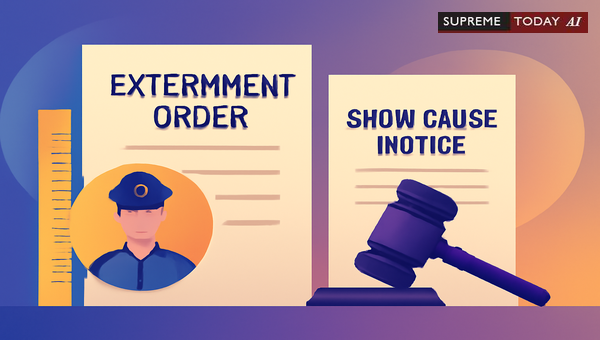
are powerful tools used by police authorities to remove individuals from specific areas to maintain public order. However, these orders must strictly adhere to principles of . A critical issue arises when authorities base such orders on material not disclosed in the . Does consideration of material not mentioned in the vitiate the externment order? Typically, yes—this practice often renders the order illegal and subject to quashing by courts.
In this post, we delve into the legal principles, judicial precedents, and practical implications. This information is for educational purposes only and does not constitute legal advice. Consult a qualified lawyer for specific cases.
Externment proceedings, governed by acts like the (Sections 54-60), (Section 59), and , restrict an individual's right to movement under . These are extraordinary measures requiring of current danger to persons or property. 2023 0 Supreme(Kar) 1139
A is the cornerstone of fairness. It must detail specific allegations, FIRs, cases, or material relied upon, allowing the proposed a meaningful opportunity to respond. Failure to do so violates . Courts have consistently held that the order must be confined to the notice's scope. 2002 0 Supreme(Bom) 1162 2006 0 Supreme(Guj) 424
The fundamental rule is clear: an externment order must be based solely on grounds explicitly mentioned in the . This ensures adherence to fair hearing principles. If authorities introduce —like additional FIRs or unmentioned allegations—the order becomes vitiated. 1988 0 Supreme(Bom) 226 2012 0 Supreme(Mad) 3911
For instance, the must contain specific allegations and details of the material relied upon, enabling the petitioner to effectively respond and defend against the charges. 1987 0 Supreme(Bom) 291
Relying on unmentioned material frustrates the purpose of the notice and denies effective defense. Courts quash such orders as they breach procedural safeguards.
Megha Naranbhai Harijan Case: The court emphasized that material not disclosed in the , even if considered during order passage, invalidates the externment order. 2006 0 Supreme(Guj) 424
In another ruling, the externment order must be passed on the basis of material referred to in the else the itself would be meaningless. 2022 0 Supreme(Bom) 535
Externment Order refers to material which is not referred to in show-cause notice hence impugned order of externment liable to be quashed. 2007 0 Supreme(Bom) 587
Similar views echo in cases under the . For example, where a notice mentioned six cases but the order relied on undisclosed reports, the order was set aside for lacking . 2013 0 Supreme(Bom) 262 2010 0 Supreme(Bom) 763
Under Sections 54-60, externment infringes fundamental rights and demands a fair hearing per Section 58. In a case involving closed with fines, the court quashed the order for arbitrariness and insufficient justification, stressing objective material of current danger. 2023 0 Supreme(Kar) 1139
Courts recognize limited exceptions:- If the material is a natural consequence of mentioned grounds or within the notice's scope, the order may stand.- However, entirely new grounds or extraneous matters—like stale cases or irrelevant reports—typically lead to quashing. 2002 0 Supreme(Bom) 1162 2006 0 Supreme(Guj) 424
Reliance on unmentioned grounds or extraneous considerations, including stale or irrelevant matters, vitiates the order. 1984 0 Supreme(Bom) 199 2010 0 Supreme(Bom) 763
Several judgments reinforce these principles:
Maharashtra Police Act, Section 59: Orders against petitioners with only two cases were quashed for lacking sufficient material and excessive nature, without subjective satisfaction. 2022 0 Supreme(Bom) 535
Cases: In disputes of private nature, externment is undesirable as it severs family ties, potentially increasing criminality. When roots of man are cut he is more likely to commit offences. One order failed because material used was not in the notice. 2019 0 Supreme(Bom) 2499 2019 0 Supreme(Bom) 1141
Political Motivations: Courts caution against malice, especially with public figures. Insufficient material and undisclosed grounds led to quashing. 2019 0 Supreme(Bom) 999
Inquiry Flaws: Even if no response to notice, relying on uncommunicated reports vitiates the action. 2022 Supreme(Online)(Bom) 6440
These cases highlight: Authorities must provide detailed notices and stick to them. Errors like absent material in notices affect hearing rights, as externees lack time to refute. 2019 0 Supreme(Bom) 2499
To withstand scrutiny:1. Detailed Notice: List all FIRs, cases, and evidence.2. Fair Hearing: Allow response time; consider replies.3. Confine to Notice: Avoid new material.4. Objective Satisfaction: Base on current threat, not past or private disputes.5. Minimal Restraint: Limit area and duration; prefer proceedings for private issues.
Externment is a serious infringement of the right to movement and must be based on of current danger or harm. 2023 0 Supreme(Kar) 1139
This aligns with judicial emphasis on fairness in proceedings that curb freedoms. Stay informed, but seek professional advice for your situation—legal outcomes depend on facts.
Word count: Approximately 1050. Sources cited are for illustrative purposes from reported judgments.
#ExternmentLaw, #NaturalJustice, #PoliceAct


In order to consider applicability of the proposition to the facts of the case on hand, it would be necessary to go through the show cause notice and the material relied upon in the show cause notice, which ultimately converged into the order of externment thereby recording subjective satisfaction on ... The first #H....

The show cause notice was issued on 01/06/2011 and externment order was passed on 06/02/2012. ... The show cause notices tabulate criminal cases registered against the Petitioners. These range from 2008 to 2011. By the time the externment order was passed, these could not be said to have retained any immediacy. ... T....

On the day on which the petitioner was directed to appear, the impugned order is passed. Verbatim similar to what was obtaining in the show cause notice. There is not a whisper in the order about the notice being sent or received by the petitioner and his reply being submitted. ... The case of the petitioner merits consideration on the touchstone of th....
In order to consider the applicability of the proposition to the facts of the case on hand, it would be necessary to go through the show cause notice, the reply to the show cause notice given by the petitioner, the other materials relied upon in the show cause notice and the orders passed by the respondent ... In #HL....

The show cause notice was issued on 01/06/2011 and externment order was passed on 06/02/2012. ... The show cause notices tabulate criminal cases registered against the Petitioners. These range from 2008 to 2011. By the time the externment order was passed, these could not be said to have retained any immediacy. ... T....
In the said proposal, reliance was placed on the same six offences registered against the appellant, which were made a part of the show-cause notice dtd. 7/7/2020 on the basis of which the impugned order of externment was passed. ... The said report against the petitioner is communicated to the petitioner to show cause as to why an order of e....
The first show cause notice by S.D.P.O was issued on 06.06.2023. He submitted his inquiry report to the S.D. M. on 11.07.2023. The S.D.M. issued a fresh show-cause notice on 02.08.2023 and passed the impugned order 19.03.2024. ... He submitted that the order of the Commissioner was without reason. Nowhere in a show cause#HL_....
In the said proposal, reliance was placed on the same six offences registered against the appellant, which were made a part of the show-cause notice dtd. 7/7/2020 on the basis of which the impugned order of externment was passed. ... After having failed to satisfy the learned Judicial Magistrate about the necessity of detaining the appellant for 15 days, the Sub-Divisional Police Officer initiated action ....
The petitioner has not filed copy of the show cause notice issued in terms of Section 59 of the Act to state that no particulars have been supplied. ... The last offence has been registered on 24.10.2020, whilst the first show cause notice was issued on 26.11.2020 in terms of Section 59 of the Maharashtra Police Act (hereinafter referred to as “the Police Act” for sho....
The petitioner did not respond to the show cause notice, which required the authority to re- with requisite apprehension, the action vitiates. ... along with actionable material, still the order vitiates, as it is not possible for the Court to decide as to what extent irrelevant made by this Court. ... cause #H....

As a necessary corollary, therefore, the externment order must be passed on the basis of material referred to in the show cause notice else the show cause notice itself would be meaningless. However, in the instant case there are contradictions in the show-cause notices as well as the order of externment passed by respondent No. Therefore, the order should not be based on considerations other than those mentioned in show cause notice”. Before an externment order is issued und....

Similarly, if the material could not have been considered under section 56 of the Act, the externment order cannot sustain in law. Absence of material even at the time of issuance of notice, but mentioning some material affects the right of hearing of proposed externee as ordinarily he does not get sufficient time to collect the material of aforesaid nature to refute the allegations made in show cause notice. If there is error in show cause notice like absence of material, but such m....
Similarly, if the material could not have been considered under section 56 of the Act, the externment order cannot sustain in law. Absence of material even at the time of issuance of notice, but mentioning some material affects the right of hearing of proposed externee as ordinarily he does not get sufficient time to collect the material of aforesaid nature to refute the allegations made in show cause notice. If there is error in show cause notice like absence of material, but such m....
If there is error in show cause notice like absence of material, but such material is mentioned in show cause notice, that circumstance will be sufficient to set aside the order of externment. Similarly, if the material could not have been considered under section 56 of the Act, the externment order cannot sustain in law. Absence of material even at the time of issuance of notice, but mentioning some material affects the right of hearing of proposed externee as ordinarily he ....
There is nothing of the sort in the externment order. Apparently, therefore, there is no application of mind. The order, therefore, suffers from infirmity and is therefore, liable to be quashed. The externment order as pointed out earlier refers to material which is not referred to in the show cause notice and the learned Magistrate has taken into consideration the material which he could not have.


An indispensable Tool for Legal Professionals, Endorsed by Various High Court and Judicial Officers
Please visit our Training & Support
Center or Contact Us for assistance

Scan Me!
India’s Legal research and Law Firm App, Download now!


For Daily Legal Updates, Join us on :



 Back to top


