


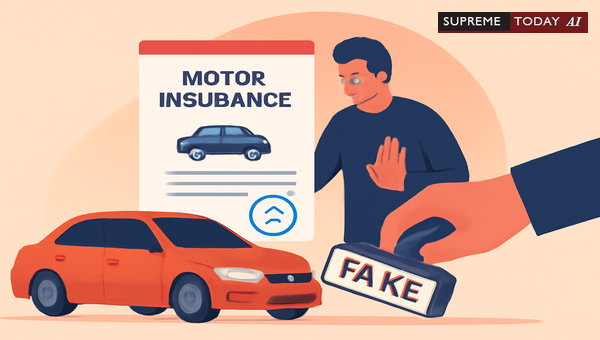
Fabricated Motor Insurance Policy Given to Police in Accident: What Offence is Made Out?
In the chaotic aftermath of a motor accident, vehicle owners may face immense pressure during police investigations. Imagine this scenario: the owner of a vehicle involved in a collision hands over a fabricated copy of a motor insurance policy to the authorities. What legal repercussions follow? This raises critical questions about criminal offences and implications for insurance claims under Indian law, particularly the .
This post explores the potential offences involved, how courts view such actions in the context of policy breaches, and whether they absolve insurers from liability. While providing general insights based on judicial precedents, note that this is not legal advice—consult a qualified lawyer for specific cases.
Understanding the Scenario: Fabricated Policy in Investigations
When a vehicle owner submits a fake insurance policy document to police, it typically occurs to falsely demonstrate compliance with mandatory third-party insurance requirements under . Such deception can trigger multiple legal issues:
- Criminal offences: Actions like creating or using forged documents may fall under provisions, though courts emphasize evidence of intent.
- Impact on claims: In motor accident compensation claims under , a fabricated policy questions the very existence or validity of coverage, potentially leading to denial of claims.
Courts scrutinize such matters closely, often shifting focus to and . Let's delve into key principles.
Main Legal Finding: Breaches Do Not Automatically Exonerate Insurers
A of policy conditions—such as lacking a valid driving license, driving without a badge, or even submitting questionable documents—does not automatically exonerate the insurance company from paying compensation to third-party victims in motor accident claims. Liability persists unless the insurer proves the breach was fundamental and directly contributed to the accident2007 0 Supreme(Ker) 396 2013 0 Supreme(Ker) 743.
Key court-established principles include:- The rests with the insurer to show both the breach and its causal link to the accident 2007 0 Supreme(Ker) 396 2013 0 Supreme(Ker) 743.- Mere proof of breach (e.g., no valid license) is insufficient; must be demonstrated 2001 0 Supreme(SC) 1765.
For instance, the court in 2013 0 Supreme(Ker) 743 held: merely asking the tribunal to issue a direction to produce a driving license and failure to produce it does not automatically prove breach or exonerate the insurer unless the breach is shown to have contributed to the accident.
Detailed Analysis from Court Judgments
and
Judicial precedents consistently place the onus on insurers. In 2007 0 Supreme(Ker) 396, the court clarified: the lies with the insurer to establish a breach of policy conditions by the insured and that the absence of a badge alone is not sufficient to exonerate the insurance company from liability. The insurer must also prove that the breach contributed to the accident.
Similarly, 2001 0 Supreme(SC) 1765 states: the insurer cannot avoid liability even where the breach of policy condition regarding the holding of a valid licence by the driver is established unless it satisfies that such breach... contributed to the cause of the accident.
In the context of a fabricated policy, this could be viewed as a severe breach, akin to no policy at all. However, courts require proof of , not just invalidity. Related cases on document validity reinforce this:- In 2020 0 Supreme(Bom) 1012, the court noted: The burden of proving the validity of the driver's license lies with the owner, and the insurance company can be directed to pay first and recover from the owner.- 2020 0 Supreme(Bom) 1233 affirmed: the burden to prove the existence of a valid driving license lies on the owner, and the owner failed to discharge this burden.
Learner's License and Statutory Violations
Cases like 2023 0 Supreme(Mad) 922 highlight stricter scrutiny for statutory breaches. The court found a learner's licence could not be considered effective unless accompanied by an instructor per , deeming it a . Yet, the insurer was held liable, with recovery rights from the owner.
Quote: It found a of policy condition and violation of statutory provisions, modifying the award to hold the Insurance Company liable and allowing them to recover from the vehicle owner.
Policy Production and Comprehensive Coverage
Insurers cannot evade responsibility without producing originals. In 2015 0 Supreme(Tri) 460, the court criticized the tribunal: The cannot be a silent spectator and it could have directed the Insurance Company to produce the original policy of insurance. For package/comprehensive policies, insurers must pay fully, subject to scrutiny.
In 2024 Supreme(Online)(MP) 30208, the insurance company was challenged on defenses during investigation, underscoring the need for solid evidence.
Contrasting Cases and Exceptions
While breaches rarely fully exonerate insurers, exceptions exist:- proven: If a breach (e.g., drunken driving in 2023 0 Supreme(Ker) 39) fundamentally causes the accident, exoneration may apply 2007 0 Supreme(Ker) 396.- Overloading or unauthorized use: In 2019 0 Supreme(Bom) 400, carrying extra passengers breached policy but was not so fundamental so as to exonerate the Insurance Company.
In -like scenarios, owners bear the risk. Courts in 2010 0 Supreme(Guj) 446 upheld exoneration where breach was regarding and of the fundamental conditions.
Other insights:- Mere accident allegations (even murder claims) suffice for claims if vehicle use caused harm 2024 0 Supreme(Guj) 2020.- Insurers often directed to from owners/ drivers 2020 0 Supreme(Bom) 1012 2023 0 Supreme(Mad) 922.
Recommendations for Stakeholders
- Vehicle owners: Avoid fabricating documents—comply strictly to prevent personal liability and aid smooth claims.
- Insurers: Gather evidence of beyond mere breach; prepare for '' directions.
- Claimants: Focus on accident proof; tribunals prioritize victim compensation.
In investigations, fabricated policies may lead to separate probes, but accident claims proceed on merits.
Key Takeaways
- Fabricating a motor insurance policy for police submission may constitute serious offences, but in claims, focus shifts to proven for insurer defenses.
- Breaches like invalid licenses or documents rarely absolve insurers outright 2013 0 Supreme(Ker) 743 2001 0 Supreme(SC) 1765.
- Courts mandate evidence; owners prove validity, insurers prove impact 2020 0 Supreme(Bom) 1233.
Summary: Unless a policy breach directly causes the accident, insurers generally remain liable to third parties. Always verify documents and seek professional advice.
This article draws from reported judgments for educational purposes. Laws evolve; specific cases vary.
#MotorInsuranceFraud, #AccidentClaimsLaw, #InsuranceBreach















