Searching Case Laws & Precedent on Legal Query.....!
Analysing the retrieved Case Laws
Scanned Judgements…!



Searching Case Laws & Precedent on Legal Query.....!
Analysing the retrieved Case Laws
Scanned Judgements…!
False Pretext of Marriage - Main Points and Insights
Legal Criteria for Offence of Rape on False Pretext of Marriage To establish this offence, the prosecution must prove that sexual relations were induced by a false promise of marriage from the very beginning, with no genuine intention to marry (2025 0 Supreme(Del) 370). If the woman herself admits that marriage took place, the claim of rape on false pretext cannot stand, as the relationship would be between spouses (2025 0 Supreme(Del) 370).Analysis: The core issue is whether the promise of marriage was genuine or made in bad faith, and whether it directly influenced the woman's consent.
Consent and Marital Status Considerations If the victim was already married or not legally eligible to marry, alleging false pretext of marriage becomes complicated. For example, if the woman was married to someone else, she cannot claim to have been deceived into marriage (2023 0 Supreme(Del) 5684). Conversely, if the woman was unmarried and led to believe the man was eligible and would marry her, a false promise could constitute an offence under Section 376 IPC (2023 0 Supreme(Del) 5684).Analysis: The legal validity of the claim hinges on the victim’s marital status and the accused’s intent at the time of promising marriage.
Duration and Consistency of Relationship Long-term relationships spanning years, where physical relations continued even after the woman’s marriage to another person, cast doubt on the false pretext claim. If the woman married another person and still maintained relations with the accused, it suggests the relationship was not solely based on a false promise of marriage (2023 0 Supreme(Del) 5847).Analysis: The persistence of relationships post-marriage indicates that the initial promise may have been false, or that the relationship was not solely predicated on marriage promises.
Timing of FIR and Evidence Delay in lodging FIR after the relationship started can influence the credibility of the false pretext claim. The absence of immediate complaint suggests the relationship may have been consensual or based on mutual understanding (2016 0 Supreme(Del) 1296).Analysis: Timeliness of complaint and tangible evidence are crucial to substantiate claims of deception.
Nature of Promises and Intent A promise of marriage made in bad faith, with no intention to fulfill, is essential for establishing the offence. The false promise must have been relevant to the woman’s decision to engage in sexual relations (2023 0 Supreme(Del) 1923, 2024 0 Supreme(Del) 74).Analysis: The distinction between a broken promise and a false promise made dishonestly is significant; only the latter constitutes an offence.
Relationship with Existing Marriages Allegations against a woman who is still married or whose marriage is not dissolved at the time of the alleged incident weaken the false pretext claim. For example, ongoing disputes over marriage dissolution suggest the woman was not deceived into marriage (2022 0 Supreme(Raj) 2835).Analysis: The marital status at the time of the relationship is a key factor in such cases.
Moral and Cultural Considerations Societal views on virginity and morality influence perceptions of false pretext allegations, especially when the woman is a mature, educated professional. The nature of consent and the understanding of the promise’s sincerity are scrutinized (2023 0 Supreme(Del) 1923).Analysis: Cultural norms may impact legal interpretations but do not substitute for factual evidence.
Distinction Between Breach of Promise and Fraud Not every breach of promise or consensual relationship can be termed as rape on false pretext. The promise must have been made dishonestly, with intent to deceive (2024 0 Supreme(Raj) 1316).Analysis: The legal focus is on the accused’s intent and the nature of the promise, not just the existence of a promise.
No Fraudulent Inducement in Some Cases Some judgments indicate that if the accused had no mala fide intention and relationship was known to be consensual, allegations of false pretext may not hold (
Sreekanth Sasidharan VS State of Kerala represented by the Public Prosecutor - Crimes (2022)
).Analysis: Evidence of genuine intention and absence of deceit are crucial for conviction.Summary and Conclusion
The offence of rape on false pretext of marriage requires proof that the sexual act was induced by a false promise of marriage made in bad faith, with no intention of fulfilling it, and that this promise directly influenced the woman’s consent. Factors such as the woman’s marital status, the duration and nature of the relationship, timing of FIR, and the accused’s intent are critical in assessing such cases. Many courts emphasize that mere long-term relationships or physical relations without clear evidence of fraudulent intent do not suffice to establish the offence. Each case hinges on specific facts, especially the credibility of the promise and the circumstances under which consent was given.
References:
Sreekanth Sasidharan VS State of Kerala represented by the Public Prosecutor - Crimes (2022)
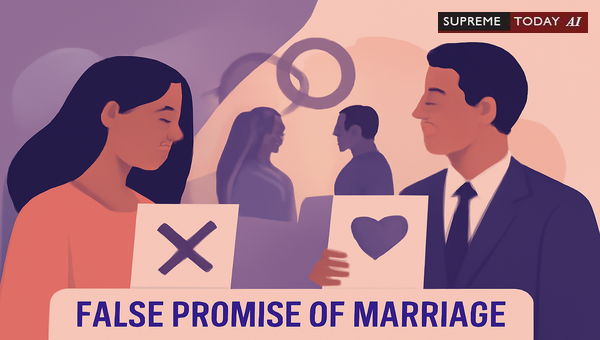
In the realm of Indian criminal law, few issues stir as much debate as the and its implications on consent in sexual relationships. What happens when a promise of marriage turns out to be a deception? Does it automatically under Section 375 and 376 of the (IPC)? These questions often arise in cases involving allegations of rape by false pretext. This blog delves into what is the as per , drawing from landmark judgments and legal principles to provide clarity.
Note: This article offers general information based on judicial precedents and is not legal advice. Consult a qualified lawyer for specific cases.
The concept of a revolves around whether consent given for sexual relations was obtained through deceit. The has consistently held that consent is vitiated only under specific conditions. A mere breach of promise to marry does not suffice; the promise must be false from the inception, made with no intention to fulfill it, solely to induce sexual relations. 2022 0 Supreme(UK) 386
As per judicial interpretation, the promise must be proven to be false and made in bad faith for it to affect consent in sexual relationships. 2021 0 Supreme(J&K) 595
In one instance, the court quashed proceedings noting no evidence of deceit, especially when the complainant married someone else post-FIR. 2022 0 Supreme(UK) 386
rulings emphasize evidence requirements. Without clear proof of falsity and , charges under Section 376 IPC are often quashed under .
Another ruling clarified: The consent of a woman under Section 375 is vitiated on the ground of a '' where such misconception was the basis for her choosing to engage in the said act. 2022 0 Supreme(Del) 2129 The court directed trial courts to weigh all aspects before framing charges, exercising power sparingly.
A prolonged relationship on promise of marriage does not imply vitiated consent. While it may constitute a , it falls short of rape under unless deceit is proven from the start. 2022 0 Supreme(UK) 298
In cases involving minors or aggravated assault, like under and , courts focus on vulnerability. One petition highlighted a girl allegedly induced on false pretext, leading to pregnancy, but medical boards assessed risks for termination. 2020 0 Supreme(Jhk) 458
The marital status of parties is pivotal. If both knew of mutual marriages, consent cannot be deemed vitiated.
Conversely, claims of divorce by customs have been scrutinized, with courts doubting intent where evidence is thin. 2022 0 Supreme(Del) 2129
Unrelated but illustrative, cruelty cases under show how non-consummation post-marriage can amount to , underscoring consent's nuances even in wedlock. 2022 0 Supreme(Mad) 1600 Though not directly on false promises, it highlights relational breakdowns.
Courts demand substantial evidence:- Specific details in FIR/complaint.- Proof of initial .- Consistency in prosecution story.
Absence leads to quashing or acquittal. 2021 0 Supreme(J&K) 595 2022 0 Supreme(UK) 386
Recommendations for Legal Proceedings:- Gather evidence on parties' intentions and marital statuses.- Challenge claims using precedents on consent.- Seek early quashing/bail if allegations lack merit. 2020 0 Supreme(MP) 258
In summary, rulings protect against misuse of IPC 376 while upholding justice for genuine deceit victims. Understanding these principles aids informed decisions.
References:2022 0 Supreme(UK) 386 2021 0 Supreme(J&K) 595
2022 0 Supreme(UK) 298 2022 0 Supreme(Del) 2129 2020 0 Supreme(Del) 1257 2020 0 Supreme(MP) 258 2020 0 Supreme(Jhk) 458
Word count: Approximately 1050. Always seek professional legal counsel.
#FalsePromiseMarriage, #SupremeCourtIndia, #IPC376


In these circumstances, the learned senior counsel for the petitioner prays that the present FIR be quashed as no case for rape on false pretext of marriage is made out. ... It is well settled that, for attracting the offence of rape on the ground that consent was obtained on a false pretext of marriage, the prosecution must establish that the sexual relationship between the parties had ....

Rape on False Pretext of Marriage vs. Live-in-Relationship Agreement 18. ... However, when the victim herself is not legally eligible to marry someone else due to her existing marriage to another partner, she cannot claim to have been induced into a sexual relationship under false pretext of marriage. ... For example, if an unmarried person is induced into a sexual rela....
The respondent first established the relationship with her at the house of his friend on 27.04.2017 on a false pretext of marriage and he continued to do so. ... However, even thereafter she continued to meet the respondent at different places and established physical relationship, but she again asserted that it was on the false pretext of marriage. ... They started going out and at time....
Therefore, whether the consent of the prosecutrix was obtained on a false pretext of marriage, considering the age difference and the fact that the prosecutrix is a literate person working as HR Manager in a company, cannot be presumed. ... The aspect that the prosecutrix was in a physical relation much prior to filing of the complaint, the same whether was consensual or was on pretext of marriage which w....

It is stated that the complainant was in relationship with him and he had established physical relations with her at his rented accommodation in Delhi on the false pretext of marriage. ... It is stated that the accused had even introduced her to his family members and had assured her of marriage and on the pretext of such false promise, he had continued to maintain physical relations wit....

The allegation that the consent was obtained on false pretext of getting married is pulpably false as marriage between the prosecutrix and one Ram Singh was subsisting on 20.9.2021 when the prosecutrix filed a case before the Civil Judge, Bamanvas for a decree of dissolution of marriage against Ram Singh ... Thereafter on different places of the District, the petitioner was in physical relations with the ....

It is also apparent that the prosecutrix did not lodge the report/FIR soon after she was lured into physical relationship by the petitioner on the pretext of marriage on 23-11-2017. ... Thus, the Court must examine whether there was made, at an early stage a false promise of marriage by the accused and whether the consent involved was given after wholly understanding the nature and consequences of sexual indulgence. ... Th....

The allegations made by her against the petitioner regarding the commission of rape on false pretext of marriage do not seem to be convincing. ... As per the allegations levelled in the statement of the prosecutrix recorded under Section 164 CrPC, she submitted herself before the petitioner on account of false pretext of marriage. ... The prosecutrix has also alleged in the statement rec....

No fraudulent or dishonest inducement under the pretext of marriage can be revealed to attract the offence under Section 406 or 420 of IPC. ... The admitted fact that the 4th respondent is having a relationship with the petitioner since 2010 and she continued the relationship knowing about his marriage from 2013 onwards would nullify the story regarding the sexual intercourse on the false pretext of marry....

pretext of marriage. ... Every consensual relationship, where a possibility of marriage may exist, cannot be given a colour of a false pretext to marry, in the event of a fall out. ... It is also alleged by respondent No. 2 that the petitioner had been using her for the last six to seven years and cheating her on the pretext of marriage. ... Through the respondent No. 2....

The allegations of false pretext of marriage are specifically made. According to her she had already got divorced from her earlier husband by rituals/customs.

The allegation that the marriage was not consummated is false. The respondent/wife is not interested with her husband, it is established through cross examination. The allegation of cruelty towards the appellant has not been proved by the respondent.

2 was forced and fraudulently induced to have sexual relationship with the accused/person, for which an FIR has been registered being Gomiya P.S. Case No. 50 of 2020 under Section 376 (3) of IPC and under Section 6 of POCSO Act. It is alleged that because of sexual assault, petitioner no. It is alleged that on false pretext of marriage, the girl who is petitioner no.

Even otherwise, case arises on false promise of marriage. 2. It is the submission of counsel for the applicant that the false case has been registered against him and he is suffering confinement since 25.12.2019 whereas charge-sheet has already been filed.
She was waiting downstairs and thereafter, the respondent had called her and asked her to come upstairs. In the house, the respondent, on the pretext of false promises of marriage, had established physical relations with her.


An indispensable Tool for Legal Professionals, Endorsed by Various High Court and Judicial Officers
Please visit our Training & Support
Center or Contact Us for assistance

Scan Me!
India’s Legal research and Law Firm App, Download now!


For Daily Legal Updates, Join us on :



 Back to top


