


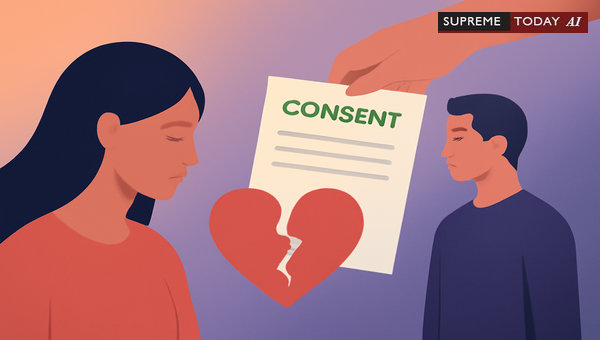
False Promise of Marriage: When Does It Vitiate Consent Under IPC 375?
In the realm of criminal law, few issues stir as much debate as cases involving allegations of rape based on a false promise of marriage. Imagine a relationship that begins with whispers of lifelong commitment, only to unravel into legal accusations under . The addressed this delicate balance in Sonu @ Subhash Kumar v. State of U.P. (2021) 5 SCC 697, providing crucial clarity on what constitutes valid consent and when deceit can render it invalid. This landmark judgment has guided lower courts in and ensuring justice is fact-specific. 2020 0 Supreme(SC) 952
Whether you're navigating a personal legal matter or seeking to understand evolving jurisprudence, this post breaks down the ruling, its implications, and applications in subsequent cases.
The Core Legal Question: Consent and False Promises
The pivotal question in Sonu @ Subhash Kumar v. State of U.P. (2021 SCC OnLine SC 181) revolves around consent under , particularly when allegedly obtained through a false promise of marriage. The Court held that consent must be . A false promise given in —with no intention of fulfillment and bearing a to the woman's decision to engage in sexual intercourse—can vitiate consent. However, mere misconception does not automatically invalidate it unless these strict criteria are met. 2020 0 Supreme(SC) 952
This ruling emphasizes that courts must scrutinize each case on its facts, avoiding presumptions based solely on unfulfilled promises.
Key Principles from the Judgment
The Supreme Court distilled several key points:
- Active and Reasoned Consent: Consent is an act of reason, accompanied by deliberation, the mind weighing, as in a balance, the good and evil on each side. 2020 0 Supreme(SC) 952
- False Promise Criteria: It must be made in , with no intention to adhere at the time, and directly relevant to the sexual act. 2020 0 Supreme(SC) 952
- No Automatic Vitiation: Misconceptions from promises do not invalidate consent without proof of dishonesty and nexus. 2020 0 Supreme(SC) 952
- Fact-Specific Inquiry: Each case demands examination of intent and relevance. 2020 0 Supreme(SC) 952
Drawing from Deepak Gulati v. State of Haryana (2013 SCC 675), the Court reaffirmed that consent can be but must be . 2020 0 Supreme(SC) 952
Detailed Analysis: and Nexus
Clarifying Vitiation of Consent
In Sonu @ Subhash Kumar, the Court elaborated: for consent to be vitiated under Section 375, the false promise of marriage must have been: - Made in , - With no intention of being adhered to at the time it was made, - Of immediate relevance or bearing a to the woman's decision to engage in sexual activity. 2020 0 Supreme(SC) 952
This sets a high threshold, preventing misuse of rape laws in consensual relationships soured by broken promises.
Exceptions and Limitations
- Consent may be vitiated if the promise was dishonest, intentional deceit, and pivotal to the decision.
- Mere allegations without evidence of are insufficient; courts require proof. 2020 0 Supreme(SC) 952
Application in Lower Courts: Real-World Impact
The ruling's influence extends beyond the Supreme Court, as seen in numerous High Court decisions quashing FIRs where facts didn't align with the Sonu criteria.
For instance, in a case, the court relied on , noting: Recently, the Hon’ble Supreme Court in ... Taking into account the aforesaid facts and in view of ratio of law laid down by the Hon’ble Supreme Court in Sonu @ Subhash Kumar (Supra), this Court is inclined to quash the present FIR, as no useful purpose w.... SURG LT CDR AASHISH CHANDRA TIWARY vs STATE GOVT OF NCT OF DELHI AND ANR-1021_2021)
Similarly, another Delhi HC order echoed: The Hon’ble Supreme Court in Sonu @ Subhash Kumar (Supra) further held as under... this Court is inclined to q....
SURG LT CDR AASHISH CHANDRA TIWARY vs STATE GOVT OF NCT OF DELHI AND ANR
In , the referenced the case alongside others, underscoring its applicability: It is not necessary that the facts of Sonu @ Subhash Kumar and .
These precedents illustrate how Sonu empowers courts to dismiss cases lacking evidence of deceitful intent, promoting fairness. 2024 0 Supreme(SC) 615
Recommendations for Prosecutors and Courts
The judgment offers practical guidance:
- Examine Facts Rigorously: Establish and nexus through evidence, not assumptions.
- Avoid Presumptions: No automatic invalidation of consent from unfulfilled promises.
- Holistic Review: Consider the relationship's timeline and parties' intentions. 2020 0 Supreme(SC) 952
Legal practitioners should highlight these in defenses, while victims' advocates must build strong evidentiary foundations.
Broader Legal Context and Evolving Jurisprudence
This decision aligns with prior rulings emphasizing deliberate consent, as in Deepak Gulati. It counters trends of in live-in relationships, balancing women's protection with men's rights against false claims. 2020 0 Supreme(SC) 952
Related cases, like those invoking Sonu for quashing proceedings under , reinforce that consent's validity hinges on reason, not hindsight regret.
Key Takeaways
- Consent is King: Must be active, reasoned, and uncoerced.
- False Promise Threshold: Requires , no intent to fulfill, and .
- Case-by-Case Basis: Courts prioritize facts over generalizations.
- Judicial Caution: Prevents abuse of IPC 375 in consensual matters.
In summary, Sonu @ Subhash Kumar v. State of U.P. (2021) 5 SCC 697 fortifies the legal framework, ensuring consent under IPC 375 is robust yet nuanced. 2020 0 Supreme(SC) 952
Disclaimer: This article provides general information based on judicial precedents and is not legal advice. Laws and interpretations may vary; consult a qualified attorney for personalized guidance.
References:1. 2020 0 Supreme(SC) 952: Supreme Court decision on consent validity.2. 2024 0 Supreme(SC) 615: Background on consent principles.3. Various High Court citations as noted.
#FalsePromiseMarriage, #IPC375, #SupremeCourtRuling












