


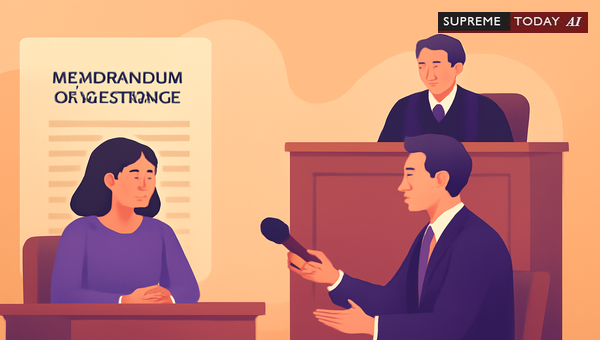
: Care in Recording Witness Memorandums
In family law proceedings, where emotions run high and stakes involve personal lives, procedural fairness is paramount. A critical question arises: while recording the the have to be careful. This issue centers on Section 15 of the Act, 1984, which mandates a summary yet careful approach to witness evidence. Mishandling this can lead to miscarriages of justice, appeals, and undermined credibility assessments. This post explores the legal obligations, safeguards, and best practices for to ensure prevails.
Main Legal Finding
Under Section 15, must record a memorandum of the substance of a , signed by both the witness and the judge, forming part of the record. This is not a but a concise summary demanding utmost care for accuracy and fairness. Courts typically mandate oral examination for , allow , and prefer assessing in open court unless parties consent otherwise. 2021 3 Supreme 260 2018 0 Supreme(All) 1518 2014 0 Supreme(Tri) 205
Failure to follow these steps risks invalidating evidence, as seen in cases where affidavits were improperly used for substantive proof or was denied. This aligns with the Act's summary yet adjudicatory nature, balancing efficiency with justice. 1995 0 Supreme(All) 270
Key Procedural Safeguards
must distinguish between evidence types and adhere to strict protocols:
- Oral Recording Mandate: require oral deposition via signed memorandum, unlike under Section 16. Witnesses of fact have to be examined by the Family Court. Their evidence cannot be taken on affidavit.1995 0 Supreme(All) 270
- Rights: Parties must get a fair chance to cross-examine, unless waived. of the witnesses is necessary except where it is denied by the party to cross-examine the witnesses.2018 0 Supreme(All) 1518
- In-Court Preference: Judges should record evidence personally to evaluate . Delegation to commissioners is allowed under with consent. The Judge of the Family Court is so given the power to record only a memorandum... only because he alone can in assessing a witness.2018 0 Supreme(Ker) 182
These steps prevent truncating testimony and uphold principles via Section 10. 2021 3 Supreme 260
Detailed Analysis: Sections 15 and 16 in Practice
Recording the Memorandum
Section 15 states: it shall not be necessary to record the evidence of witnesses at length, but the Judge... shall, record or cause to be recorded, a memorandum of the substance of what the witness deposes, and such memorandum shall be signed by the witness and the Judge and shall form part of the record.2018 0 Supreme(All) 1518 This summary method requires vigilance to capture essentials without omission.
In one ruling, courts clarified that while lengthier recording isn't prohibited, the memorandum suffices if properly done. 2018 0 Supreme(P&H) 2919 However, the judge's prerogative is exclusive: It is the prerogative of the Judge and the Judge alone of the Family Court to record a memorandum of the substance of what the witness deposes which cannot be exercised by an .
and
Denying , particularly to unrepresented parties (often women), constitutes a gross . No opportunity was given to the opposite party to cross-examine the witnesses... resulted in gross .2014 0 Supreme(Tri) 205 must assist vulnerable litigants, applying fully for pleadings, issues, and reasoned decisions. 2021 3 Supreme 260
Relatedly, in maintenance petitions under , affidavits are permissible but witnesses must face . Provisions of Section 15 and 16 of Act do not render evidence taken on affidavits to be illegal but a witness has to be subjected to .2018 0 Supreme(P&H) 2919 Courts must remove chaff from the grain in matrimonial disputes where claims are often exaggerated. 2018 0 Supreme(P&H) 2919
Assessment and Delegation
Firsthand evaluation is crucial for sensitive issues like cruelty. Delegation via commissioner requires consent: The Family Court shall have the evidence of the witnesses recorded by the ... only if either parties to the lis have no objection.2018 0 Supreme(Ker) 182 2012 0 Supreme(Gau) 1186 Without it, proceedings must occur before the face of the Court.
Exceptions and Limitations
While strict, exceptions exist with caveats:
- Formal Evidence: Affidavits work for formal matters, but parties may summon witnesses for . 2018 0 Supreme(All) 1518 2014 0 Supreme(Tri) 205
- Consent-Based Delegation: Allowed if parties agree, but courts must consider case specifics. 2018 0 Supreme(Ker) 182
- Settlement Flexibility: permits procedural tweaks for settlements, not adjudication. No skipping mandatory steps. 2012 0 Supreme(Gau) 1186 2021 3 Supreme 260
- Vulnerable Parties: Extra aid for illiterate or unrepresented litigants. 2014 0 Supreme(Tri) 205
Note that memorandum in family settlements differs—it records past transactions without needing registration if acknowledging pre-existing rights. 2024 0 Supreme(MP) 512 This context highlights careful terminology in family proceedings.
Practical Recommendations for
To avoid reversals:1. Summon orally and reject core-fact affidavits.2. Offer and record waivers explicitly.3. Note in memoranda.4. Default to in-court recording absent mutual consent.5. Use tape-recording if needed for accuracy.
Counselors' reports under Kerala Rules must avoid exhaustive narrations breaching confidentiality (Rule 29), usable cautiously. 2009 0 Supreme(Ker) 117
Conclusion and Key Takeaways
embody a conciliatory yet fair mandate. Careful memorandum recording under Section 15 safeguards credibility, prevents procedural lapses, and upholds justice. Litigants should insist on these rights; courts, adhere diligently.
Key Takeaways:- Prioritize oral exams and for facts.- Judge-led recording ensures insight.- Affidavits limited to formal evidence.
This post provides general insights based on judicial precedents and is not legal advice. Consult a qualified lawyer for your situation.
References
- 2021 3 Supreme 260: Adjudicatory procedure and applicability.
- 2018 0 Supreme(All) 1518: Section 15 process and cross-exam.
- 2014 0 Supreme(Tri) 205: Signed memoranda and vulnerable parties.
- 1995 0 Supreme(All) 270: Oral exam necessity.
- 2018 0 Supreme(Ker) 182: and delegation limits.
- 2012 0 Supreme(Gau) 1186: Harmonious application.
: Judge's exclusive role.
- 2018 0 Supreme(P&H) 2919: Cross-exam in maintenance.












