


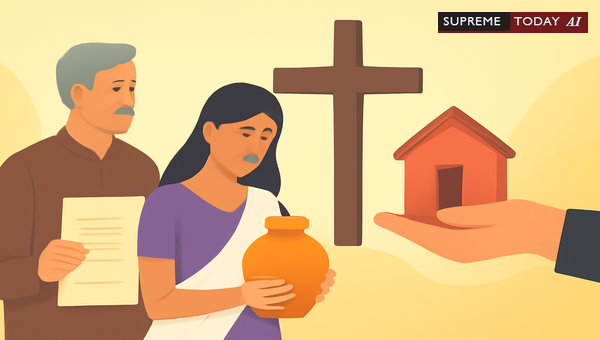
Father's Rights to Married Daughter's Property in Roman Catholic Law
In the intricate world of inheritance laws, particularly within specific religious communities, questions about family property rights often arise. Imagine a scenario where a married woman from the Roman Catholic community passes away, leaving behind property. Does her father have any claim to it? This is a nuanced issue governed by customs, statutes, and judicial interpretations, especially in regions like Travancore (modern-day ) with unique Christian succession practices.
This blog post delves into the legal question: When a Married Woman Died Whether her Father has any Right in her Property in the Case of Roman Catholic Community. We'll examine key principles, potential arguments, and insights from relevant sources, while emphasizing that this is general information—not personalized legal advice. Always consult a qualified lawyer for your specific situation.
Inheritance Framework for Roman Catholics in India
Inheritance among Roman Catholics, particularly those of the Latin rite in southern India, often blends statutory law with longstanding customs. The plays a pivotal role, recognizing where male and female heirs share equally in the . This equal sharing principle is well-documented in legal precedents. 1955 0 Supreme(Ker) 99 1985 0 Supreme(Ker) 331
However, the documents do not directly affirm a father's automatic right to his deceased married daughter's property. Rights typically prioritize closer heirs like the spouse and children, but customs can extend to parents under certain conditions.
Role of in Inheritance
, or dowry given to a daughter at marriage, is another custom highlighted in the sources. While it doesn't explicitly bar a father's inheritance claim, it underscores how marriage provisions might influence property disposition. 1960 0 Supreme(Ker) 228 1985 0 Supreme(Ker) 331
Courts stress that any custom-based claim must be specifically pleaded and proven. Without clear evidence of community practice favoring the father over other heirs, such rights remain uncertain. 1962 0 Supreme(Ker) 120 1985 0 Supreme(Ker) 331
Potential Arguments for a Father's Claim
When asserting rights, consider these angles:
: No inherent birthright is explicitly granted to a father in the reviewed documents. This hinges on local Roman Catholic customs, which may vary by rite (e.g., Latin vs. Syrian). 2022 Supreme(Online)(KER) 56013
Status as : Fathers aren't typically primary heirs post-marriage. Priority goes to the surviving spouse and issue. However, if no children or will exist, distant relatives like parents might qualify, subject to proof.
Impact of Marriage: Marriage via might signal the daughter's property independence, potentially limiting parental claims. Yet, this isn't conclusively addressed.
In related contexts, Roman Catholic marriages and community affiliations affect inheritance. For instance, inter-community marriages (e.g., Roman Catholic Syrian with Latin Catholic) require verifying followed customs and rituals. 2022 Supreme(Online)(KER) 56013
Insights from Related Legal Precedents
While direct cases on a father's rights are scarce, analogous decisions provide context:
Customary Equality: The Travancore Act upholds equal shares for male and female heirs, breaking from stricter patriarchal norms elsewhere. This could indirectly support broader family claims if proven. 1955 0 Supreme(Ker) 99 1985 0 Supreme(Ker) 331
Roman-Dutch Influences: In Ceylon (Sri Lanka) cases involving Roman Catholics, in marriages was key. For example, spouses married in community disposed of half-shares, with survivors holding prior rights to common property.
.
He very well knew the meaning of the community. by his will (D 5) he disposed of a....
These highlight how marital regimes impact posthumous distribution, potentially relevant for Indian Roman Catholics with historical ties.
- Conversion and Community Status: Several cases discuss Roman Catholic conversions affecting status, like Scheduled Tribes or Castes. A family's conversion centuries ago, followed by Roman Catholic marriage, doesn't automatically sever tribal ties—trial courts decide. 2016 0 Supreme(Guj) 254 2015 8 Supreme 705 2006 1 Supreme 166 2005 0 Supreme(Ori) 768 2004 0 Supreme(Mad) 679
In this case, it has been contended that the family of the victim had been converted about 200 years' back and in fact the father of the victim married a woman belonging to a Roman Catholic, wherefrom he again became a Roman Catholic. 2016 0 Supreme(Guj) 254
Though not directly about inheritance, these affirm that community customs persist post-marriage or conversion, requiring evidentiary proof.
- Marriage and Caste/Tribe Claims: High-caste individuals can't claim Scheduled status merely via marriage to a lower-caste partner without community acceptance. This principle may analogize to inheritance: mere familial ties don't confer rights without custom. 2006 1 Supreme 166
A person who is a high caste Hindu and not subjected to any social or educational or backwardness in his life; by reason of marriage alone cannot become a member of Scheduled Caste... 2006 1 Supreme 166
Building a Strong Legal Strategy
To pursue a claim:
Research Customs: Investigate region-specific Roman Catholic practices, e.g., Latin rite equality under Travancore law.
Expert Consultation: Engage specialists in Christian personal law.
Evidence Gathering: Collect wills, marriage records, proofs, and witness testimonies on customs.
Plead Customs: Explicitly argue equal inheritance and substantiate with evidence. 1962 0 Supreme(Ker) 120 1985 0 Supreme(Ker) 331
Key Takeaways and Conclusion
The father's right to a deceased married daughter's property in the Roman Catholic community isn't straightforward. Customs favor equal heir shares, but proof is essential, and marriage impacts claims via or spousal priority. Related cases on and conversions underscore custom's primacy.
In summary:- No automatic paternal right; depends on heirs and customs.- Plead and prove specific usages.- Prioritize spouse/children; parents secondary.
Further research is crucial, as laws evolve. This overview draws from available documents but isn't exhaustive. For tailored advice, contact a legal professional specializing in Indian Christian succession laws.
Disclaimer: This post provides general insights based on referenced sources and is not legal advice. Laws vary by jurisdiction and facts.
#RomanCatholicLaw #InheritanceRights #FamilyLawIndia












