


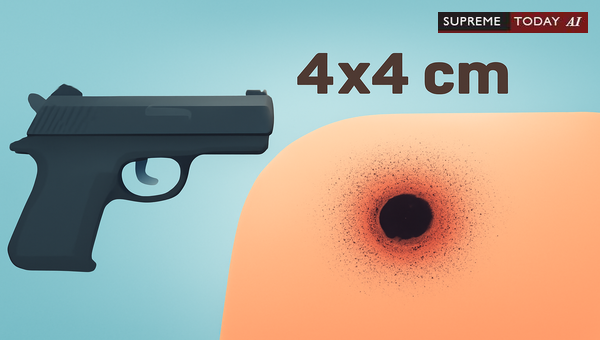
Can a 4x4 cm Entry Wound Come from a Firearm?
In and , the size and characteristics of play a crucial role in determining the type of weapon used and the circumstances of a shooting. A common question that arises is: Whether a 4x4 cm entry wound is possible from any firearms? This query often surfaces in legal contexts where wound dimensions are scrutinized to link injuries to specific firearms or shooting distances.
This article delves into insights drawn from legal documents and case analyses. We'll examine wound variability, documented examples, and key indicators like inverted margins, , and . While this provides general educational information, it is not legal or medical advice—consult forensic experts or attorneys for case-specific guidance.
Overview of Firearm Entry Wound Characteristics
Firearm are not uniform; their size, shape, and features depend on factors such as the firearm type (e.g., handgun, shotgun, rifle), ammunition caliber, range of fire, and impact angle. Typically, are smaller than due to the bullet's stretching effect on skin, but larger calibers or close-range shots can produce bigger defects.
Key characteristics include:- : often show inward-beveled edges, distinguishing them from 2021 0 Supreme(All) 271 1988 0 Supreme(All) 240.- and : Close-range discharges deposit soot () or gunpowder particles () around the wound 1994 0 Supreme(All) 12.- Size variability: Wounds range from tiny punctures (e.g., 0.4 cm x 0.4 cm 1988 0 Supreme(All) 240) to larger lacerations (up to 5 cm x 4 cm 1994 0 Supreme(All) 12).
These traits help forensic experts reconstruct events, as seen in numerous Indian court cases involving (murder) and violations.
Documented Entry Wound Sizes from Legal Cases
Legal records provide concrete examples of measured firearm , demonstrating the feasibility of a 4x4 cm size:
- A 4 cm x 4 cm wound on the left chest side was documented, aligning directly with the query 1994 0 Supreme(All) 12.
- Nearby, a 5 cm x 4 cm wound was noted, showing larger dimensions are possible 1994 0 Supreme(All) 12.
- Smaller examples include 2.5 cm x 2 cm 2021 0 Supreme(Bom) 1090, 1.5 cm x 1.5 cm 2021 0 Supreme(All) 271, 1 cm x 1 cm , and 0.4 cm x 0.4 cm 1988 0 Supreme(All) 240
.
Other cases reinforce this range:- Firearm wound of entry 2.0 cm x 2.0 cm x chest cavity deep. Left side back 2 cm below injuries of left scapula, present 2018 0 Supreme(All) 686.- Firearm wound of entry 1 cm x 1 cm x depth kept under observation 2017 0 Supreme(All) 2651.- Firearm wound of entry 2 cm x 2 cm x chest cavity deep with inverted margins, ecchymosed edges, , , and charring 2016 0 Supreme(All) 4158.- Firearm wound of entry 2 cm x 1.5 cm in size with margin inverted. , around the margin 2012 0 Supreme(UK) 217.- A rifled firearm entry wound of 1x0.5 cm on the abdomen 2014 0 Supreme(Del) 1942.
These measurements illustrate that while small wounds (under 1 cm) are common with high-velocity rifles, broader defects occur with shotguns, expanding bullets, or tumbling projectiles. A 4x4 cm wound falls within plausible parameters, especially for contact or near-contact shots.
Specific Analysis: Feasibility of 4x4 cm Wounds
In one analyzed case, a 4 cm x 4 cm chest wound exhibited firearm hallmarks, supporting its origin from a gun 1994 0 Supreme(All) 12. Multiple wounds in another incident varied in size but confirmed firearm involvement through inverted margins 2021 0 Supreme(All) 271 1988 0 Supreme(All) 240.
Forensic texts and cases note that wound size expands with:1. Caliber and bullet type: Larger slugs (e.g., 12-gauge shotgun) create bigger entry holes.2. Distance: Close range causes tissue avulsion, enlarging the defect 1994 0 Supreme(All) 12.3. Yawing or fragmentation: Bullets that yaw upon entry stretch skin more.
Conversely, some cases lack firearm traits: There was no injury consistent with entry wound or exit wound of firearm... no or 2025 0 Supreme(All) 3697, highlighting diagnostic importance.
Insights from Broader Legal Contexts
Court judgments often hinge on wound analysis. For instance:- Punctured lacerated wounds on the neck (entry/exit) with pellets recovered from thorax, linked to firearms 2023 0 Supreme(Raj) 773.- A 1x0.5 cm oval penetrating wound classified as rifled firearm entry 2014 0 Supreme(Del) 1942.
In under /149, convictions rely on consistent wound descriptions and witness testimonies. One case upheld where all accused persons... armed with firearms... started indiscriminate firing 2023 0 Supreme(Raj) 773. Another due to mismatched , like a back-entry wound inconsistent with alleged frontal shooting: No cogent explanation of lateral and upward direction of firearm wound of entry 2012 0 Supreme(UK) 217.
U.S. cases discuss firearm regulations but underscore definitional consistency for firearms under Chapter 44, indirectly relevant to 2025 Supreme(US)(scotus) 3517. note no strict line on wound-producing weapons 2023 Supreme(US)(ca7) 507 2023 Supreme(US)(ca7) 506 2023 Supreme(US)(ca7) 503 2023 Supreme(US)(ca7) 502.
These examples show wound size alone isn't conclusive—contextual evidence like ballistics and autopsy reports is essential.
Forensic Recommendations for Legal Proceedings
When a 4x4 cm wound is in question:- : Forensic pathologists can opine on compatibility with specific firearms.- Additional tests: Ballistic matching, , and .- Cross-examination focus: Challenge inconsistencies in wound direction or soot patterns 2012 0 Supreme(UK) 217.
Courts emphasize reliable : did not corroborate the manner in which victim sustained bullet injury led to acquittal 2012 0 Supreme(UK) 217.
Conclusion and Key Takeaways
Yes, a 4x4 cm entry wound is possible from firearms, as evidenced by documented cases like the 4 cm x 4 cm and 5 cm x 4 cm wounds 1994 0 Supreme(All) 12. Variability underscores the need for comprehensive forensic analysis.
Key Takeaways:- typically show inverted margins, / 2021 0 Supreme(All) 271 1994 0 Supreme(All) 12.- Sizes range widely (0.4 cm to 5 cm+), making 4x4 cm feasible.- Integrate medical, ballistic, and eyewitness evidence for robust cases.
This analysis draws from legal precedents for educational purposes. For your situation, seek professional forensic and legal counsel. Stay informed on to navigate such complexities effectively.
References:- 2021 0 Supreme(Bom) 1090 2021 0 Supreme(All) 271 1988 0 Supreme(All) 240 1994 0 Supreme(All) 12 2018 0 Supreme(All) 686 2017 0 Supreme(All) 2651 2016 0 Supreme(All) 4158 2014 0 Supreme(Del) 1942 2012 0 Supreme(UK) 217 2025 0 Supreme(All) 3697 2023 0 Supreme(Raj) 773
#FirearmWounds, #ForensicBallistics, #GunshotAnalysis















