Searching Case Laws & Precedent on Legal Query.....!
Analysing the retrieved Case Laws
Scanned Judgements…!



Searching Case Laws & Precedent on Legal Query.....!
Analysing the retrieved Case Laws
Scanned Judgements…!
Rule for removal of a Central Government employee upon conviction - The primary rule invoked for removal is Rule 14 of the CCS (CCA) Rules, 1965, which mandates that an employee can be dismissed or removed based on criminal conviction, with the authority required to consider the circumstances of the case. The rule emphasizes that conviction on a criminal charge is sufficient grounds for disciplinary action, including dismissal, without necessarily requiring a departmental inquiry ["2023 0 Supreme(All) 280"], ["2024 0 Supreme(Gau) 245"].
Legal provisions and principles - The proviso to Article 311(2)(a) of the Constitution and Rule 19 of the CCS (CCA) Rules stipulate that on conviction, an employee can be dismissed or removed based on conduct that led to the conviction, without the need for a further inquiry. However, the conduct leading to the conviction must be considered by the employer, and the decision should be based on the nature and gravity of the offence ["2023 0 Supreme(HP) 125"], ["2023 0 Supreme(Raj) 576"].
Procedure and considerations - The disciplinary authority must consider the nature of the offence, the conduct leading to conviction, and the impact on service. The authority is not required to hold a departmental inquiry after conviction, but must consider the circumstances of the case ["2025 Supreme(Online)(All) 2590"], ["2025 Supreme(Online)(All) 2590"]. Additionally, opportunity for representation should be given before imposing penalties ["2025 Supreme(Online)(CAT) 12420"].
Impact of conviction on pension and benefits - Generally, a conviction leading to removal results in forfeiture of pension and gratuity unless exceptional circumstances apply. The rules do not bar the employee from claiming pension if the conviction is overturned or acquitted on appeal ["
Saheb Lal vs Mahanagar Telephone Nigam Limited - Delhi
"], ["2023 0 Supreme(Bom) 1949"].Deemed suspension - In cases where an employee is in incarceration or facing criminal charges, courts and rules (e.g., Rule 32 of CISF Rules, 2001) recognize deemed suspension, which can lead to dismissal if the conviction is for a serious offence ["2025 Supreme(Online)(CAT) 12420"], ["INDCAT00000151450"].
Main insights - The key rule enabling removal after conviction is Rule 14 of CCS (CCA) Rules, 1965, which empowers the employer to dismiss or remove an employee based solely on the conviction, after considering the nature of the offence and conduct. The discretion lies with the disciplinary authority, who must consider the gravity and implications of the criminal charge, but no departmental inquiry is mandatory ["2023 0 Supreme(All) 280"], ["2024 0 Supreme(Gau) 245"].
Conclusion - In case of a conviction of a Central Government employee, the rule that primarily authorizes removal is Rule 14 of the CCS (CCA) Rules, 1965, supplemented by constitutional provisions and other rules that emphasize consideration of conduct and circumstances. The employer can directly dismiss or remove the employee based on the conviction, with the discretion to consider the nature of the offence, but without the necessity of a departmental inquiry ["2023 0 Supreme(All) 280"], ["
Saheb Lal vs Mahanagar Telephone Nigam Limited - Delhi
"].References:
Saheb Lal vs Mahanagar Telephone Nigam Limited - Delhi
"]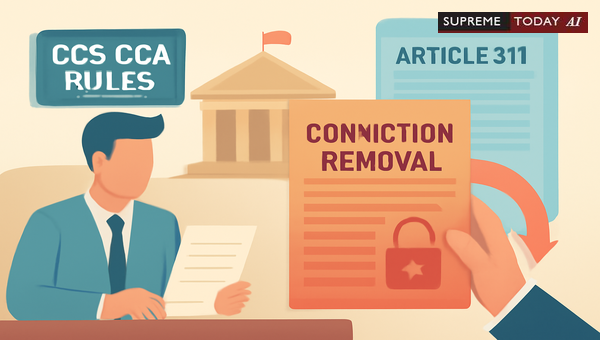
When a Central Government employee faces a criminal , questions often arise about their job security. Can they be swiftly removed from service? What rules govern this process? This post dives into the legal framework, drawing from constitutional provisions, service rules, and judicial insights to provide clarity.
Important Disclaimer: This article offers general information based on legal precedents and rules. It is not legal advice. Consult a qualified lawyer for advice specific to your situation.
In case of of a Central Government employee, what rule or provision allows for their ? The answer lies primarily in (a) of the and (CCS(CCA) Rules). These provisions enable disciplinary authorities to impose major penalties like or without a full departmental inquiry, but only under specific conditions. 1996 0 Supreme(SC) 227
alone does not trigger automatic . The must evaluate the conduct leading to the to determine if it warrants a . This nuanced approach ensures fairness while upholding service integrity. 1996 0 Supreme(SC) 227
protects civil servants from arbitrary , , or reduction in rank without an inquiry and opportunity to be heard. However, carves out an exception: Clause (2) shall not apply... where the person has been convicted on a criminal charge... if the is satisfied that the conduct which led to the ... warrants a . 1996 0 Supreme(SC) 227
Under Rule 19 of CCS(CCA) Rules, 1965, the authority may impose penalties based on the conduct resulting in , considering case circumstances without detailed procedure. 1996 0 Supreme(SC) 227 2023 0 Supreme(Raj) 576
Key principle: alone does not automatically result in ; the conduct leading to the must be considered. 1996 0 Supreme(SC) 227
The authority examines:- Nature of the offence- Conduct involved- Involvement of or serious misconduct
If the conduct justifies it, or follows. For minor or technical offences, severe penalties may not apply. 1996 0 Supreme(SC) 227
Judicial backing reinforces this: The has the undoubted power after hearing the delinquent employee and considering the circumstances of the case to inflict any ... without any further departmental inquiry. 2025 0 Supreme(All) 3280 2026 Supreme(Online)(CAT) 116
Typically, demands a hearing. But under , it's dispensed with since the serves as proof of misconduct. Proceedings are . 1996 0 Supreme(SC) 227 2024 0 Supreme(All) 380
However, courts emphasize in some contexts. In a UP case, based solely on is invalid without consideration of conduct; procedural safeguards must be observed, including issuing a show-cause notice. 2025 0 Supreme(All) 3280
For Central services, the focus remains on post- conduct review, not full inquiry.
Example: altered from murder () to grievous hurt () still led to under Maharashtra rules, absent special compassion. 2023 0 Supreme(Bom) 1436
and stress :- The authority must consider the conduct which led to the , not merely the itself. 2024 0 Supreme(All) 380- In suspension contexts, rules like limit periods post- if not removed. 2022 0 Supreme(AP) 634 2023 0 Supreme(AP) 175
State analogies apply similarly:- Pension stoppage for convicted retirees requires hearing in some views, as pension is not bounty but a benefit earned. 2017 0 Supreme(MP) 500- Educational institutions echo: on ground, but procedure mandatory unless excepted. 2022 0 Supreme(Raj) 559 2025 0 Supreme(Raj) 1304
A Karnataka case clarified temporary employees aren't auto-removed without cause, even post- absent . 2015 0 Supreme(Kar) 739
For convicted employees:- Serious cases: Expect risk.- Minor cases: Argue against .
| Aspect | Rule/Provision ||--------|----------------|| Primary Basis | (a), 1996 0 Supreme(SC) 227 || Key Criterion | Conduct leading to 2024 0 Supreme(All) 380 || | Generally not required 2024 0 Supreme(All) 380 || Serious Offences | Warrant 1996 0 Supreme(SC) 227 || Minor Offences | May not justify 1996 0 Supreme(SC) 227 |
Central Government employees enjoy protections, but convictions for grave conduct enable streamlined . Always review specifics.
References:1. 1996 0 Supreme(SC) 227: Core on -based action.2. 2024 0 Supreme(All) 380: Conduct consideration.3. 2023 0 Supreme(Raj) 576: Penalty imposition.4. 2025 0 Supreme(All) 3280: Show-cause need.5. Others as cited.
Stay informed on service rules to navigate challenges effectively.
#GovtServiceRules, #EmployeeDismissal, #LegalInsights


Rathore's case would not help the applicant's contention. This was a case dealing with rule 69 of the Central Services (Pension) Rules particularly rule 69 (i) (b). ... The Petitioner in the present case has been removed from service keeping in view the Certified Standing Order 35(E) and (F), which empowers the employer to pass an order of removal/ dismissal consequent to conviction in a criminal case. ... Based upon his c....

The Rule 18 of the KCS (CC&A) Rules, 1960 is pari passu with Rule 19 of the Central Civil Services (Classification, Control and Appeal) Rules, 1965 as reproduced in previous para. In the present case, in Criminal Misc. ... On his conviction, the Disciplinary Authority imposed major penalty of dismissal from service under Rule 11 (ix) of the Central Civil Services (Classification, Control and Appeal) Rules, 1965, vide order dated 27.06.2019 (Annexure A/2) on the ground....

State of U.P. 1993 LCD 70 held that on conviction of an employee of a criminal charge, the order of punishment cannot be passed unless the conduct which has led to his conviction, is also considered. ... The disciplinary authority has the undoubted power after hearing the delinquent employee and considering the circumstances of the case to inflict any major penalty on the delinquent employee without any further departmental inquiry, if the authority is of the opinion that the #HL_START....

Rule 14 in the case of conviction of the government servant is required to consider the ‘circumstances of case’ and make such orders thereon. The Rule does not mandate the authority to pass a reasoned and speaking order. ... The requirement of the Rule mandates that the disciplinary authority to ‘consider the circumstances’ of the case i.e. trial Court judgement leading to the conviction of the officer. The conduct/role which has led to the #HL_START....

Insofar as Rule 101 is concerned, rather than furthering the case of the petitioner, the substantive rule provides that an employee, who is removed from service, shall forfeit his pension and gratuity. Reliance is placed on the proviso. ... The employee was removed from service since he was convicted under Sec. 302 of the Indian Penal Code, which conviction was altered by the High Court to Sec. 325 of the Indian Penal Code. ... Meghe on Rul....
Before issuing the aforesaid notice, Authority should consider the nature of crime in which employee has been convicted. It is not necessary that regular departmental enquiry should be conducted after conviction by the Criminal Court. ... A rule which provides for any other case in which any of these three penalties can be imposed would be unconstitutional. ... Therefore, looking to aforesaid position of law, it can be said that upon the basis of the conviction in criminal case, depar....
The factual matrix in Anna Deoram Londhe was that the employee was removed from service since he was convicted under Section 302 of the Indian Penal Code, which conviction was altered by the High Court to Section 325 of the Indian Penal Code. ... Sub-Rule (1) provides that if an employee is alleged to be guilty of any of the grounds specified in Sub-Rule (5) of Rule 28 and if there is reason to believe that in the event of the guilt being proved, the employe....

, if, in the event of a conviction for an offence, he is sentenced to a term of imprisonment exceeding forty-eight hours and is not forthwith dismissed or removed or compulsorily retired consequent to such conviction. ... It may be relevant to refer Rule 10 (1) and (2) of the Central Civil Services (CCA) Rules, 1965, which reads as follows: “10. ... The respondents 1 and 3 have also filed their counter reiterating the same facts as stated by the 2nd respondent, but however contended that Rule#....

(b) with effect from the date of his conviction, if, in the event of a conviction for an offence, he is sentenced to a term of imprisonment exceeding forty-eight hours and is not forthwith dismissed or removed or compulsorily retired consequent to such conviction. ... It may be relevant to refer Rule 10 (1) and (2) of the Central Civil Services (CCA) Rules, 1965, which reads as follows: “10. ... The respondents 1 and 3 have also filed their counter reiterating the same facts as stated....

The penalty which can be imposed may be some other major penalty or even a minor penalty, depending upon the fact and circumstances of the each case. 11. In the case in hand, the Rule 10 (i) is an analogous rule to that of Article 311 (2)(a). ... The conviction of the delinquent employee would be taken as sufficient proof of misconduct and then the authority will have to embark upon and determine the nature and extent of the penalty to be imposed on the delinquent and it is the discre....

(ii) where it is not practicable or expedient to give that employee an opportunity of showing cause, the consent of the Director of Education has been obtained in writing before the action is taken, or (iii) where the managing committee is of unanimous opinion that, the services of an employee can not be continued without prejudice to the interest of the institution, the services of such employee are terminated after giving him six months notice or salary in lieu thereof and the consent of the Director of Education is obtained in writing.” (i) to an employee who is removed or dismi....
(i) to an employee who is removed or dismissed on the ground of conduct which led to his conviction on a criminal charge, or (iii) where the managing committee is of unanimous opinion that, the services of an employee can not be continued without prejudice to the interest of the institution, the services of such employee are terminated after giving him six months notice or salary in lieu thereof and the consent of the Director of Education is obtained in writing.” (h) On receipt of the approval as mentioned in sub-clause (g) above, the managing committee may issue appropria....

Article 311 of the Constitution or rule 19 of CCA Rules provides that an employee can be punished on the ground of conduct which has led to his conviction on a criminal charge. If an existing employee is convicted on a serious criminal charge, he can be dismissed or removed from service. Needless to mention that when an existing Government employee is dismissed or removed from service, his source of livelihood, remaining years of service as well as and right to get pension and retiral dues comes to an end. Thus, penalty/termination on an existing employee on the ground of c....

Yet she has been removed from her service without following the procedure established by law. Secondly, even if her appointment were on a temporary basis, Section 92 of the Act deals with dismissal and removal of an employee of unaided school. However, in the present case the petitioner was not convicted by the criminal court for any misconduct involving moral turpitude. According to the proviso attached to Section 92(1) of the Act, an employee can be removed or dismissed without following the procedure contemplated under Section 92 of the Act, in case if he or she commits a miscon....

Where it is not practicable or expedient to give that employee an opportunity of showing cause, the consent of the Director of Education has been obtained in writing before the action is taken, or (i) To an employee who is removed or dismissed on the ground of conduct which led to his conviction on a criminal charge, or Provided that the provisions of this rule shall not apply:-


An indispensable Tool for Legal Professionals, Endorsed by Various High Court and Judicial Officers
Please visit our Training & Support
Center or Contact Us for assistance

Scan Me!
India’s Legal research and Law Firm App, Download now!


For Daily Legal Updates, Join us on :



 Back to top


