
Searching Case Laws & Precedent on Legal Query.....!
Analysing the retrieved Case Laws
Scanned Judgements…!
Searching Case Laws & Precedent on Legal Query.....!
Analysing the retrieved Case Laws
Scanned Judgements…!
Granddaughter's Rights When Father is Alive - Generally, when the father (or a male lineal ancestor) is alive, the granddaughter does not have a right to claim partition or share in the ancestral property. Courts have held that a granddaughter cannot seek partition against her grandfather while he is alive, especially in the context of coparcenary property inherited from ancestors ["2025 Supreme(Online)(Mad) 45289"], ["2023 0 Supreme(Chh) 643"].
Legal Rulings and Principles - The Supreme Court and other courts have reinforced that, under traditional Hindu law, a granddaughter's right to partition is obstructed if her father is alive, as the property is considered coparcenary or ancestral, and the law restricts direct partition between grandchild and grandfather during the grandfather's lifetime ["2025 Supreme(Online)(Mad) 45289"].
Property Inheritance and Family Dynamics - Property inherited from paternal ancestors (father, grandfather, great-grandfather) is typically considered coparcenary property, and only male issues have rights in it during the lifetime of the senior male members. The granddaughter's claim is further limited if her mother is alive and has not claimed a share ["2025 Supreme(Online)(Bom) 6656"].
Specific Cases and Evidence - In some cases, courts have examined facts such as the presence of the grandfather at the time of incidents or the existence of documentation linking the granddaughter to her claimed ancestors. Lack of proof of such linkage or absence of relevant documents can weaken her claim ["2021 0 Supreme(HP) 976"], ["2023 0 Supreme(Gau) 1376"].
Exceptions and Circumstances - While the general rule restricts a granddaughter's right to seek partition when the grandfather is alive, circumstances like encumbrance of property, settlement, or specific family arrangements may influence court decisions. However, these are exceptions rather than the norm ["2025 Supreme(Online)(Del) 8063"].
Grandfather's Attitude and Family Relations - Courts also consider the attitude of the grandfather, especially if he has no objection to the granddaughter residing with her father, indicating that the primary legal principle remains that the granddaughter cannot unilaterally claim partition during the grandfather's lifetime ["Soundarapandian vs The Superintendent of Police - Madras"].
Analysis and Conclusion:Based on the legal principles and case law, a granddaughter cannot challenge or claim a share in the ancestral property against her grandfather while he is alive. The law restricts such claims to maintain the integrity of coparcenary rights and family hierarchy. Exceptions are rare and require specific circumstances or proof, which are generally not established in typical cases. Therefore, the Granddaughter Challenge to the will or property partition will generally not succeed when the grandfather is alive, especially if the law and evidence support the traditional inheritance and family rights framework.
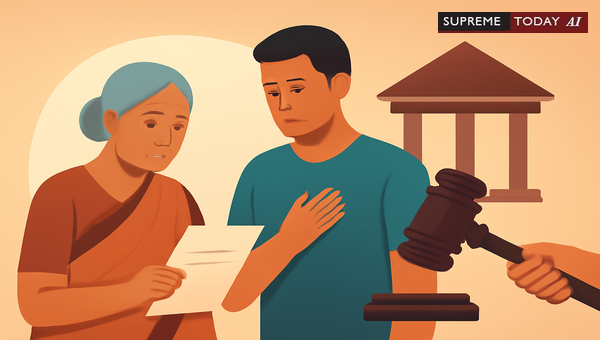
In many families, the passing of an elderly loved one like an 80-year-old grandmother raises pressing questions about inheritance and property rights. A common query is: Can 80 Years Old Grandmother Died can Grandson Claim Compensation? This often translates to whether a grandson can seek a share in her estate, compensation for losses, or challenge any will or distribution. Under Indian law, particularly Hindu law governing most such cases, the answer hinges on concepts like coparcenary rights, heirship, and succession rules. This post breaks it down step-by-step, drawing from key legal principles and precedents.
Disclaimer: This is general information based on legal precedents and not specific legal advice. Laws vary by facts, religion, and jurisdiction. Consult a qualified lawyer for personalized guidance.
Hindu families often deal with two types of property: ancestral (coparcenary) and self-acquired. Ancestral property passes by birthright among coparceners, while self-acquired property follows testamentary or intestate succession.
According to the principle of Nemo est haeres viventis (no one is an heir while their ancestor lives), a grandson typically cannot claim as an heir to his grandmother's estate if his father (the son of the grandmother) is alive. The grandson is not having any right in the property of the grandfather when the father is alive. 2019 0 Supreme(Mad) 3056
Similarly, in cases involving granddaughters: Radha Devi / wife of defendant No. 2 and daughter-in-law of applicant would get any share nor respondent No. 1 / daughter of defendant No.2 and granddaughter of applicant would get any share as her father is still alive. 2025 Supreme(Online)(MP) 3692
This extends to grandmothers' estates. The Hindu Succession Act, 1956, prioritizes Class I heirs: sons, daughters, widows first. Grandchildren enter only if the direct line (parent) predeceases. Thus, generally, a grandson has no direct claim as an heir if his father survives the grandmother. 1976 0 Supreme(Mad) 150
However, if the property is ancestral, a grandson may have coparcenary rights by birth under the Mitakshara school of Hindu law. Coparceners include sons, grandsons, and now daughters (post-Vineeta Sharma).
Under Hindu law, specifically the Mitakshara school, a grandson or granddaughter has locus standi to challenge the alienation of ancestral property by a grandfather, even if their father (the nearest reversioner) is alive. This is because they are considered coparceners entitled to a share in the property by birth. 1999 0 Supreme(HP) 199
The landmark Vineeta Sharma Vs. Rakesh Sharma affirmed daughters' coparcenary rights by birth, equal to sons. While focused on daughters, it reinforces birthrights in joint family property, potentially benefiting grandsons too. In one case: The judgment in Vineeta Sharma Vs. Rakesh Sharma was cited establishing granddaughter's rights to inherit. 2025 Supreme(Online)(MP) 3692
For a grandmother's death:- If her property includes undivided ancestral shares from her husband's HUF, the grandson (as coparcener through his father) might claim a partition share.- But pure self-acquired property of the grandmother follows her will or intestate rules, excluding grandchildren if parents live.
If the grandmother left a will, can the grandson challenge it for compensation (e.g., a share)? Standing depends on being a coparcener, not just an heir.
A granddaughter may challenge a will if she can demonstrate that the will was made under circumstances that invalidate it (e.g., lack of testamentary capacity, undue influence, etc.). However, her standing to challenge is contingent upon her being a coparcener rather than an heir. 1999 0 Supreme(HP) 199 1976 0 Supreme(Mad) 150
Analogously for grandsons:- Valid grounds: Undue influence, fraud, lack of mental capacity, or if the will alienates ancestral property disproportionately.- No standing as heir: If father alive, grandson isn't a direct heir. According to the principle of Nemo Rst-Waeres Viventis, no one can be an heir while their ancestor is alive. 1976 0 Supreme(Mad) 150
In a related partition suit: Plaintiff is entitled for 1/3rd in all these properties - Plaintiff is entitled for relief as prayed in respect of plaint 'A' schedule properties and that she is not entitled for any share in plaint 'B' schedule properties for want of proof. 2020 0 Supreme(AP) 820 This highlights proof's importance in claiming shares.
Partition and Non-Joinder: In suits, all heirs must be impleaded. In a partition suit all the legal heirs are to be impleaded – As one of the legal representatives of Muthuthevar, is not impleaded this suit is bad for non-joinder of necessary party. 2019 0 Supreme(Mad) 3056
Family Arrangements: These can settle disputes but aim to avoid litigation. The object of the family arrangement is to protect the family from long-drawn litigation or perpetual strifes. 2020 0 Supreme(AP) 820
Eviction and Family Rights: Broader family ties don't always grant property claims. When we apply the said concept, it cannot be said that merely owing to the relationship of grandfather and granddaughter, the granddaughter would not be a member of the family. 2017 0 Supreme(Del) 4252
Irrelevant sources like citizenship or organ donation don't apply here.
Pro Tip: Mediation via family courts or lok adalats often resolves amicably, preserving relations.
Typically, a grandson cannot directly claim compensation or inheritance from his grandmother's estate if his parent is alive, per heirship rules. However, coparcenary rights in ancestral property may allow challenges, especially post-Vineeta Sharma equality. Success depends on facts, proof, and property nature. 1999 0 Supreme(HP) 199 1976 0 Supreme(Mad) 150
Key Takeaways:- No automatic heirship with living parent. 1976 0 Supreme(Mad) 150- Coparcener standing possible for ancestral shares. 1999 0 Supreme(HP) 199- Challenge wills on merits, not mere relation.- Seek expert advice to avoid disputes.
For further action, gather documents and consult a lawyer. Family unity often outweighs litigation—consider settlements.
#InheritanceRights, #HinduLaw, #FamilyProperty
Radha Devi / wife of defendant No. 2 and daughter-in-law of applicant would get any share nor respondent No. 1 / daughter of defendant No.2 and granddaughter of applicant would get any share as her father is still alive. ... Challenging the order passed by the Court below, it is submitted by counsel for applicant that the applicant is father-in-law of respondent No. 2 and grandfather of respondent No. 1/p....
When the grandfather is alive, when the father is alive, the granddaughter cannot seek partition. In the latest ruling of the Hon'ble Supreme Court in the case of Vineetha Sharma Vs. ... I, Sec. 5 Verse 3) there can be no partition directly between grandfather and grandson while the father is alive.” ... cannot maintain a Suit for partition against th....
Sharma, learned senior counsel for respondents No. 1 and 2, would submit that original owner of the land was late Janak Ram, who was the father of respondent No. 1 and grandfather of respondent No. 2 and since respondent No. 1 was found unfit in medical test, he was not granted employment and none in ... The aforesaid challenge has arisen on the following factual backdrop :- 2.1. ... It is not in dispute that an item of land which was acqui....
The grandfather of the deceased, PW3, Jaisi Ram, testified that when he was returning home along with his granddaughter, then tempo vehicle came in a high speed and hit his granddaughter. ... In his cross-examination he admitted that he was walking ahead of his granddaughter, who was walking behind him. He also admitted that at that time he was holding the hands of his granddaughter. ... It is clear from ....
Dixit that plaintiff does not have any interest as long as her mother is alive and she does not claim any partition or share in the property of her father. ... Applicants and other defendants submitted application Exh.31 under Order 7 Rule 11 contending that plaintiff being granddaughter is not entitled to maintain a suit for partition and claim any share when her mother defendant No.1 is alive and she is not claiming any ....
If Ramila Bibi was 20 years of age in 1997, she would have born in the year 1977, which means that her father ought to have been alive atleast till 1976. Therefore, on the basis of the testimony of Md. Ramesh Ali, as discussed above, it cannot be said that Ext-F was proved. ... So, from the entire discussions made hereinabove, we have seen that the projected grandfather of the petitioner Wakib Ali of Village-Purbagool may be an Indian citiz....
6.2 Upon a query raised by this Court, learned counsel representing the Respondents disclosed that the grandfather has been regularly investing small amounts in Public Provident Funds (PPFs) account opened in the name of the granddaughter. ... With respect to the argument raised by the learned senior counsel for the Appellant concerning the amount of Rs. 52 lakhs deposited in FDRs by the maternal grandfather of the minor child, it is note....
There is no evidence that she is the granddaughter or daughter of the person whose names have been reflected in the Voters Lists of 1966 and 1971, respectively, whom she projected as her father and grandfather. ... So, from the entire discussions made above, we have seen that the projected father or projected grandfather of the petitioner, namely Abdul Jalil and Sikanddar Ali, respectively may be Indian c....
that plaintiff is misusing the name of father of S/o Thippanna Talwar as his maternal grandfather. ... If at all there are two sets of persons, one claimed by plaintiff to be her maternal grandfather and mother and defendants claiming to be the father of defendant ... Since the name of plaintiff's maternal grandfather and father of defendant No.1 are similar except the surname, ta....
The petitioner/grandfather also has no objection, if his granddaughter resides with her father. 6. The investigation in Crime No.157/2023 shall be completed as expeditiously as possible. ... We interacted with the petitioner and his granddaughter Supriya. ... The petitioner is the grandfather of Miss.Supriya, D/o.Ashokpandian, born on 05.10.2006 and now aged about 17 years. ... Petiti....
A living person may authorize removal of his organ when alive (a living donor to a person who is not his near relative also). Act defines near relative as 'spouse, son, daughter, father, mother, brother, sister, grandfather, grandmother, grandson or granddaughter'. This right of a person to donate his organ for transplantation into the body of a patient, which is medically required, is controlled in order to achieve one of the fundamental objects of the THO&T Act i.e. 'prohib....
This case illustrates such an unfortunate exception of a granddaughter, who lost her mother within a few days of her birth, who is denied a justifiable share in the family properties by her maternal grandmother. Yet, the grandmother was not successful during her lifetime and the will of the grandfather prevailed to give away due share in his estate to his granddaughter. A La conflict of filial bondage and economic interests in a Hindu Family is mirrored.
It is mentioned that the property in Survey No. 199/1 was purchased from Hindu Undivided Family income. The grandson is not having any right in the property of the grandfather when the father is alive.
When we apply the said concept, it cannot be said that merely owing to the relationship of grandfather and granddaughter, the granddaughter would not be a member of the family of the grandfather or that the grandfather would be prevented from seeking eviction of a tenant for accommodating his granddaughter. I have already hereinabove drawn attention to the dicta of the Supreme Court where a female was held to be entitled to continue the petition for eviction on the ground of ....
The word relative means legitimate relative and has no application to any relationship by marriage. The term any nearer relative includes father, mother, son, daughter, grandfather, grandmother, grandson, granddaughter, brother or sister. 9. The question as to who are the near relations for the purpose of Section 118 is to be determined according to the Table of Consanguinity, as per Section 28 read with Schedule I of the Act.
Login now and unlock free premium legal research
Login to SupremeToday AI and access free legal analysis, AI highlights, and smart tools.
Login
now!
India’s Legal research and Law Firm App, Download now!
Copyright © 2023 Vikas Info Solution Pvt Ltd. All Rights Reserved.







