


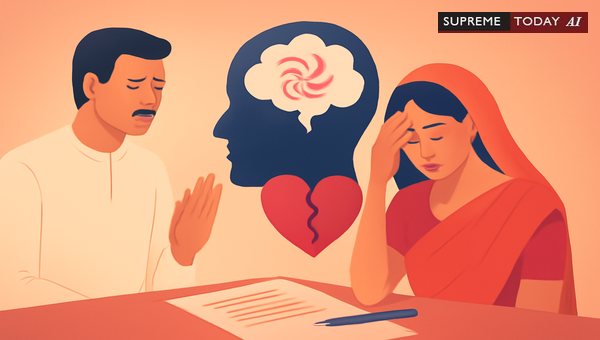
Divorce for Hindu Husband if Wife is of Unsound Mind
Marriage is a sacred bond under Hindu law, but what happens when one spouse's mental health makes cohabitation impossible? Many Hindu husbands face this dilemma: What is the Legal Remedy Available to a Hindu Husband when his Wife is of Unsound Mind and he Wants to Dissolve the Marriage? This question arises in distressing situations where a wife's disrupts family life. In this comprehensive guide, we explore the primary legal pathway under Indian family law, key judicial interpretations, evidence requirements, and practical insights. Note that this is general information and not personalized legal advice—consult a qualified lawyer for your specific case.
Primary Legal Remedy:
The cornerstone remedy for a Hindu husband in this scenario is filing for divorce under Section 13(1)(iii) of the . This provision allows dissolution of marriage if the other party has been , or has been suffering continuously or intermittently from of such a kind and to such an extent that the petitioner cannot reasonably be expected to live with the respondent. 2023 6 Supreme 264
The Explanation to this section clarifies that encompasses mental illness, arrested or incomplete development of mind, psychopathic disorder, or any other disability of mind, including schizophrenia. 2023 6 Supreme 264 However, not every mental health issue qualifies—mere abnormality or treatable conditions do not suffice. The husband must prove the disorder is and grave enough to make living together unreasonable. 2024 5 Supreme 459
Key Requirements for Success
- Incurability and Severity: The mental condition must be proven or so severe that cohabitation is untenable.
- Burden of Proof: Lies entirely on the petitioner (husband).
- Medical Evidence: Essential—includes psychiatrist reports, clinical assessments, and treatment history.
If these are established, courts typically grant a divorce decree. Conversely, manageable conditions with medication, where the wife can fulfill matrimonial duties, rarely lead to dissolution. 2024 5 Supreme 459
Judicial Interpretations: What Courts Demand
Indian courts, particularly the , have refined this ground through landmark rulings. In Kollam Chandra Sekhar v. Kollam Padma Latha (2014) 1 SCC 225, the Court ruled that the mere existence of , such as schizophrenia, is not sufficient; the disorder must be of a grave and nature supported by medical evidence. 2024 5 Supreme 459 It further noted that well-controlled disorders do not incapacitate a spouse from marital obligations, denying divorce in such cases. 2024 5 Supreme 459
This interpretation ensures protection against frivolous claims while safeguarding genuine petitioners. Courts assess the degree of disorder, not just its presence, emphasizing evidence over allegations.
Proving Unsound Mind: Role of Medical and Expert Evidence
Success hinges on robust proof. The husband must demonstrate:1. Existence of Disorder: Via credible medical reports from qualified psychiatrists or medical boards.2. Severity and Incurability: Clinical history showing continuous or intermittent suffering that defies treatment.3. Impact on Cohabitation: Testimony showing how it prevents reasonable married life.
For instance, if the wife's condition is controlled with medication and she leads a normal life, courts are unlikely to dissolve the marriage. 2024 5 Supreme 459 Expert testimony is crucial, as mere family claims fall short.
Insights from Related Cases and Exceptions
Other judicial precedents highlight limitations and nuances. In one case, allegations of the wife's unsound mind were dismissed because the court did not form any opinion regarding unsound mind of wife... there was no appointment of the guardian for the wife in the proceedings. Further, in the wedlock a child was born. 2022 Supreme(Online)(KER) 52844 2022 Supreme(Online)(KER) 28623 Despite this, the court dissolved the marriage on other grounds, underscoring that unsound mind requires standalone proof.
Similarly, courts have refused divorce where mental issues were unproven or overshadowed by factors like child birth or lack of guardian appointment. 2022 Supreme(Online)(KER) 52844 In contrast, substantial evidence of incapacity has led to dissolution, aligning with Section 13(1)(iii). 2025 Supreme(Online)(Pat) 644 2025 Supreme(Online)(Pat) 387
Exceptions and Limitations:- Temporary or Treatable Issues: Do not qualify; e.g., controlled schizophrenia. 2024 5 Supreme 459- Insufficient Evidence: Mere allegations without medical backing fail. 2025 Supreme(Online)(Pat) 644 2022 0 Supreme(Mad) 3693- Alternative Grounds: If unsound mind isn't proven, consider , , or . One case noted when a wife refused conjugal rights despite intent to perform obligations.
- Other Factors: Conversion or rituals disputes do not dissolve Hindu marriages automatically.
2014 0 Supreme(AP) 1174
Courts also weigh if the wife is declared unsound by prior order or ceases to be Hindu, potentially easing dissolution without consent. 2021 0 Supreme(All) 239 2021 0 Supreme(All) 1560
Alternative Remedies and Practical Recommendations
If divorce seems unattainable, explore:- (): Allows living apart without dissolving the marriage.- : If the wife is willing to resume cohabitation.
- Counseling: Often court-mandated for reconciliation.
Recommendations for Husbands:- Gather comprehensive medical records early.- Engage psychiatrists for evaluations.- File in family court with detailed petitions.- Consider alimony implications, as seen in cases where maintenance was awarded post-dissolution. 2022 0 Supreme(Telangana) 537
Conclusion: Key Takeaways
In summary, a Hindu husband's primary remedy is divorce under Section 13(1)(iii) of the Hindu Marriage Act, but only with ironclad proof of the wife's unsound mind rendering cohabitation impossible. Backed by cases like Kollam Chandra Sekhar, courts prioritize medical evidence to balance compassion and justice. 2024 5 Supreme 459 2023 6 Supreme 264
Key Takeaways:- Prove gravity via experts—allegations alone fail.- Exceptions abound for treatable conditions.- Explore alternatives if evidence is weak.
This outlines general principles under Hindu law; outcomes vary by facts. Always seek professional legal counsel for tailored advice. For more on family law, stay tuned to our blog.
References:- 2023 6 Supreme 264 - Statutory grounds under Section 13(1)(iii).- 2024 5 Supreme 459 - on grave, disorders.- 2022 Supreme(Online)(KER) 52844, 2022 Supreme(Online)(KER) 28623 - Cases on proof requirements.- 2025 Supreme(Online)(Pat) 644, 2022 0 Supreme(Mad) 3693, 2021 0 Supreme(All) 239, 2021 0 Supreme(All) 1560, 2025 Supreme(Online)(Pat) 387 - Additional grounds and evidence insights.
#HinduDivorce, #UnsoundMindMarriage, #FamilyLawIndia















