


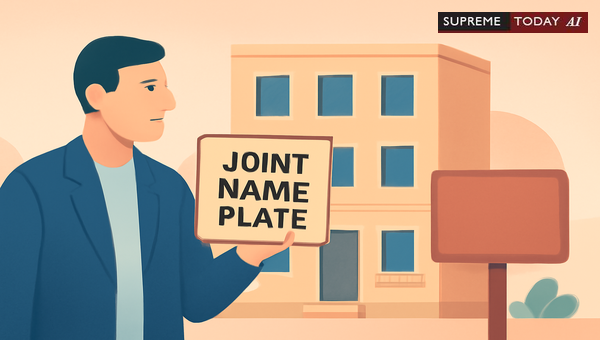
Joint Name Plate in Housing Society: Rights if Refused
Owning a flat in a cooperative housing society comes with shared responsibilities and rights, but what happens when the property is in joint names? A common issue arises: Whether there Could be Joint Name Plate in Housing Society where Flat is in Joint Name and what if Society Refuses. This question touches on ownership recognition, membership privileges, and society governance. In this post, we'll explore the legal framework, your rights as joint owners, and steps to take if the society pushes back.
Note: This article provides general information based on legal precedents and is not a substitute for professional legal advice. Consult a lawyer for your specific situation.
Understanding in Housing Societies
of flats in is widely recognized under Indian cooperative laws, particularly the (or equivalent state laws). When a flat is registered in joint names—such as between spouses or family members—both parties typically hold equal rights to the property. This is evidenced by the issued by the society, which lists both names as joint owners. For instance, in cases where a husband and wife jointly acquired a flat, both were acknowledged with equal rights 2002 0 Supreme(Bom) 1021.
Societies must respect this joint status, extending to both owners. These rights often include displaying a name plate reflecting . Refusing such a simple acknowledgment can undermine the principles of equity in cooperative frameworks.
Key Legal Principles Supporting Joint Name Plates
Recognition of : Legal documents like share certificates confirm joint status. Courts have upheld that joint owners are entitled to society privileges 2002 0 Supreme(Bom) 1021.
: Under cooperative norms, members' names can be displayed on name plates. This aligns with that do not explicitly prohibit joint displays 2023 0 Supreme(Bom) 1461.
From additional precedents, societies have processed applications for membership and share transfers in joint names, indicating acceptance of dual ownership 2025 0 Supreme(Bom) 1191. For example, Respondent No.3 and 4 claimed to have applied for the membership of the Petitioner Society and the transfer of shares in their name 2025 0 Supreme(Bom) 1191.
What If the Society Refuses a Joint Name Plate?
It's not uncommon for to resist changes, citing administrative hassles or vague by-law interpretations. However, such refusals may lack legal grounding if is duly registered.
Grounds for Challenge
Contrary to Principles: Refusal ignores established rights, as seen in cases where minor documentation discrepancies did not impede ownership claims 2023 0 Supreme(Bom) 1461.
Review: Most society do not ban joint name plates. If silent or permissive, the refusal is unjustified. Precedents emphasize that societies cannot arbitrarily deny registered joint owners their due recognition 2023 0 Supreme(Bom) 1381.
Legal Precedents on Refusal: Courts have ruled that societies must act reasonably. In one case involving share certificates, (or joint owners) could stake claims without undue barriers 2022 0 Supreme(Bom) 1892. Similarly, joint applications for membership are standard, and refusals can be appealed 2023 0 Supreme(Bom) 1381 2024 0 Supreme(Bom) 1078.
If refused, societies have faced challenges under and , where members seek declarations upholding their rights 2023 0 Supreme(Bom) 1381.
Practical Examples from Case Law
Share Certificates in Joint Names: Owners like Mannalal Surajmal Khandelwal held flats with share certificates entitling heirs or co-owners to rights 2022 0 Supreme(Bom) 1892.
Membership Transfers: Joint applicants for shares are recognized, provided consistent with lease terms 2025 0 Supreme(Bom) 1191.
No Arbitrary Denials: Courts stress that societies cannot deny rights to joint owners without valid cause, especially for residential flats 2022 0 Supreme(Cal) 1005. The flat in question is in a cooperative housing society exclusively meant for residential purpose 2022 0 Supreme(Cal) 1005.
Flats in joint names are permissible, and name plates are a standard extension of 2023 0 Supreme(Bom) 1381 2025 0 Supreme(Bom) 1455 2024 0 Supreme(Bom) 1078.
Steps to Secure Your Joint Name Plate
Don't let a refusal stand without action. Here's a roadmap:
Review Society : Check for provisions on name plates. Many are silent, supporting your request 2023 0 Supreme(Bom) 1461.
Gather Documentation: Compile share certificates, sale deeds, and proof of 2002 0 Supreme(Bom) 1021.
Formal Written Request: Submit a polite application to the managing committee, citing ownership docs.
Escalate if Needed:
- File a complaint with the Deputy/Assistant Registrar of Cooperative Societies.
- Appeal under relevant sections (e.g., 23(2) for membership disputes) 2023 0 Supreme(Bom) 1381.
Approach court for if support you 2024 0 Supreme(Bom) 1078.
Additional Insights: Societies reserve names and handle joint matters routinely 2025 0 Supreme(Bom) 1500. Refusals without basis, like in plot allotments to individuals (not joint families), highlight the need for clear registration 2010 0 Supreme(All) 1536.
In disputes, courts favor joint owners when ownership is registered, ensuring display rights 2025 0 Supreme(Bom) 1455.
Broader Context: Rights Beyond Name Plates
extends to voting, maintenance, and transfers. For instance, proposed societies can hold property entitlements pre-registration 2014 0 Supreme(Bom) 1789. Commercial misuse might complicate matters, but pure residential joint flats are protected 2014 0 Supreme(Bom) 1280.
Societies must not change names or deny rights arbitrarily 2024 0 Supreme(Bom) 455. The said building shall always be known as 'MANODAY' and the name of the Co-operative Society... shall bear the name 'MANODAY' Co-operative Housing Society' 2024 0 Supreme(Bom) 455.
Non-owners may join plot-holder societies, but flat owners' rights are stronger 2025 Supreme(Online)(Cal) 2529.
Conclusion and Key Takeaways
Joint name plates are generally permissible for flats in joint names within housing societies, reflecting recognized ownership and 2002 0 Supreme(Bom) 1021 2023 0 Supreme(Bom) 1461. If refused, challenge via review, registrar complaints, or courts—precedents support you 2023 0 Supreme(Bom) 1381 2024 0 Supreme(Bom) 1078 2025 0 Supreme(Bom) 1455.
Key Takeaways:- via share certificates entitles both to name plates.- Refusals must be by-law based; arbitrary ones are challengeable.- Act with documentation and escalate promptly.- Societies cannot undermine registered rights.
Stay informed, assert your rights, and maintain harmony in your society. For personalized guidance, reach out to a cooperative law expert.
References: 2002 0 Supreme(Bom) 1021 2023 0 Supreme(Bom) 1461 2025 0 Supreme(Bom) 1191 2022 0 Supreme(Bom) 1892 2024 0 Supreme(Bom) 455 2025 Supreme(Online)(Cal) 2529 2025 0 Supreme(Bom) 1500 2022 Supreme(Online)(Del) 7379 2022 0 Supreme(Cal) 1005 2014 0 Supreme(Bom) 1789 2014 0 Supreme(Bom) 1280 2010 0 Supreme(All) 1536 2004 0 Supreme(Bom) 524 2023 0 Supreme(Bom) 1381 2025 0 Supreme(Bom) 1455 2024 0 Supreme(Bom) 1078
#HousingSocietyLaw, #JointOwnership, #CoopSocietyRights












