


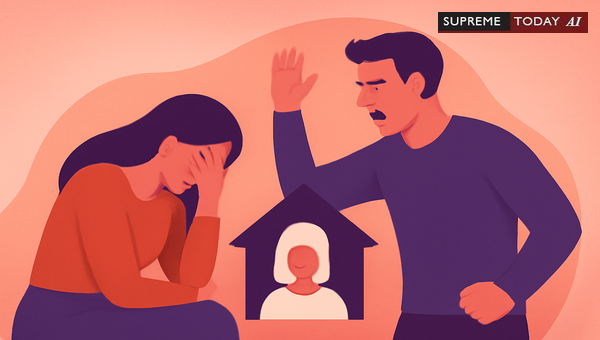
Can a Husband Be an Under DV Act?
is a pervasive issue affecting families across India, often sparking debates on legal protections. But what if the victim is the husband? Can a husband be an under the (DV Act)? This question arises frequently in matrimonial disputes, challenging the scope of gender-specific laws. In this post, we delve into the Act's definitions, judicial interpretations, and alternatives for men facing abuse. Note: This is general information, not legal advice. Consult a qualified lawyer for your situation.
Understanding the DV Act: Core Definitions
The DV Act aims to provide comprehensive protection to women against . To answer our central question—Can a Husband be an under Prevention of ?—we must start with key definitions.
Who is an ''?
Under Section 2(a) of the DV Act, an is defined as any woman who is, or has been, in a with the and who alleges to have been subjected to any act of by the 2018 0 Supreme(AP) 813 2013 8 Supreme 122. This explicit reference to woman sets the tone for the Act's protective framework, focusing solely on female victims. Courts have upheld this gender-specific definition, emphasizing its legislative intent to safeguard women 2025 0 Supreme(Ker) 1468.
- Key takeaway: The term is statutorily limited to women, excluding men by design 2013 8 Supreme 122.
What Constitutes a ''?
Section 2(f) defines a as one between two persons who live or have lived together in a , related by , marriage, or a relationship in the nature of marriage, or as family members in a joint family 2018 0 Supreme(AP) 813 2013 8 Supreme 122. While broad, this definition operates within the clause, which restricts it to women seeking relief against respondents—typically adult males 2016 7 Supreme 232.
For instance, Section 2(q) clarifies that the means any adult male person who has been in a '' with the 2022 0 Supreme(Ker) 942. This reinforces the Act's structure: women as complainants, men as potential abusers 2019 0 Supreme(Pat) 549.
Applicability to Husbands: Why Not?
The DV Act's provisions are structured to protect women, with aggrieved persons explicitly defined as women and respondents as adult males 2018 0 Supreme(AP) 813 2016 7 Supreme 232. A husband cannot claim the status of an because:
- The definition in Section 2(a) uses any woman, leaving no room for male inclusion 2021 0 Supreme(Ker) 410. As noted, Women only can be an under Section 2(a)2021 0 Supreme(Ker) 410.
- Courts have rejected attempts by men to invoke the Act, holding that it does not extend relief to husbands as victims 2022 0 Supreme(AP) 1114 2014 0 Supreme(SC) 984.
In practice, this means a husband alleging violence by his wife cannot file under for , , or exclusively under the DV Act 2018 0 Supreme(Gau) 641.
Judicial Precedents Reinforcing the Gender-Specific Scope
Indian courts have consistently interpreted the DV Act narrowly to align with its object of protecting women. Key rulings illustrate this:
- In multiple cases, courts affirmed that only women qualify as aggrieved persons, dismissing male claims outright 2022 0 Supreme(AP) 1114 2014 0 Supreme(SC) 984. The has urged a narrow interpretation of terms like relative to prevent misuse, further limiting scope 2022 0 Supreme(AP) 1114.
- Section 2 (a) means any woman who is or has been, in a with the 2018 0 Supreme(Gau) 641. This was echoed in proceedings where only female petitioners were granted relief, such as a widow protecting her against in-laws 2025 0 Supreme(Ker) 1468.
- Another ruling clarified: Only adult male can be arrayed as against whom has any grievance, quashing proceedings against females 2019 0 Supreme(Pat) 549.
- Even in maintenance disputes, courts treat DV Act proceedings as inquiries for women, not adjudications open to men 2021 0 Supreme(Ker) 410.
These precedents underscore that while the Act protects women's rights to shared households—a household where person aggrieved lives or at any stage has lived in a 2022 0 Supreme(Ker) 942—it does not reciprocate for husbands.
Alternatives for Husbands Facing
If a husband experiences abuse, the DV Act isn't the avenue. Instead, consider:
- (IPC): File FIRs under (hurt), 354 (assault), 506 (), or 498A (, though typically against husbands) where applicable.
- : Seek quashing of false cases or protection via .
- Maintenance and Divorce Laws: Under or , husbands can claim maintenance if dependent, though rare.
- General Protection: Approach police for non-DV remedies or civil suits for injunctions.
Recommendation: Men should seek counsel early, as it is advisable to explore other legal avenues outside the DVC Act2018 0 Supreme(AP) 813. Cases like post-divorce claims highlight time bars and the need for specific pleadings 2018 0 Supreme(Bom) 470.
Broader Context: and Rights
The DV Act emphasizes women's right to reside in shared households, even post-separation: The court affirmed that a woman has the right to reside in a under the DV Act, regardless of ownership of other properties2025 0 Supreme(Ker) 1468. This protective intent doesn't extend symmetrically, sparking discussions on gender-neutral laws. However, legislative design prioritizes women's vulnerability.
Conclusion and Key Takeaways
In summary, a husband cannot be classified as an under the DV Act due to its explicit focus on women 2018 0 Supreme(AP) 813 2013 8 Supreme 122. Courts uphold this through precedents, ensuring the Act serves its purpose without expansion.
Key Takeaways:- = Woman only (Section 2(a)) 2013 8 Supreme 122.- Seek IPC or other remedies for male victims.- Always substantiate claims with evidence of and violence.- Consult a lawyer for personalized guidance.
References:2018 0 Supreme(AP) 813 2013 8 Supreme 122 2022 0 Supreme(AP) 1114 2014 0 Supreme(SC) 984 2025 0 Supreme(Ker) 1468 2022 0 Supreme(Ker) 942 2021 0 Supreme(Ker) 410 2019 0 Supreme(Pat) 549 2018 0 Supreme(Gau) 641 2018 0 Supreme(Bom) 470
Stay informed, and remember: justice is accessible beyond one statute.
#DVA ctIndia, #MensRightsDV, #FamilyLawIndia















