


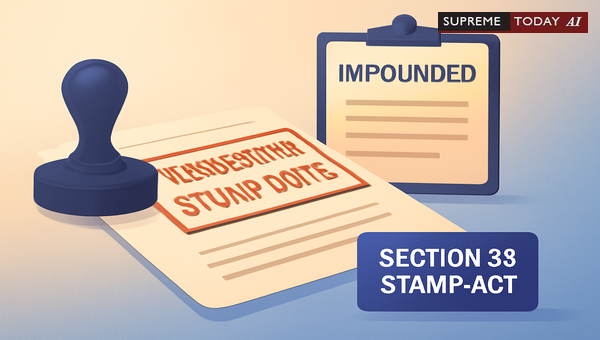
Can Unstamped & Documents Be ?
In the realm of property transactions and legal disputes in India, documents like agreements, leases, and sale deeds often face scrutiny over stamp duty and registration. A common question arises: whether a document can be if it is and both? This issue frequently surfaces in court proceedings, where parties challenge the validity and usability of such documents as .
Understanding the nuances of impounding under the (and state variants like the ), is crucial for litigants, lawyers, and businesses. Impounding isn't automatic; it hinges on specific triggers. This post breaks down the legal position, drawing from key judgments and provisions, to clarify when courts may or may not exercise this power. Note: This is general information based on precedents and not specific legal advice. Consult a qualified lawyer for your case.
Main Legal Finding
Generally, a document that is both and cannot be solely on the ground of insufficiency of stamp duty or lack of registration. Impounding typically applies when the document is produced or tendered in , and the focus is on whether it is at that moment. Courts have consistently held that without production in , mere discovery of these defects doesn't trigger impounding. 2020 3 Supreme 1 2011 5 Supreme 205
As emphasized in precedents, impounding is primarily triggered when the document is produced or tendered in and appears not to be . 2020 3 Supreme 1 This ensures the power isn't misused preemptively.
Key Points on Impounding
- Trigger for Impounding: Sections 33 and 35 of the Indian Stamp Act mandate impounding only upon production or tendering in before authorized persons or courts. 2020 3 Supreme 1
- Documents: Even if , documents requiring registration (e.g., under the ) can't be used as in certain cases, but this doesn't automatically lead to impounding. 2020 3 Supreme 1 2011 5 Supreme 205
- Combined Defects: When both issues exist, impounding isn't warranted unless presented in proceedings. Courts generally do not impound it unless it is being presented as and the deficiency is identified at that time. 2024 0 Supreme(AP) 921 2007 7 Supreme 402
- No Preemptive Action: The power is exercised during proceedings, not outside when the document merely comes into possession without evidentiary context. 2020 3 Supreme 1 2024 0 Supreme(AP) 921
Detailed Analysis: When Does Impounding Occur?
Legal Provisions Explained
The Indian Stamp Act outlines a clear process. Under Section 33, any person with authority to receive (e.g., courts) must impound an not when produced. Section 35 bars admission of unstamped or documents as unless defects are cured. However, these apply strictly at the stage. 2020 3 Supreme 1
If produced and found deficient, the court has a duty to impound and direct payment of deficit duty plus penalty. It is the duty of the Court to see that a particular document which is has to be by paying the deficit stamp duty and penalty. Just because the objection is not raised, it will not absolve the Court of its responsibility. 2025 0 Supreme(Kar) 532
Impact of Registration
Registration defects under the Registration Act don't directly invoke Stamp Act impounding. An document may be inadmissible for proving title but can serve . Combined with stamping issues, it still requires evidentiary tendering for impounding. 2024 0 Supreme(AP) 921
Landmark Case Law Insights
Several judgments reinforce this position:
: The clarified that impounding power arises only when the document is produced and appears improperly stamped. Notably, a copy of an unstamped or document cannot be validated by impounding, and it's tied to admission. 2007 7 Supreme 402
: The held that impounding occurs when the document is brought for purposes, not merely because it's and otherwise. 2024 0 Supreme(AP) 921
Additional sources highlight court duties:
In a Karnataka case under the Stamp Act, even after admission in , objections to stamping can't be raised later, but the mandatory duty to impound persists regardless of objections. The trial court ordered payment of Rs.1,68,234/- in duty and penalty. 2025 0 Supreme(Kar) 532
Another ruling quashed orders for post-admission impounding by trial courts, affirming that appellate courts can review, but ultimate determination lies with the Deputy Commissioner. Once an is admitted in , even by inadvertence, the ... cannot be questioned thereafter. 2022 0 Supreme(Kar) 480
in arbitration context (NN Global Mercantile): Unstamped instruments aren't enforceable contracts until cured, but courts under must impound if originals are deficient. 2023 0 Supreme(SC) 414
Photocopies pose unique issues: photocopy of a document cannot be , as it cannot be treated as an . 2022 0 Supreme(Ker) 964
These cases underscore that timing and context—production in —are pivotal.
Exceptions and Limitations
Impounding isn't absolute. Key exceptions include:
- During : Mandatory if produced and deficient. Courts must act . 2020 3 Supreme 1 2025 0 Supreme(Kar) 532
- Collateral Use: /stamped documents may be used for non-title purposes without impounding.
- Post-Admission: Can't question later, but duty to impound pre-admission holds. 2022 0 Supreme(Kar) 480
- Arbitration: Tribunals handle stamping issues, not bound by strict rules. 2022 0 Supreme(Del) 1835
- No Tendering: No impounding if not produced. 2024 0 Supreme(AP) 921
In one case, a sub-lease was flagged as and , but the court deferred to trial for . 2020 3 Supreme 110
Practical Recommendations
To avoid pitfalls:
- Rectify Before Use: Pay deficit stamp duty and register where required prior to tendering in court.
- Limit to Stage: Don't seek impounding outside proceedings; it's not warranted.
- Court's Role: Judges must examine stamping independently. Parties should raise objections timely.
- Penalties: Expect duty plus penalty (often 10x or more); Deputy Commissioner determines final amount. 2022 0 Supreme(Kar) 480
For agreements like sale deeds, ensure compliance from inception to prevent evidentiary bars.
Conclusion and Key Takeaways
In summary, a document and cannot be merely on those grounds without being produced or tendered as . The process safeguards revenue while tying to procedural fairness. Key takeaway: Impounding is evidentiary, not preemptive.2020 3 Supreme 1 2024 0 Supreme(AP) 921
- Always verify stamp duty based on market value.
- Registration is mandatory for certain documents; non-compliance risks inadmissibility.
- Courts have mandatory duties, but powers are context-specific.
Stay compliant to streamline legal proceedings. For tailored guidance, reach out to a stamp duty expert or advocate.
References: Cited document IDs from judicial precedents.
#StampDutyLaw #DocumentImpounding #LegalAdmissibility












