


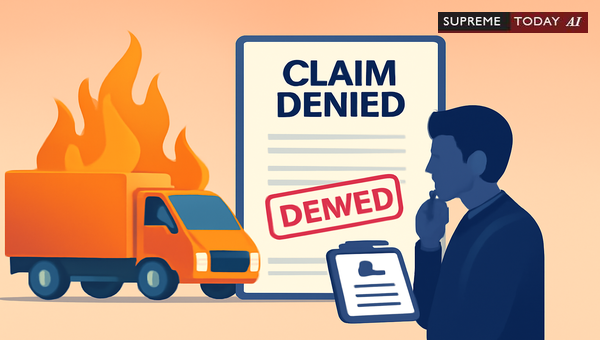
Can Insurers Deny Truck Fire Claims Without Proof?
Imagine your truck bursts into flames due to an unavoidable situation—perhaps a mechanical fault or external factor beyond control. You file a claim with your insurance company, only to hear it's being classified as a and denied. But can they do this without proper proof? This is a common frustration for truck owners and fleet operators facing fire-related losses.
In this post, we explore the legal landscape surrounding truck fire insurance claims, particularly when insurers attempt to deny coverage without substantiating evidence. Drawing from key court judgments, we'll break down the insurer's obligations, relevant precedents, and practical tips. Note: This is general information based on legal principles and is not specific legal advice. Consult a qualified attorney for your situation.
The Core Legal Question
If a Truck Gets Fire Due to Unavoidable Situation, and Claiming Money from Insurance Company, can a Insurance Company Say Non Standard Claim, Without Submitting Proper Proof to the Court?
The short answer: No, generally not. An insurance company cannot arbitrarily classify a claim as non-standard or deny it without submitting credible proof, especially for fires stemming from unavoidable or accidental causes. Courts consistently hold that the insurer bears the to justify denial. Mere suspicion or incomplete reports won't suffice.
United India Insurance Co. Ltd. VS Raghava Ispat - Consumer (2024)
Insurer's Obligation to Provide Proper Proof
Under standard fire insurance policies, coverage typically extends to accidental fires unless explicitly excluded. When a truck fire occurs due to an unavoidable situation, the insurer must investigate thoroughly. However, they cannot rely on vague assertions.
Key Legal Principles
- Burden on Insurer: The insurer must produce credible evidence like expert reports, police investigations, or forensic analysis to support denial. Courts have ruled that the insurer's reliance on reports that do not conclusively establish the cause of fire or are based on suspicion is inadequate.
United India Insurance Co. Ltd. VS Raghava Ispat - Consumer (2024)
- No Arbitrary Denials: Simply labeling a claim non-standard without proof is unjustified. In one case, the court observed that the insurance company has settled the claim of the appellants based on reports that indicated the fire was accidental.
United India Insurance Co. Ltd. VS Raghava Ispat - Consumer (2024)
- Surveyor Reports Scrutinized: If a surveyor's report lacks reasoning or evidence—e.g., concluding a blast wasn't due to fire without basis—it cannot uphold denial.
United India Insurance Co. Ltd. VS Raghava Ispat - Consumer (2024)
This principle echoes broader insurance law: Once a case for coverage is made (e.g., accidental fire), the shifts to the insurer. 2023 2 Supreme 28
Landmark Court Rulings on Fire Claims
Indian courts, including and , have addressed similar disputes repeatedly.
Case Spotlight: Accidental vs. Suspicious Fires
United India Insurance Co. Ltd. VS Raghava Ispat - Consumer (2024)
In a pivotal ruling, the court held that insurers cannot travel beyond the grounds mentioned in the letter and that the on grounds of suspicion is not sustainable. Proper proof, such as admissible forensic evidence, is mandatory for claims involving alleged non-accidental causes. The insurer's duty is clear: Substantiate or settle.
Refusal Without Conclusive Evidence 2025 8 Supreme 364
Here, the court deemed an insurer's refusal unjustified because reports did not conclusively prove that the fire was not accidental. This reinforces that incomplete investigations lead to overturned denials.
Precedent on Surveyor Assessments 2023 2 Supreme 28
Referencing Amalendu Sahu vs. Oriental Insurance Co. Ltd., courts note: Once a surveyor's report indicates fire damage and isn't disputed, denial on suspicion alone fails. This protects policyholders from arbitrary rejections.
Insights from Additional Cases
Other judgments highlight nuances:
Exclusions: Coverage may be denied if the insured admits fire from without an 'add-on' cover. The Complainant having admitted that the fire was caused due to and having not taken ‘add on’ cover of , it certainly gets excluded from the Policy. 2022 Supreme(Online)(NCDRC) 298 However, this requires proof of the cause, not assumption.
Challenges: In disputes over surveyor findings, like misrepresentation claims, criminal complaints against surveyors were dismissed when evidence was lacking. This underscores the need for solid proof before . 2019 0 Supreme(SC) 496
Motor Vehicle Fire Contexts: For trucks, own-damage claims paid by insurers can imply policy compliance, weakening third-party denial arguments. 2008 0 Supreme(UK) 10 2008 0 Supreme(All) 31
These cases illustrate that while exclusions exist (e.g., deliberate arson, policy lapses), they demand concrete evidence, not speculation.
Exceptions: When Denials May Hold
Insurers can succeed in denial if they provide robust proof:- Credible Forensic/Police Reports: Linking fire to fraud or excluded perils.- Policy Exclusions Proven: E.g., no coverage for without rider.
UNITED INDIA INSURANCE CO. LTD. vs DALAS BIOTECH LIMITED
- Fraud or Misrepresentation: Established via investigation, as in surveyor cases. 2019 0 Supreme(SC) 496Absent this, courts typically side with the insured, awarding claims plus interest and costs. 2019 0 Supreme(SC) 1284
Practical Recommendations for Truck Owners
To safeguard your claim:- Document Everything: Photos, videos, witness statements, and immediate FIR/police report.- Prompt Reporting: Notify insurer within policy timelines to avoid laches arguments.- Challenge Surveyors: Dispute flawed reports via if needed.- Seek Legal Help Early: Forums like handle insurance disputes efficiently.
Insurers should:- Conduct thorough, unbiased investigations.- Avoid suspicion-based repudiations to prevent litigation losses.
Key Takeaways
| Principle | Court Stance | Citation ||----------|-------------|----------|| | On insurer for denial |
United India Insurance Co. Ltd. VS Raghava Ispat - Consumer (2024)
|| Suspicion Insufficient | Requires concrete evidence | 2025 8 Supreme 364 || Surveyor Reports | Must be reasoned/disputable | 2023 2 Supreme 28 || Exclusions | Proven cause needed | 2022 Supreme(Online)(NCDRC) 298 |Conclusion
In summary, insurance companies cannot declare truck fire claims 'non-standard' without proper proof, particularly for unavoidable situations. Courts demand evidence, protecting policyholders from unfair denials. By understanding these principles, you can navigate claims confidently.
Disclaimer: Legal outcomes vary by facts and jurisdiction. This post summarizes general precedents like
United India Insurance Co. Ltd. VS Raghava Ispat - Consumer (2024)
2025 8 Supreme 364 and is for informational purposes only. Always consult a legal professional for advice tailored to your case. #InsuranceClaimDenial #TruckFireInsurance #LegalRights















