


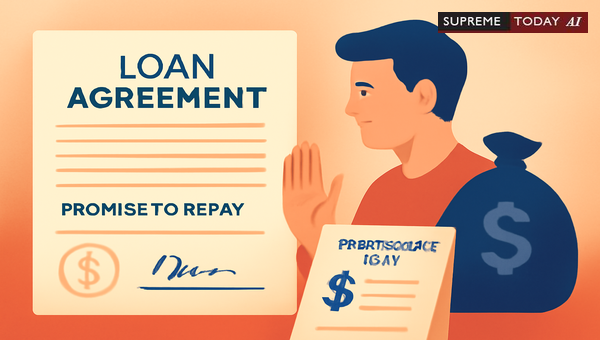
Is a Promise to Repay a Loan Legally Binding?
Lending money to a friend, family member, or business associate with a verbal or written promise to repay in the future is a common scenario. But what happens when repayment doesn't occur? Is money lent with a future repay promise legally binding? This question often arises in disputes, raising concerns about whether it's a simple civil matter or potentially criminal. In this post, we'll explore the legal nuances under Indian law, drawing from key judicial principles and case insights.
Note: This article provides general information based on legal precedents and is not a substitute for professional legal advice. Consult a qualified lawyer for your specific situation.
Understanding the Nature of Loan Agreements
At its core, a money lending agreement with a promise to repay creates a . Under contract law, when one party lends money to another expecting repayment, it forms a debt. This is not an immediate debt but a promise to pay in the future, which courts recognize as binding.
For instance, a division bench clarified that entering into certain agreements, like a chitty, does not create a debt immediately but embodies a promise to pay, indicating that the obligation arises from the agreement itself rather than an existing debt 2019 0 Supreme(SC) 1237. Similarly, a bond is defined as a written instrument evidencing a debt, where the issuer promises to repay borrowed money at a specified time, aligning lending agreements with this concept 1994 0 Supreme(SC) 234.
Other cases reinforce this. A contract of loan of money is a contract whereby one person lends or agrees to lend a sum of money to another in consideration of an express or implied promise to repay that sum on demand or at a fixed or determinable time or conditionally upon an event which is a certainty 2022 0 Supreme(Cal) 427
Keshavlal Khemchand and Sons Pvt. Ltd. VS Union of India
. This definition underscores that even implied promises can bind parties.Key Elements of a Valid Loan Promise
- Agreement: Clear terms on amount, repayment timeline, and interest (if any).
- Consideration: Money advanced in exchange for the promise.
- Intention: Parties must intend to create legal relations.
Without proper documentation, proving the agreement becomes challenging, as seen in cases where oral promises lacked evidence 2024 Supreme(Online)(Kar) 43193.
Civil vs. Criminal Liability: Breach or ?
A critical distinction lies between (civil) and (criminal) under .
- : If the borrower intended to repay at the time of borrowing but later defaulted due to financial issues, it's typically civil. Lenders can sue for recovery.
- : Requires fraudulent or dishonest intention from the outset. If a borrower deceives the lender into believing they will repay the loan without the intention to do so, it constitutes 2006 6 Supreme 66. Mere non-repayment isn't enough; proof of initial deceit is key 2008 0 Supreme(SC) 1851 2006 0 Supreme(SC) 645.
Courts emphasize the borrower's intention at the time of agreement. The intention of the parties and the content of the documents are crucial in determining the nature of a transaction, whether it is a loan or a sale 2023 0 Supreme(Cal) 1089. In money recovery suits, admissions like issuing cheques or partial payments strengthen the lender's case 2022 0 Supreme(Cal) 427.
Role of Documents: Promissory Notes and Guarantees
Written evidence is crucial. A is valid if it contains a clear promise: The words ‘agree to repay the same with interest’ would amount to promise. It is enough the contained a promise made to the promisee... to repay a certain sum of money 2022 0 Supreme(Mad) 226.
Even hybrid documents can support loan claims. Ex.A1... carries two parts. First the transaction of money and promise to repay with interest on demand. Secondly, the security of immovable property as mortgage... the content of the document is important and not the nomenclature assigned by the parties 2020 0 Supreme(Mad) 1377. Courts look at substance over labels.
Guarantees add protection: A third party promises to fulfill the borrower's obligation if they default. Without explicit guarantees, recourse is limited to the borrower 2021 1 Supreme 584.
Under laws like the , lenders must comply with licensing for larger sums, but personal loans often fall outside strict regulation unless specified
.
Exceptions and Challenges for Lenders
- Fraudulent Intent: If proven (e.g., borrower vanishes post-loan), criminal charges may apply 2008 5 Supreme 383.
- Document Disputes: Transactions misclassified as sales vs. mortgages hinge on evidence and intent 2023 0 Supreme(Cal) 1089.
- Limitations: Recovery suits have time bars; act promptly.
- NPAs in Banking: For formal loans, non-repayment leads to , with definitions allowing flexibility: Advancing of money... under an agreement by which the recipient... agrees to repay the amount on such agreed terms
Keshavlal Khemchand and Sons Pvt. Ltd. VS Union of India
.
In one case, a lender relied on an agreement despite no license, but courts upheld basic obligations
.
Practical Recommendations for Lenders
To safeguard interests:1. Document Everything: Use promissory notes or written agreements specifying amount, interest, repayment schedule, and penalties.2. Witnesses and Guarantees: Involve third parties for stronger enforceability.3. Interest and Compliance: Check local money lending laws (e.g., Section 13) 2022 0 Supreme(Cal) 427.4. Digital Records: Emails or apps for tracking.5. Legal Recourse: Start with demand notices; escalate to civil suits or police if fraud suspected.
Conclusion and Key Takeaways
Generally, money lent with a future repayment promise is legally binding as a contract, enforceable civilly unless fraudulent intent elevates it to . The borrower's initial intention and documentation quality determine outcomes. Cases like those under IPC Section 415 highlight: failure to repay alone isn't criminal, but deceit is 2006 6 Supreme 66 2006 0 Supreme(SC) 645.
Key Takeaways:- Promises create debts; document them clearly.- Distinguish civil defaults from criminal fraud.- Courts prioritize intent and evidence over labels.
By understanding these principles, lenders can better protect themselves. For personalized guidance, reach out to a legal expert.
References
2019 0 Supreme(SC) 1237 1994 0 Supreme(SC) 234 2008 0 Supreme(SC) 1851 2006 0 Supreme(SC) 645 2021 1 Supreme 584 2006 6 Supreme 66 2008 5 Supreme 383 2024 Supreme(Online)(Kar) 43193 2023 0 Supreme(Cal) 1089
2022 0 Supreme(Cal) 427 2022 0 Supreme(Mad) 226 2020 0 Supreme(Mad) 1377
Keshavlal Khemchand and Sons Pvt. Ltd. VS Union of India
Keshavlal Khemchand and Sons Pvt. Ltd. VS Union of India
#LoanLaw, #DebtRecovery, #LegalBinding














