


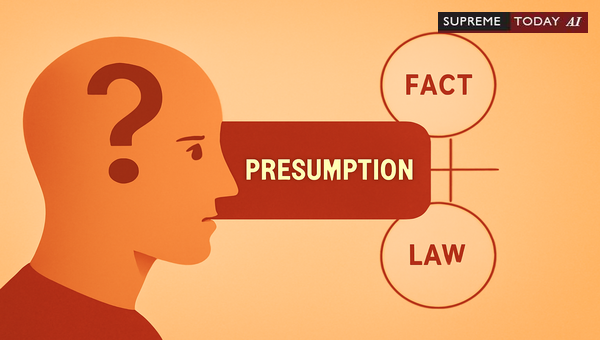
Presumptions in Law Without Specific Acts Explained
In legal proceedings, presumptions play a crucial role in facilitating proof where direct evidence might be scarce. But what happens when no specific Act provides for a presumption? This is a common query: Presumption under no Act. Generally, courts rely on general principles of law, drawing reasonable inferences from established facts rather than rigid statutory rules. This blog post breaks down the concept, types, application, and limitations of presumptions in such scenarios, drawing from key judicial insights and statutes for context. Note: This is general information, not legal advice. Consult a qualified lawyer for your specific case.
The Core Concept of Presumption in Law
Presumption refers to an inference or conclusion drawn from known or proved facts, which can be rebutted unless specified otherwise. It shifts the burden of proof to the party against whom it operates but is never conclusive proof—merely a rule of inference. 2023 7 Supreme 49 2006 5 Supreme 547
Without a specific Act mandating a presumption, courts apply general principles: they may draw logical inferences from facts, but these must be reasonable and evidence-based. The absence of a statutory presumption does not preclude the court from drawing inference based on facts established. 2006 5 Supreme 547
Types of Presumptions
Presumptions are broadly classified into two categories:- (): Discretionary. Courts may infer a fact based on common sense and evidence. For example, recent possession of stolen goods may suggest involvement, but this is rebuttable. 2023 7 Supreme 49 1973 0 Supreme(SC) 309- (): Mandatory if conditions are met. Courts shall presume the fact, shifting the burden, though it remains rebuttable. 2023 7 Supreme 49 2000 8 Supreme 498
Even absent a statute, these distinctions guide judicial discretion. Presumption is a tool to facilitate proof, not a substitute for evidence. 2023 7 Supreme 49 2006 5 Supreme 547
Presumptions When No Specific Act Applies
The question Presumption under no Act highlights scenarios without tailored statutory provisions, like those in the or other laws. Here, courts turn to foundational evidence rules:
- Inferences from Facts: Courts draw presumptions based on probabilities. If direct evidence is absent, courts may draw inferences or presumptions based on surrounding circumstances, but such inferences must be reasonable and supported by facts. 2006 5 Supreme 547
- No Automatic Application: Without statutory backing (e.g., no ), it's not mandatory. The court exercises judgment, ensuring the holds—prosecution must still prove . 2023 7 Supreme 49
For instance, mere long absence doesn't presume death without /108 conditions. The court cannot presume death merely because a person has been missing for over seven years unless the specific statutory presumption applies. 2004 2 Supreme 709
Statutory Examples for Contrast and Insight
While the focus is on no Act, understanding statutory presumptions illustrates general principles. These often use or :
(NI Act) Section 139
The presumption under Section 139 of the is a , as distinguished from presumption of facts. 2020 0 Supreme(Guj) 635 2020 0 Supreme(Guj) 956 2019 0 Supreme(Kar) 2294 2019 0 Supreme(Kar) 2244 2019 0 Supreme(Kar) 2024
It presumes a cheque was issued for a legally enforceable debt—rebuttable on probabilities, not . The burden of rebuttal lies with the accused, and rebuttal does not require proof but on probabilities.
Amit Jain VS Sanjeev Kumar Singh - Crimes
2023 0 Supreme(P&H) 3002 2024 0 Supreme(Guj) 68Presumptions are rules of evidence and do not conflict with the . 2020 0 Supreme(Guj) 635
Presumes gratification by a public servant was for official purposes (). Rebuttable by accused evidence. 2000 8 Supreme 498 2023 2 Supreme 742
Presumes culpable mental state for duty evasion—rebuttable. 2023 1 Supreme 691
These show how statutes codify general rules; without them, courts apply similar logic discretionarily.
Rebutting Presumptions: Key Principles
All presumptions discussed are rebuttable:- Produce credible evidence showing the presumed fact is improbable.- Standard: , not . The obligation on the prosecution may be discharged with the help of presumptions... unless the accused adduces evidence showing the reasonable possibility of the nonexistence of the presumed fact. 2020 0 Supreme(Guj) 956 2019 0 Supreme(Kar) 2294
Examples:- NI Act: Defendant shows no debt existed. 2018 0 Supreme(SC) 743- Stolen property: Explain lawful possession. 1973 0 Supreme(SC) 309- Corruption: Disprove gratification intent. 2023 2 Supreme 742
Rebuttable presumptions can be displaced by evidence produced by the opposing party. 2023 7 Supreme 49
Limitations and Exceptions
Presumptions have boundaries, especially without statutes:- Cannot Replace Proof: They assist, not substitute, essential facts. 2006 5 Supreme 547- : Fundamental; statutory presumptions don't override it. 2007 2 Supreme 177 2023 7 Supreme 49- Conditions Must Be Met: For , foundational facts required; else, no presumption arises.- Illegal Foundations: Presumptions from unlawful searches fail. 2018 0 Supreme(SC) 743- Limited Scope: E.g., presumes death after 7 years but not time/manner. 2004 2 Supreme 709
Statutory presumptions are subject to the conditions specified within the act; if conditions are not satisfied, the presumption does not arise. (From general analysis in sources)
Practical Recommendations
- Verify if any statute applies first.
- For rebuttal, gather probability-based evidence early.
- Distinguish (mandatory) vs. (discretionary). 2006 0 Supreme(SC) 1124
- Use presumptions strategically in lacking direct evidence, but prepare for challenges.
When relying on presumption, ensure the conditions for statutory presumptions are satisfied. Always consider the possibility of rebuttal. (Derived from 2023 7 Supreme 49)
Conclusion and Key Takeaways
In summary, presumption under no Act relies on general legal principles: courts draw rebuttable inferences from facts, distinguishing factual (discretionary) from legal (mandatory where applicable) types. Absent statutes, flexibility reigns, but reasonableness is key. Statutory examples like reinforce that presumptions aid proof without eroding innocence. 2023 7 Supreme 49 2006 5 Supreme 547
Key Takeaways:- Presumptions shift burdens but are rebuttable on probabilities.- No statute? Use fact-based inferences judiciously.- Always rebut with evidence; standard is lower than criminal proof.- prevails.
This framework empowers better navigation of evidence challenges. For tailored advice, seek professional legal counsel.
#LegalPresumption, #EvidenceLaw, #RebuttablePresumption















