


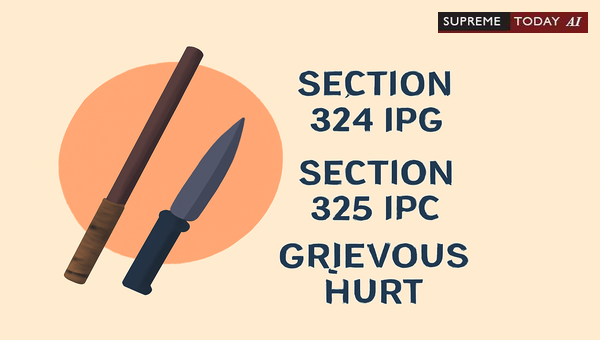
Is Lathi a Instrument Under IPC? Legal Analysis
In the realm of Indian criminal law, the classification of weapons plays a pivotal role in determining charges and penalties. A common question that arises in assault cases is: Is Lathi a Instrument Under IPC? This query often surfaces in disputes involving traditional implements like the lathi—a wooden stick widely used in rural India for herding, self-defense, or unfortunately, altercations. Understanding its legal status under the Indian Penal Code (IPC) can significantly impact case outcomes.
This blog post delves into the legal analysis of a lathi, drawing from judicial precedents and statutory provisions. We'll examine its nature, relevant IPC sections, court findings, and comparisons with other instruments. Note: This is general information based on legal interpretations and not specific legal advice. Consult a qualified lawyer for case-specific guidance.
What is a Lathi? Definition and Characteristics
A lathi is fundamentally a wooden stick, typically long and sturdy, employed for assault or defense. It is described as a hard and blunt object, lacking any sharp edge designed for slicing or piercing. Unlike knives, axes, or spades, a lathi relies on impact force rather than action to inflict harm.
Legal documents consistently portray it this way, emphasizing its blunt nature. For instance, witness testimonies have confirmed assaults with a lathi, explicitly distinguishing it from sharp weapons 2017 0 Supreme(Jhk) 344. This distinction is crucial, as IPC classifications hinge on an instrument's inherent design and capability.
Legal Framework: IPC Sections 324 and 325
Under the , the nature of the weapon dictates the applicable offense:
: Punishes by or means, including instruments for shooting, , or , or those likely to cause death when used as a weapon of offense. The emphasis is on the instrument's potential lethality by design 2023 0 Supreme(All) 2699.
: Addresses voluntarily causing without specifying , applicable to injuries.
Courts have ruled that a lathi does not meet the criteria of an instrument likely to cause death or one used for . It is not considered a dangerous weapon by its very nature2016 0 Supreme(MP) 461 2016 0 Supreme(MP) 1103. Instead, it aligns more with Section 325 for causing , as it can produce simple or serious injuries through blunt trauma but lacks capability 1980 0 Supreme(All) 341.
The legal test often involves assessing whether the weapon is inherently lethal. As one ruling notes, for Section 324, the instrument must render death probable by its nature, which a lathi does not
.
Judicial Findings on Lathi's Classification
Indian courts have repeatedly clarified that a lathi is a , not a instrument. In a notable case, the learned trial judge observed that while a lathi can cause simple or , it falls outside Section 324's ambit. It is appropriately handled under 1980 0 Supreme(All) 341.
Witness accounts reinforce this: the deceased was assaulted with a lathi and not with sharp weapons, underscoring its non- status 2017 0 Supreme(Jhk) 344. Furthermore, courts have held that a lathi used in assaults cannot be said to be by its very nature an instrument likely to cause death
.
This classification impacts sentencing. For example, in cases involving land disputes, convictions under () were set aside due to the lack of to kill, evidenced by non-grievous injuries from lathis or similar blunt objects, while upholding Sections 323 and 324 with reduced sentences 2024 0 Supreme(Jhk) 865.
Comparisons with Other Instruments: What Qualifies as ''?
To appreciate the lathi's status, consider judicial distinctions with other tools:
Sharp Weapons: Items like a spade (used in agriculture but capable of ), dao (sharp-edged), basula (carpenter’s axe), or bhujali (described as a sharp instrument) are classified differently. Witnesses identifying these as 'sharp instruments' lead to escalated charges 2024 0 Supreme(Jhk) 865 2012 0 Supreme(UK) 620 2012 0 Supreme(Jhk) 1765 2012 0 Supreme(Jhk) 1326.
Non- Instruments: Like the lathi, human nails are not deemed instruments for or under Section 324. Courts have quashed charges under Section 324 for nail scratches, noting they are not an instrument used for either or 2015 0 Supreme(MP) 765. Similarly, a moosal (grinding instrument) or aut (for grass, but context-specific) may not inherently qualify as lethal unless proven otherwise 2012 0 Supreme(UK) 620 2020 0 Supreme(Bom) 463.
These comparisons highlight that , nature of injuries, and weapon design are evaluated holistically. Mere presence of injuries does not elevate a blunt tool to 'dangerous' status; permanence and severity must be established 2023 0 Supreme(All) 2699.
In one appeal, convictions under were altered to lesser offenses due to non-serious injuries from such weapons, stressing the prosecution's burden to prove beyond reasonable doubt 2024 0 Supreme(Jhk) 865.
Practical Implications in Legal Arguments
When arguing cases involving lathis:- Emphasize distinctions: Highlight the gap between blunt (lathi) and sharp instruments (dao, spade).- Cite precedents: Reference IPC sections and cases like those quashing overcharged Section 324 claims 2015 0 Supreme(MP) 765.- Consider context: Sudden fights or land disputes often lack premeditated , leading to reduced charges 2024 0 Supreme(Jhk) 865.
Probation or sentence reductions may apply in long-pending cases, factoring age, rehabilitation, and evidence strength 2023 0 Supreme(All) 2699.
Conclusion and Key Takeaways
Based on reviewed legal documents, a lathi is not an instrument used for . It is a capable of injury but not inherently dangerous or lethal under IPC standards, typically falling under Section 325 rather than 324 2016 0 Supreme(MP) 461 2016 0 Supreme(MP) 1103. Judicial interpretations, witness evidence, and comparisons affirm this view.
Key Takeaways:- Lathis cause hurt via , not .- Courts prioritize weapon nature and injury severity for classification.- Prosecution must prove beyond doubt for higher charges like Section 324 or 307.- Always distinguish from sharp tools like spades or daos.
For those facing or defending in such cases, understanding these nuances is essential. Stay informed on evolving jurisprudence, and seek professional legal counsel.
References:- 1980 0 Supreme(All) 341- 2017 0 Supreme(Jhk) 344- 2016 0 Supreme(MP) 461- 2016 0 Supreme(MP) 1103- 2024 0 Supreme(Jhk) 865- 2023 0 Supreme(All) 2699-
- 2015 0 Supreme(MP) 765- 2012 0 Supreme(UK) 620
(Word count: approx. 1050)
#IPCLaw, #LathiWeapon, #CriminalLawIndia















