



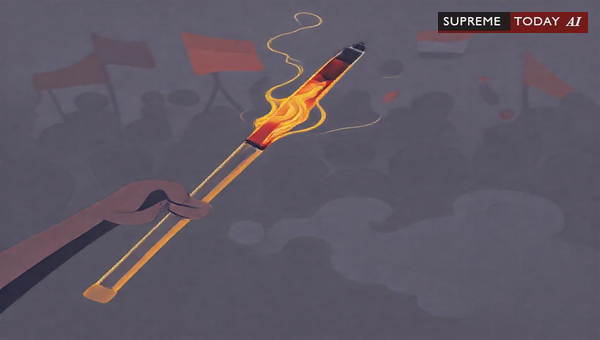
Evaluating Whether a Lathi Constitutes a in Cases of Rioting Under Section 148
The (IPC) distinguishes between various degrees of rioting, with the severity of the charge often depending on the nature of the weapons involved. A frequently contested issue in criminal courts is whether a lathi—a common bamboo staff—qualifies as a for the purposes of . Understanding the classification of such objects is crucial, as provides for a more rigorous punishment than basic rioting, and the misclassification of a weapon can lead to significant discrepancies in sentencing.
Understanding :
prescribes punishment for rioting when the accused is armed with a or with anything which, when used as a weapon of offence, is likely to cause death. The essential ingredients that the prosecution must establish to sustain a conviction under this section include:
- The assembly of five or more persons.
- The existence of an with a .
- The use of force or violence in the prosecution of that .
- The fact that the accused was a member of this assembly.
- The presence of a or an instrument capable of causing death
2021 0 Supreme(Gau) 24.
The law is clear that the term generally refers to objects explicitly designed to cause death, such as firearms, rifles, or swords. The second limb of the provision—anything which, used as a weapon of offence, is likely to cause death—is intended to capture instruments that, while not inherently deadly, pose a lethal threat based on the manner in which they are deployed 2011 0 Supreme(All) 2401.
Is a Lathi Categorized as a ?
The judicial consensus on whether a lathi qualifies as a typically leans toward the negative. In multiple instances, courts have held that a lathi is neither a by design nor inherently likely to cause death when used in a standard manner 2011 0 Supreme(All) 2401.
For example, in various appellate decisions, courts have drawn clear distinctions between instruments like farsas, gadasas, or firearms, and wooden staffs like lathis. When an accused is armed only with a lathi, while other members of the assembly carry undeniably lethal weapons, courts have often quashed convictions under , arguing that the lathi does not satisfy the statutory threshold of a 2011 0 Supreme(All) 2401.
In cases where the prosecution fails to produce evidence that the lathi was used in a specific, exceptionally violent manner likely to result in death, the judiciary has frequently set aside convictions under 2022 0 Supreme(Cal) 1018. This is supported by findings where courts observed that injuries caused by a blunt object, while constituting assault or hurt, do not automatically escalate the offence to the category required for Section 148 2021 0 Supreme(Gau) 24.
Alternative Convictions: When Section 148 Does Not Apply
If a court determines that an accused was not armed with a as defined by law, the charge under cannot be sustained. However, this does not mean the accused walks free. Depending on the evidence, the prosecution and the court may pivot to other relevant sections of the .
1. Conviction Under ()
If an accused participated in an and used force but was not carrying a , the appropriate conviction is typically under , which deals with . The penalty for Section 147 is generally less severe than Section 148. Courts have explicitly directed that where the evidence supports participation in an but fails to prove the element, the conviction should be reduced to Section 147 2011 0 Supreme(All) 2401.
2. Conviction Under ()
When injuries are inflicted during the altercation, even if the weapon was a lathi, the accused may be found guilty of under . This is often read in conjunction with (acts done by several persons in furtherance of common intention) to establish liability for the physical harm caused 2022 0 Supreme(Cal) 1018.
3. The Role of ()
is a vital provision that holds members of an liable for offences committed in prosecution of their . Even if a specific member of the assembly was not carrying a , they may still be held vicariously liable for the acts of other members who did carry such weapons, provided the conditions of are satisfied. This allows the law to account for the collective responsibility of the mob, regardless of whether every individual was armed with a lethal instrument 2017 0 Supreme(Ori) 1328.
The Principle of Mutual Exclusivity
A critical legal doctrine established by the courts is that a person cannot be convicted and sentenced simultaneously under both Section 147 and for the same act of rioting 2011 0 Supreme(All) 2401. These sections are viewed as regarding the specific nature of the weapon carried:
- If the accused is armed with a , Section 148 applies.
- If the accused is not armed with a , Section 147 applies.
It is considered legally erroneous for a trial court to convict an individual for both. If a higher court finds that a conviction under Section 148 was unjustified due to the nature of the weapon (e.g., a lathi), it will typically set aside that conviction and, if the evidence supports it, maintain the conviction under Section 147 2012 0 Supreme(All) 25392000 0 Supreme(Bom) 587.
Conclusion and Key Takeaways
The characterization of a lathi under is fact-dependent but generally does not meet the threshold. While courts have occasionally upheld more serious charges if the evidence demonstrates a lethal manner of use, the prevailing view is that lathis are blunt instruments associated with (Section 147) rather than the enhanced offence of rioting with a (Section 148).
When dealing with such charges, the prosecution must ensure that the deadly nature of the weapon is clearly proven. If that burden is not met, the court retains the authority to convict the accused under alternative provisions like or , ensuring that the punishment remains proportional to the specific actions and capabilities of the accused. As judicial interpretations can vary based on the specific circumstances of each case, the evidentiary record regarding the weapon and the injuries sustained remains the most influential factor in how these cases are ultimately decided.
#IndianPenalCode #CriminalLaw #LegalInsights #IPCSection148







