


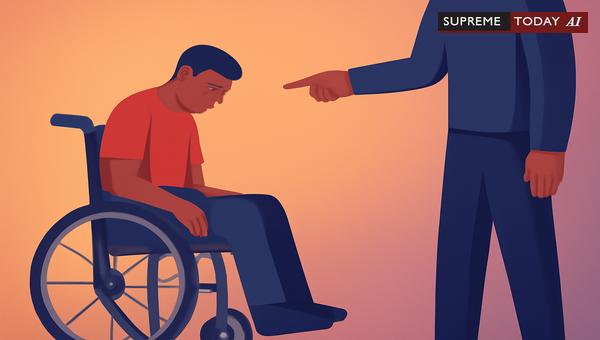
Is Humiliating a Disabled Person Illegal in India?
In today's society, interactions with persons with disabilities (PwD) demand sensitivity and respect. But what happens when someone intentionally humiliates a PwD? Is it just a social faux pas, or does it cross into illegal territory? The question humiliate a person with disability strikes at the heart of , raising concerns about , , and under Indian law.
This blog post delves into the legal framework prohibiting such acts, drawing from constitutional provisions, statutes like the , and key judicial precedents. While this provides general insights, it is not legal advice—consult a qualified lawyer for specific situations.
Constitutional Safeguards for and
Human is a cornerstone of the Indian Constitution. guarantees the right to life and personal liberty, which courts have expansively interpreted to include the right to live with . Humiliating or degrading treatment of PwD directly breaches this fundamental right. As noted in a pivotal judgment, human is a and a fundamental goal under and appropriate, fair and caring treatment is a guarantee owed to persons with disabilities—acts that humiliate or traumatize them violate 2016 4 Supreme 243.
The jurisprudence consistently emphasizes that PwD must be treated with respect, sensitivity, and fairness. Any act of humiliation is violative of these principles 2016 4 Supreme 243 2025 0 Supreme(SC) 432. In the landmark Jeeja Ghosh case, the condemned the callous behavior of who humiliated a PwD passenger, ruling it violated her right to and fair treatment under guidelines and . The court awarded damages, underscoring that such disrespectful conduct is legally condemnable 2016 4 Supreme 243.
Statutory Protections Under the RPwD Act, 2016
The RPwD Act, 2016, provides robust safeguards. prohibits on the ground of disability, defining it broadly as any distinction, exclusion, restriction on the basis of disability 2017 0 Supreme(Del) 3479. More pointedly, outlines punishments for atrocities, including:
- (a) intentionally insults or intimidates with intent to humiliate a person with disability in any place within public view;
- (b) assaults or uses force to any person with disability with intent to dishonour him or outrage the modesty of a woman with disability 2024 0 Supreme(Ker) 1093 2024 Supreme(Online)(KER) 41462.
These provisions make it clear that humiliation is not merely offensive but punishable. The Act aligns with international commitments like the , which prohibits any form of exploitation, violence, or abuse and mandates respect for inherent 2025 0 Supreme(SC) 432. includes acts that impair or nullify rights, explicitly covering humiliation and degrading treatment 2025 0 Supreme(SC) 432.
Courts have affirmed that jurisdiction for such offences may involve special courts under for speedy trials, though in cases without specific charges under the Act, regular courts handle related offences 2024 0 Supreme(Ker) 1093 2024 Supreme(Online)(KER) 41462.
Judicial Precedents Reinforcing Zero Tolerance
Indian courts have repeatedly struck down acts of humiliation. In employment contexts, arbitrary termination post-illness has been deemed discriminatory, violating Articles 14 and 16, especially for those with disabilities 2017 0 Supreme(Del) 3479. The directed renewal of an air hostess's contract after she was declared fit, highlighting unfair treatment 2017 0 Supreme(Del) 3479.
In motor accident claims, courts recognize the ongoing humiliation faced by PwD, such as being a laughing stock due to disfigurement, factoring this into compensation for loss of amenities and earning capacity. Academic qualifications alone cannot determine potential; in assessing disability impact is impermissible 2018 0 Supreme(Tri) 204.
Even in non-direct cases, like media portrayal, courts caution against derogatory depictions. In a challenge to the movie Aankh Micholi, the held that while freedom of speech under allows cinematic expression, language that disparages persons with disabilities, marginalises them further and supplements disabling barriers in their social participation, without redeeming quality of overall message... must be approached with caution 2024 5 Supreme 321. Filmmakers must promote inclusive representations to dispel stereotypes.
No Exceptions: Uniform Condemnation
Legal documents show no exceptions permitting humiliation of PwD. Whether in public view, workplaces, airlines, or media, such acts are uniformly condemned as discriminatory. The law recognizes that non-disabled individuals may lack understanding, underscoring the need for sensitivity training 2016 4 Supreme 243. International standards via CRPD further bind India to uphold without carve-outs 2025 0 Supreme(SC) 432.
Broader Implications and Sensitization
Humiliation perpetuates stigma and exclusion, channeling focus on impairments rather than societal barriers 2024 5 Supreme 321. Institutions must train staff—airlines, employers, media creators—to ensure respectful interactions. Visual media should showcase PwD's talents and contributions for balanced portrayal 2024 5 Supreme 321.
Legal remedies include damages, as in Jeeja Ghosh 2016 4 Supreme 243, and criminal penalties under . Victims may pursue claims under RPwD Act, , or .
Key Recommendations
- Treat with Respect: View any humiliation as a rights violation.
- Training Programs: Sensitize service providers, employers, and media on disability etiquette 2016 4 Supreme 243.
- Seek Remedies: Pursue damages or prosecution to deter misconduct 2016 4 Supreme 243 2024 0 Supreme(Ker) 1093.
- Promote Inclusion: Media and society should highlight PwD successes 2024 5 Supreme 321.
Conclusion: Upholding for All
Humiliating a person with disability is generally illegal in India, breaching constitutional under , RPwD Act protections, and CRPD principles. Courts like in Jeeja Ghosh and media cases reinforce this, awarding remedies and demanding sensitivity 2016 4 Supreme 243 2025 0 Supreme(SC) 432 2024 5 Supreme 321.
Key Takeaways:- Humiliation = & Rights Violation.- Punishable under RPwD .- No exceptions; always pursue fairness.
By fostering respect, we build an inclusive society. This overview is for informational purposes—specific cases require professional legal counsel.
References:1. 2016 4 Supreme 243 - Jeeja Ghosh case on violations.2. 2025 0 Supreme(SC) 432 - CRPD and principles.3. 2024 0 Supreme(Ker) 1093 - RPwD atrocities.4. 2024 5 Supreme 321 - Media portrayal guidelines.5. Others as cited.
#DisabilityRights #RPwDAct #RightToDignity












