


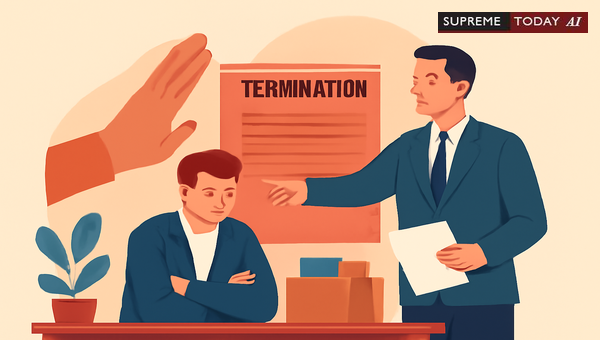
Can Employers Terminate Without Notice in India?
In today's fast-paced business environment, companies sometimes face the need to part ways with employees quickly. But what happens when an employer, such as the , decides to terminate a —like one from the —without providing any notice? This scenario raises critical questions under Indian employment law: Is abrupt termination legal? What protections do permanent employees have?
This blog post dives into the legal analysis surrounding terminating a without giving notice. We'll examine key regulations, court precedents, and exceptions, drawing from certified legal documents. Note: This is general information based on established principles and not specific legal advice. Consult a qualified lawyer for your situation.
Understanding Termination of Permanent Employees in India
Under Indian law, the employment relationship is governed by a mix of statutes like the , 1947, (state-specific), certified standing orders, and individual contracts. Generally, permanent employees cannot be terminated abruptly or arbitrarily, even if contracts stipulate notice or , unless specific statutory or contractual provisions allow it1998 3 Supreme 493.
Key Regulation Highlights
- : Outlines formal retirement procedures, entitling employees to three months' notice before retirement after a certain age or for . This underscores that notices are part of structured processes, not arbitrary dismissals 1998 3 Supreme 493.
- : For terminations due to post abolition or medical unfitness, a three-month notice or is required. Other grounds like unauthorized absence or active politics demand specific procedures 1989 0 Supreme(SC) 349.
Courts have consistently held that unilateral or is typically unlawful for permanent employees1998 3 Supreme 493. In the context of the case, no documents indicate exceptional grounds like justifying immediate action.
Notice Periods: Standard Requirements and Variations
Notice periods vary by role, company regulations, and state laws, but they are mandatory in most cases:
- Three months' notice: Common for officers or permanent staff in many service rules. For instance, No employee shall resign from the employment of the Company without giving six months notice in writing to the Company, in case of licence/approval categories. ... In all other cases, employee shall give three months notice in writing to the company or pay in lieu of the 2021 0 Supreme(Del) 1227. While this pertains to , it mirrors employer obligations symmetrically.
- One month notice: Often for lower-grade employees or probationers, as in bank regulations: The Bank may terminate the service of an ... employee after giving him one month notice or 2008 0 Supreme(Pat) 1728.
- Airline-specific rules: Pilots under must provide notice, and isn't effective until accepted, highlighting 2021 0 Supreme(Del) 1227 2021 0 Supreme(Del) 1224.
In 's case under , , termination required reasonable cause and notice. The court invalidated a termination lacking these, even for managerial staff, emphasizing: The provisions of ... require an employer to assign a reasonable cause for termination1996 0 Supreme(Mad) 114.
Exceptions: When Immediate Termination May Be Allowed
While notice is the norm, exceptions exist:
- or : Severe breaches may allow , but , including a hearing, is typically required unless conduct justifies instant action 1998 3 Supreme 493.
- or : Genuine economic reasons, like during Covid-19, can justify layoffs if done in . The court established that a genuine can occur due to economic downturns, necessitating retrenchments without constituting
. Failure to consult doesn't always vitiate if is .
- Contractual Provisions: Standing orders may permit immediate termination. In banking: Nothing in sub-regulation (2) shall alter the right of the Bank ... to retire or dismiss an officer or employee without notice or pay 2008 0 Supreme(Pat) 1728.
- Contexts: Employees can withdraw resignations before acceptance, as in pilots' cases, protecting against coerced exits 2021 0 Supreme(Del) 1224 2021 0 Supreme(Del) 1227. Analogously, employers can't force immediate ends without basis.
For the , documents do not specify or , making notice (typically three months or ) essential 2013 0 Supreme(SC) 824 1989 0 Supreme(SC) 349 1998 3 Supreme 493.
Court Precedents Reinforcing
Indian courts prioritize fairness:- Standing Orders: Confirmed employees' rights with notice, effective without employer veto, but only after 2018 0 Supreme(SC) 1622.- Koshi Kshetriya Gramin Bank: under duress was quashed; acceptance without jurisdiction led to 2008 0 Supreme(Pat) 1728.- Schemes: Employers must decide promptly; delays can't defeat benefits 2000 6 Supreme 98.
These rulings illustrate that arbitrary actions expose employers to challenges, including , , and damages.
Implications for Employers Like
Terminating without notice risks:- Legal Challenges: Employees can approach , claiming .- Financial Liabilities: , , and .- Reputational Harm: Especially in industries reliant on talent like weather services or retreats.
Recommendations:- Review employment contracts, standing orders, and service rules for termination clauses.- Document reasons and follow (, hearings).- For retrenchments, ensure compliance with (, ).- Consider to avoid disputes 2013 0 Supreme(SC) 824.
Key Takeaways
- Permanent employees are generally entitled to notice (1-6 months) or 1989 0 Supreme(SC) 349 1998 3 Supreme 493.
- Abrupt termination without basis is likely unlawful and challengeable.
- Exceptions like or genuine require proof and process.
- Always prioritize contracts and statutes to mitigate risks.
In summary, for scenarios like the and , Indian jurisprudence protects against . Employers should tread carefully to avoid court battles. Stay informed on evolving labour codes, and seek professional advice for tailored strategies.
Disclaimer: This post synthesizes general legal principles from cited documents. Laws vary by state and facts; it's not a substitute for legal counsel.
#EmploymentLawIndia, #TerminationNotice, #LabourRights















