




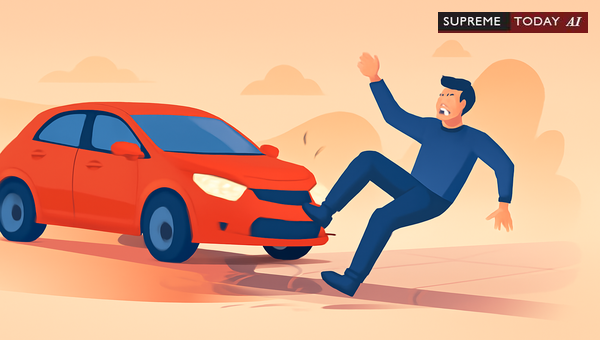
Liability When a Driver Veers onto the Footpath in a Car Collision
Car accidents are tragic events that often raise complex questions of fault and compensation. Imagine a scenario where a driver loses control, veers onto the footpath, and collides with an oncoming vehicle, resulting in fatalities. What happens legally? Who bears responsibility? This post delves into such incidents, drawing from legal principles and real case examples under Indian law.
Understanding the Incident: The Deceased Driver's Case
Consider this common yet critical legal question: The Deceased while Driving Car and Went on Foot Path and Opposite Vehicle Dashed to his Car. In such cases, the deceased driver's vehicle deviates from the roadway onto the pedestrian path before impacting an opposite-direction vehicle. This raises issues of , potential contributory fault, and liability for damages or compensation claims.
Typically, courts examine the circumstances to determine if the deceased driver's actions—such as losing control, speeding, or failing to maintain —constitute rash or negligent driving. The opposing driver's role is also scrutinized for failure to avoid the collision.
Key Legal Principles: and
Under the , in driving means failing to exercise reasonable care, which foreseeably leads to harm. involves reckless behavior endangering lives or property.
Assessment: Courts often hold drivers liable if they violate traffic rules, drive excessively fast, or lose control without justification. In the scenario above, if evidence shows the deceased veered onto the footpath due to reckless speed or distraction, they may be found primarily at fault.
: Both parties' actions matter. If the deceased crossed into the wrong lane or footpath, this could reduce the opposing driver's liability. For instance, courts apportion blame based on contributions to the accident.
Evidence like witness statements, police reports, skid marks, and vehicle conditions plays a pivotal role. As noted in similar rulings, the determination of often relies on witness testimonies and the circumstances of the accident 2021 0 Supreme(Mad) 3575.
Comparative Case Analysis
Indian courts have addressed analogous incidents, providing precedents for footpath deviations, wrong-side driving, and head-on collisions.
Footpath and Loss of Control Cases
In one case, the motor car ran over the persons sleeping on the foot path and climbed the three stairs and dashed into the shutter of the shop... The accused could not control the motor car while taking the right turn and went on the foot path 2015 0 Supreme(Bom) 2311. The driver was held negligent for failing to maintain control, mirroring scenarios where a vehicle mounts the footpath before colliding.
Another incident involved a car swerving onto a footpath, injuring pedestrians, where the driver was liable for not adhering to control standards 1972 0 Supreme(Kar) 172.
Wrong-Side and Oncoming Collisions
Frequently, losing control leads to wrong-side dashes. For example, the deceased Shivarudra Langote was driving his Maruti car... and dashed to the bus which was coming from the opposite direction... the deceased lost control over the vehicle and went to the wrong side of the road and dashed to the on coming bus
. This highlights how veering off-path often attributes primary fault to the deviating driver.
In 2022 8 Supreme 572, The car came from the opposite direction and dashed into the motorcycle driven by the Deceased... driven in a rash and negligent manner. Courts awarded compensation based on findings, emphasizing fair, case-specific awards: Adequate compensation is considered to be fair and – Courts shoulder responsibility of deciding adequate compensation on a case-to-case basis.
in High-Speed Scenarios
High speed exacerbates liability. In 2008 0 Supreme(Bom) 1211, a truck at uncontrollable speed collided with a car, holding the truck driver negligent. Similarly, in bus-car clashes like 1976 0 Supreme(Ori) 28, rash overtaking led to findings against the bus driver.
was rejected in cases where one party's rashness was the root cause: Courts below finding that rash and negligent driving on part of the bus driver was root cause of the accident – surrounding circumstances also establishing this fact – Yet courts below holding it a case of – Not tenable 2014 0 Supreme(SC) 104.
In injury claims post-collision, compensation is calculated separately, as in a driver's case where a bus dashed head-on: percentage of permanent physical disability can be taken as the extent of – assessed at 35% 2014 0 Supreme(Raj) 145.
These cases illustrate that footpath veering often signals the deviator's , but evidence dictates outcomes.
Determining Liability: Factors Courts Consider
Liability hinges on:
- Driving Behavior: Speed, intoxication, distractions, or mechanical failures.
- Road Conditions: Blind curves or poor signage, as in 2017 0 Supreme(Kar) 1633 where an Eicher vehicle dashed rashly on a curve: the driver of Eicher vehicle U-8114 came in a rash and negligent manner and dashed against the front side of the said Car.
- Opposing Driver's Response: Did they brake or swerve reasonably?
- Evidence Strength: Police FIRs, CCTV, or eyewitnesses.
If the deceased is primarily negligent, claims against their estate may falter, but opposing allows shared liability.
Compensation and Claims Process
Survivors or estates can file under . Awards cover loss of life, medical costs, and consortium, often enhanced on appeal. In 2022 8 Supreme 572, compensation reached Rs. 29,73,520/- with 9% interest, using for self-employed deceased: Final of deceased must be fixed at Rs.15,600/-... multiplier applicable... would be 16.
Recommendations include:- Collecting police reports, witness accounts, and expert reconstructions.- Arguing against if evidence supports sole fault by the other party.- Pursuing insurance claims promptly, noting like in
where after dashing the victim, the driver of the vehicle went away.
Key Takeaways and Conclusion
In accidents where a driver veers onto the footpath before a collision, the deviating party often faces primary findings, potentially leading to contributory fault assessments. However, thorough evidence can shift liability, enabling compensation.
Key points:- Prioritize Evidence: Witness testimonies and reports are crucial 2021 0 Supreme(Mad) 3575.- Assess Both Parties: Shared fault is common but must be proven.- Seek Fair Compensation: Courts aim for equitable awards on case merits.
This analysis provides general insights based on precedents; outcomes vary by facts. Always consult a qualified lawyer for personalized advice, as this is not legal counsel. Stay safe on roads—defensive driving saves lives.
Word count: Approximately 1050
#CarAccidentLiability, #RashDrivingLaw, #NegligenceClaims















